



Key Takeaways
- Major US indices faltered Friday following Thursday’s brutal session that erased roughly $800 billion in value from the “Magnificent Seven” tech giants
- Soaring artificial intelligence infrastructure costs from Alphabet and Tesla sparked the technology sector retreat
- Trump’s sweeping Section 301 tariffs, imposing duties between 10% and 12.5%, became active overnight
- Crude prices retreated Friday yet Brent remained poised for weekly gains after briefly surpassing $100 per barrel
- Verizon and American Express delivered earnings victories but revenue disappointments; Intel jumped on stronger-than-anticipated results
American equities mounted a tentative comeback attempt Friday morning following one of 2025’s most devastating single-session tech declines. Market participants grappled with a complex mix of fresh trade barriers, artificial intelligence expenditure anxiety, and elevated energy costs.
The Dow Jones Industrial Average climbed 0.3%, while the S&P 500 treaded water around unchanged levels. The Nasdaq Composite declined 0.4% as technology shares maintained their negative momentum.
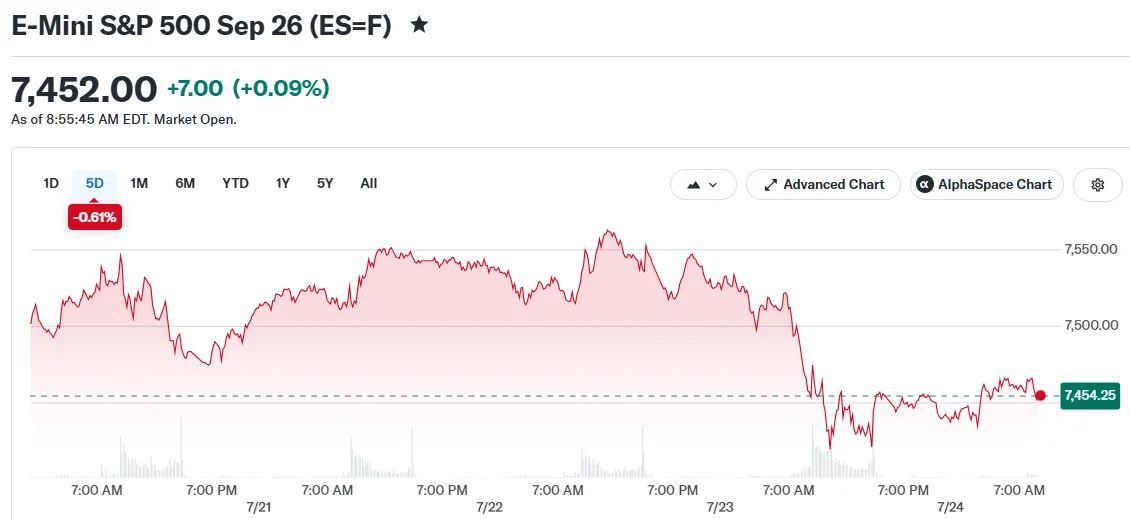
All three benchmark indices appeared destined for weekly declines. The elite “Magnificent Seven” collection of megacap technology companies saw their combined market capitalization plummet by approximately $800 billion during Thursday’s session alone.
The massive downturn originated from quarterly results released by Alphabet and Tesla, which disclosed dramatically escalating investments in artificial intelligence infrastructure. Market participants responded negatively to the expanding capital requirements.
Intel emerged as a notable exception. The semiconductor manufacturer’s shares advanced during early trading following its Thursday evening report that exceeded analyst profit forecasts.

Trump’s Tariff Program Launches
During overnight hours, the Trump administration’s latest round of comprehensive tariffs became operational. The Section 301 duties apply to virtually all American imports and impose rates spanning 10% to 12.5% on the nation’s primary trading partners.
According to White House officials, the revised tariff framework was constructed to withstand potential legal challenges more effectively than earlier iterations.
Certain energy commodities received exemptions from the tariff program. The administration granted these carveouts as petroleum prices were already climbing and risking setbacks to inflation reduction efforts.
Brent crude futures declined 2.8% Friday, settling below the $98 per barrel mark. Nevertheless, the global oil benchmark remained on course for positive weekly performance after momentarily crossing the $100 threshold earlier this week.
Corporate Quarterly Results Show Divergence
Verizon Communications and American Express both surpassed earnings projections yet underperformed on revenue metrics. Their share prices retreated despite the bottom-line achievements.
NextEra Energy exceeded earnings per share expectations while similarly coming up short on revenue targets. Unlike its counterparts, the utility company’s stock gained ground.
Intel’s robust quarterly performance emerged as an uncommon bright spot for the technology sector during an otherwise challenging week.
Market Dynamics and Sector Performance
The equal-weight S&P 500 ETF, which assigns identical importance to each constituent stock, advanced 0.5% Friday. This movement indicates that most market components performed adequately — the weakness stemmed from a concentrated group of large-capitalization technology names.
The iShares Semiconductor ETF plunged 4.3%, creating significant headwinds for broader index recovery efforts. Consumer discretionary and technology stood as the sole major sectors posting losses.
Scheduled economic releases included S&P Global’s July purchasing managers index measurements for both services and manufacturing sectors, accompanied by new residential home sales statistics.
Get 3 Free Stock Ebooks
Discover top-performing stocks in AI, Crypto, and Technology with expert analysis.
- Top 10 AI Stocks - Leading AI companies
- Top 10 Crypto Stocks - Blockchain leaders
- Top 10 Tech Stocks - Tech giants



