



TLDR
- Gold declined approximately 1% Thursday following Wednesday’s two-week peak
- Escalating Middle East conflict drove crude prices upward, intensifying inflation worries
- Next week’s Federal Reserve meeting represents critical event for precious metals traders
- Market participants remain uncertain about potential Fed rate increase
- Bargain hunters continue accumulating gold despite elevated interest rate environment
Precious metal prices retreated Thursday following the previous session’s climb to a two-week peak. New York futures contracts declined approximately 1% to reach $4,110 per troy ounce during early market hours.
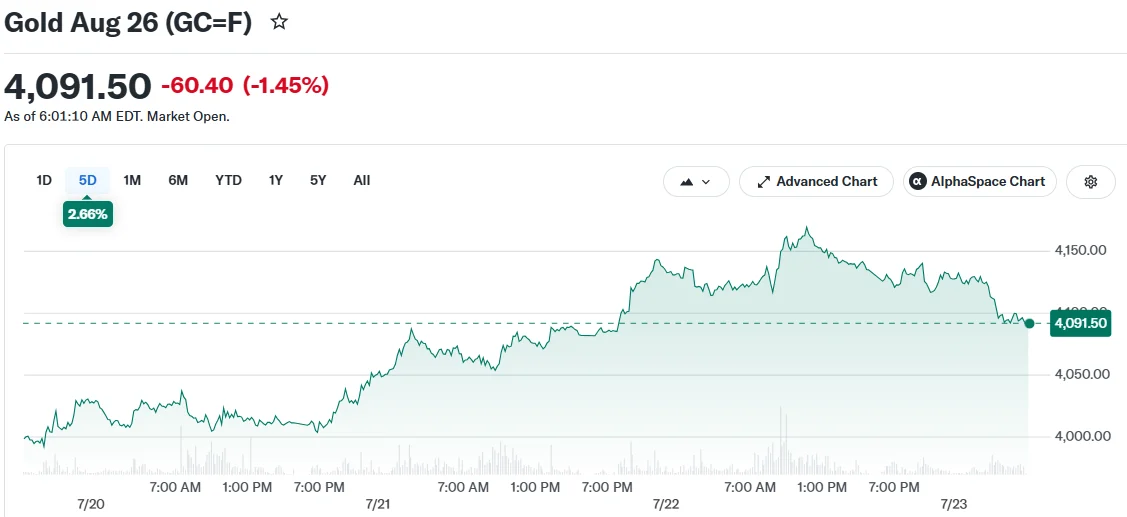
The downturn followed a robust 3% gain across the prior two trading sessions. Bargain seekers entered positions even as strengthening U.S. Treasury yields applied downward pressure on the commodity.
Spot gold decreased 0.1% to settle at $4,127.99 per ounce around 5:31 GMT. Futures contracts dropped 0.5% to $4,130.62. Both silver and platinum registered modest gains during the session.
Regional Conflict Elevates Crude Prices
Intensifying tensions across the Middle East continue fueling inflation anxieties. Diplomatic relations between the United States and Iran showed minimal progress toward renewed dialogue as confrontations escalated.
Assaults on petroleum tankers in the Red Sea emerged for the first time since hostilities commenced in late February. The Houthi movement based in Yemen acknowledged carrying out these operations.

This maritime corridor serves as a vital passage for Saudi Arabian crude shipments. The supply chain disruption contributed to petroleum prices reaching multi-week peaks, prompting markets to recalibrate inflation projections.
Elevated crude costs directly influence inflation forecasts. This development holds significance for gold because it increases the probability of the Federal Reserve maintaining elevated borrowing costs for an extended period.
Elevated interest rates amplify the opportunity cost associated with holding gold, which generates no income. This dynamic typically pressures prices downward.
Central Bank Decision Takes Center Stage
Market participants are closely monitoring next week’s Federal Reserve policy announcement. The central bank is broadly anticipated to maintain current rate levels this month.
Nevertheless, financial markets are incorporating expectations for at least one additional rate increase before year-end. Fed Chair Kevin Warsh has provided minimal clarity regarding future policy direction, contributing to market ambiguity.
Investment professionals remain divided regarding the timing of potential additional rate adjustments. This uncertainty is keeping gold confined within a narrow trading range around present levels.
Notwithstanding interest rate headwinds, certain investors have expanded their gold allocations. ANZ analysts observed that non-commercial net long positions have reached their most elevated level since January.
Capital flows into gold-backed exchange-traded funds have also accelerated. ANZ indicated that some market participants are deploying gold as protection against elevated equity market valuations.
The financial institution highlighted that opportunistic purchasing has enabled gold to maintain strength even as energy market dynamics suggest a more restrictive monetary policy environment.
Gold has maintained support above the $4,000 threshold throughout the week, a psychologically significant level closely monitored by traders. The metal experienced a sharp correction from its January record peak earlier this year.
The subsequent critical level under trader scrutiny is resistance positioned near $4,200. Gold’s capacity to generate sufficient upward momentum to test that threshold will probably hinge on the Federal Reserve’s communication next week.
Get 3 Free Stock Ebooks
Discover top-performing stocks in AI, Crypto, and Technology with expert analysis.
- Top 10 AI Stocks - Leading AI companies
- Top 10 Crypto Stocks - Blockchain leaders
- Top 10 Tech Stocks - Tech giants



