



Key Takeaways
- NEAR Intents platform has facilitated more than $23 billion in cross-chain transaction volume spanning 30+ networks
- Compared to major competitors like Ethereum, Solana, and BNB Chain, NEAR’s DeFi ecosystem remains relatively underdeveloped
- Token inflation rate has been reduced significantly from 5% annually down to approximately 2.5%
- Daily fee generation remains modest, making token valuation heavily dependent on anticipated future adoption
- The connection between product success and NEAR token value appreciation remains uncertain
NEAR Protocol represents a proof-of-stake blockchain platform designed to support smart contract functionality and decentralized applications. The network was established by Illia Polosukhin and Alexander Skidanov, engineers whose professional experience spans artificial intelligence and distributed computing systems.
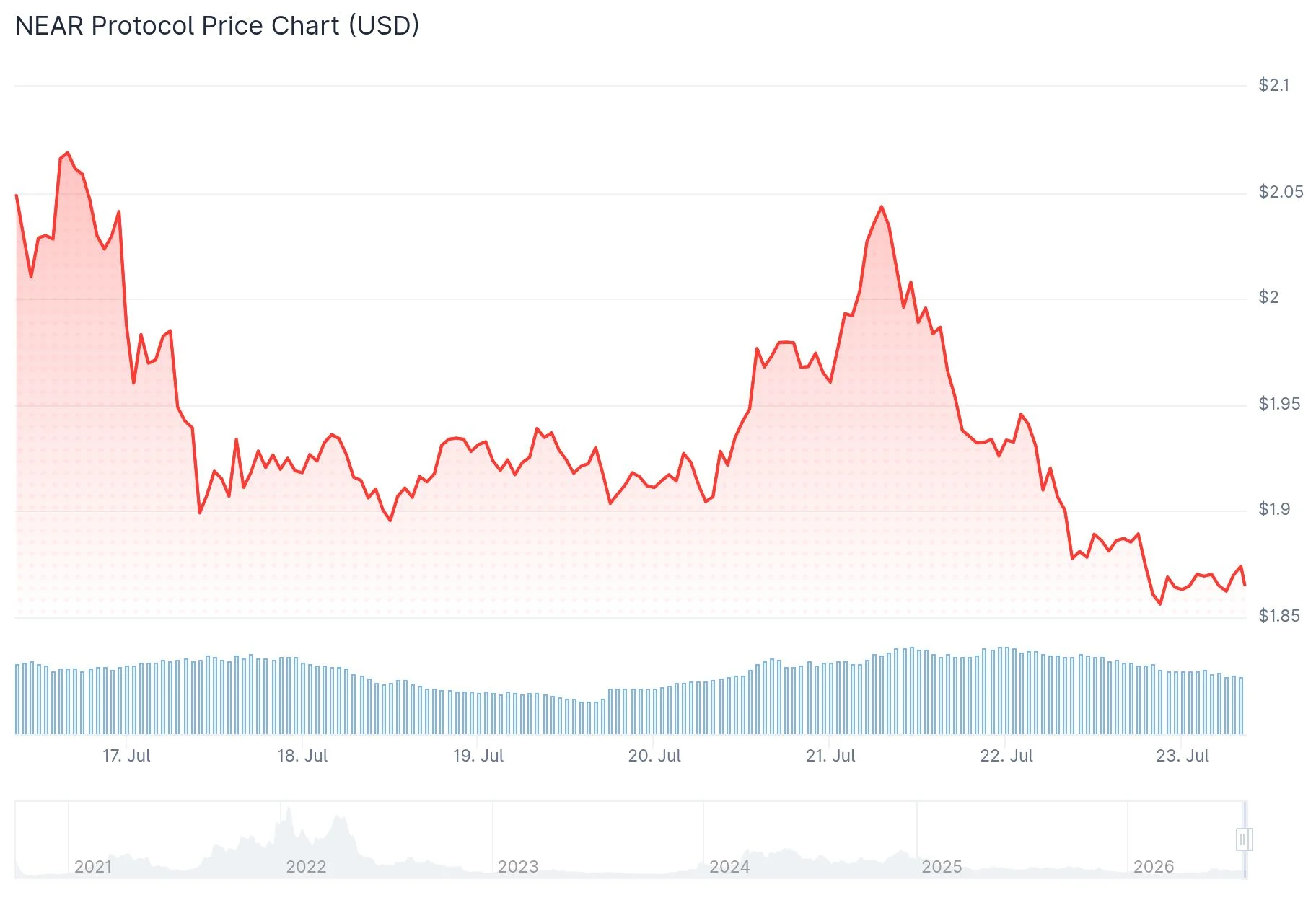
The platform’s primary strategic direction centers on “chain abstraction” technology. This approach aims to enable seamless multi-blockchain interactions without requiring users to navigate complex bridging protocols, acquire multiple native gas tokens, or operate different wallet interfaces. NEAR’s infrastructure manages these technical complexities behind the scenes.
This strategic positioning provides NEAR with a more distinctive market position compared to numerous Layer 1 blockchains whose primary differentiation relies on transaction throughput or cost efficiency.
The most compelling element of NEAR’s current ecosystem is the NEAR Intents protocol. This system allows users to specify desired transaction outcomes — such as exchanging an Ethereum-based token for a Solana asset — while competitive market makers execute the transaction at optimal pricing.
According to NEAR’s reported metrics, the Intents protocol has facilitated over $23 billion in aggregate transaction volume. The system operates across more than 30 distinct blockchain networks, accommodates over 100 different digital assets, and integrates with prominent wallet providers and cryptocurrency platforms.

These metrics demonstrate genuine product-market fit and active utilization, which stands out favorably in an ecosystem where numerous projects remain primarily theoretical or developmental.
Transaction Fees Don’t Support Current Market Capitalization
NEAR’s primary network handles several hundred thousand transactions on a daily basis with tens of thousands of distinct active addresses. However, its decentralized finance ecosystem remains substantially smaller than established platforms including Ethereum, Solana, or BNB Chain.
Both total value locked in DeFi protocols and circulating stablecoin supply represent only a minor percentage of NEAR’s multi-billion dollar market valuation. Additionally, daily transaction fee revenue remains minimal, indicating that current token pricing primarily reflects anticipated future ecosystem expansion rather than present economic activity.
While this valuation dynamic is typical for emerging blockchain platforms, it establishes a significant burden of proof for NEAR’s continued development trajectory.
Regarding token economics, NEAR has implemented meaningful improvements. The annual inflation rate has decreased from 5% to approximately 2.5% of circulating supply. Additionally, a percentage of transaction fees undergoes burning, providing some counterbalance to new token issuance.
However, current fee generation volumes remain insufficient for the burning mechanism to substantially impact overall token supply dynamics. Token holders who opt not to stake their holdings experience progressive dilution as newly minted tokens enter circulation.
Product Growth Doesn’t Guarantee Token Value Appreciation
The fundamental question facing NEAR investors concerns whether ecosystem expansion directly correlates with increased token demand.
NEAR Intents can continue expanding its volume and market presence without necessarily generating proportional demand for the NEAR token. Transaction fees on the NEAR network remain intentionally minimal, and revenue from other sources may flow to integration partners, liquidity providers, or development funds rather than accruing to token holders.
This disconnect between product metrics and token economics represents a significant consideration. The investment thesis would strengthen considerably if revenue mechanisms channeled fees more directly toward NEAR token purchases, burns, or staking rewards through transparent and predictable structures.
Currently, NEAR demonstrates impressive product traction with $23 billion in cross-chain volume facilitated through Intents, while simultaneously maintaining DeFi total value locked figures that represent only a small fraction of overall network valuation.
Get 3 Free Stock Ebooks
Discover top-performing stocks in AI, Crypto, and Technology with expert analysis.
- Top 10 AI Stocks - Leading AI companies
- Top 10 Crypto Stocks - Blockchain leaders
- Top 10 Tech Stocks - Tech giants



