


Key Highlights
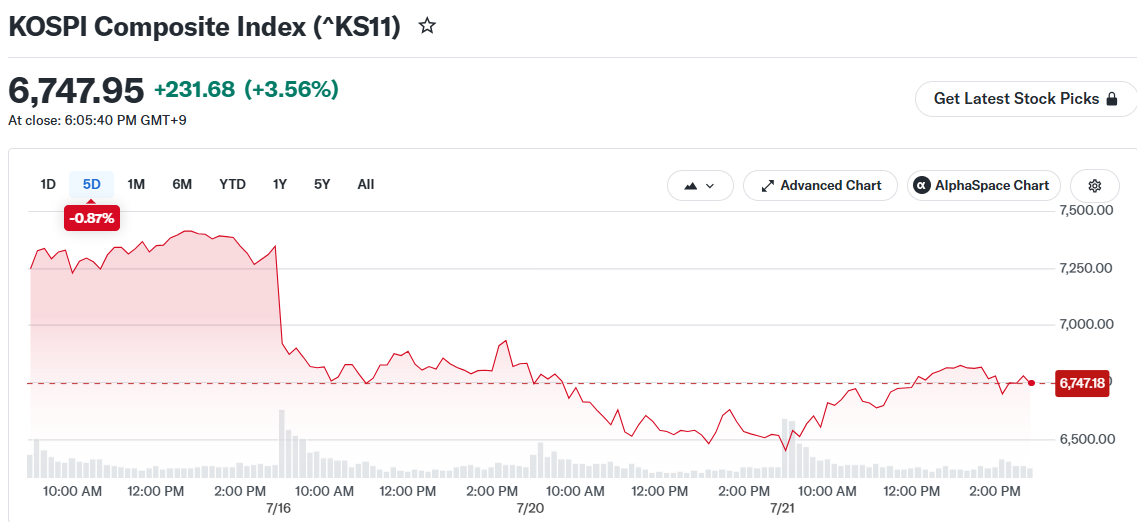
- South Korea’s benchmark KOSPI index rallied 4% Tuesday following a 9% weekly decline and 30%+ drop from June highs
- Samsung Electronics soared nearly 7% while SK Hynix advanced 5%, spearheading the market recovery
- Morgan Stanley projects KOSPI target of 9,000 with downside support at 6,000 level
- Near-perfect correlation of 0.95 between KOSPI and Nasdaq-100 highlights AI trade linkage
- Korean financial authorities have suspended new approvals for leveraged single-stock ETF products
South Korea’s primary stock index staged a robust comeback Tuesday, climbing approximately 4% as semiconductor giants Samsung Electronics and SK Hynix rebounded from an intense period of market pressure. This recovery followed a challenging week that saw the benchmark lose 9%, contributing to a total decline exceeding 30% from its June zenith.
Samsung stock prices surged nearly 7% during Tuesday’s trading session. SK Hynix posted a solid 5% gain. Both technology giants had experienced significant pressure amid growing concerns that valuations connected to artificial intelligence infrastructure investments had become overextended.
Last week’s market retreat formed part of a broader global technology sector pullback. The decline affected AI-associated semiconductor equities despite Taiwan Semiconductor Manufacturing reporting robust financial results, as market participants questioned the sustainability of elevated valuations.
Investment banking firm Morgan Stanley provided analysis suggesting the correction appears substantial but doesn’t yet signal a complete bear market cycle. The firm noted that chipmaker stocks accounted for approximately 70% of the KOSPI’s total market capitalization erosion since the latter half of the year commenced.
The financial institution maintained its 12-month price objective of 9,000 for the KOSPI while adjusting its bearish scenario projection to 6,000, acknowledging expectations for more moderate earnings expansion. Morgan Stanley characterized the 6,000 to 9,000 range as the probable trading corridor for the upcoming three to six month period.

Korean Market Emerges as AI Investment Bellwether
The South Korean equity market has gradually evolved into a critical global indicator for tracking artificial intelligence investment trends. The nation’s substantial weighting in semiconductor equities has rendered it particularly responsive to fluctuations in AI capital expenditure sentiment.
Research analysts at Evercore ISI observed that the relationship between the Kospi and Nasdaq-100 has achieved a 0.95 correlation coefficient, indicating nearly synchronized movement patterns. They characterized South Korea as representing “the tail that wags the dog” within international financial markets.
Michelle Gibley from the Schwab Center for Financial Research characterized the Korean market as “effectively a barometer for the AI trade,” highlighting memory semiconductor components’ pivotal position in AI infrastructure chains and the expanding leverage exposure among individual investors.
Leveraged Products Magnify Market Volatility
Individual investors throughout South Korea have channeled substantial capital into leveraged exchange-traded funds tracking individual stocks, especially those linked to Samsung and SK Hynix. This concentration has magnified price movements in both upward and downward directions, resulting in the Kospi activating its trading halt mechanism seven times throughout the current year.
The market turbulence reached sufficient severity that Korean regulatory authorities implemented a temporary freeze on new leveraged single-stock ETF approvals, aiming to moderate speculative trading behavior.
Notwithstanding recent market turbulence, the Kospi maintains impressive gains of 113% over the trailing twelve months and approximately 60% for the year-to-date period. Morgan Stanley indicated that forward-looking valuation metrics for both the index and its semiconductor constituents stand near historic lows, although continued uncertainty surrounding AI capital deployment and supply chain dynamics may sustain elevated volatility levels.
The investment bank continues advocating for a portfolio approach that combines exposure to technology sector leaders with more defensive investment positions.
Get 3 Free Stock Ebooks
Discover top-performing stocks in AI, Crypto, and Technology with expert analysis.
- Top 10 AI Stocks - Leading AI companies
- Top 10 Crypto Stocks - Blockchain leaders
- Top 10 Tech Stocks - Tech giants



