


Key Highlights
- KOSPI plunged 4.3% on Monday following the Constitution Day holiday break
- Benchmark index now down over 25% from June high, officially entering bear market territory
- Samsung Electronics and SK Hynix shares initially dropped over 5% at market open
- International investors purchased 278.4 billion won worth of semiconductor stocks while domestic traders exited positions
- Major US tech earnings reports this week may determine the next direction for chip equities
South Korea’s benchmark KOSPI experienced a significant downturn on Monday during its initial trading day following Friday’s Constitution Day observance. The index plummeted to 6,498 points at its session low before staging a modest rebound to settle near the 6,520 level.
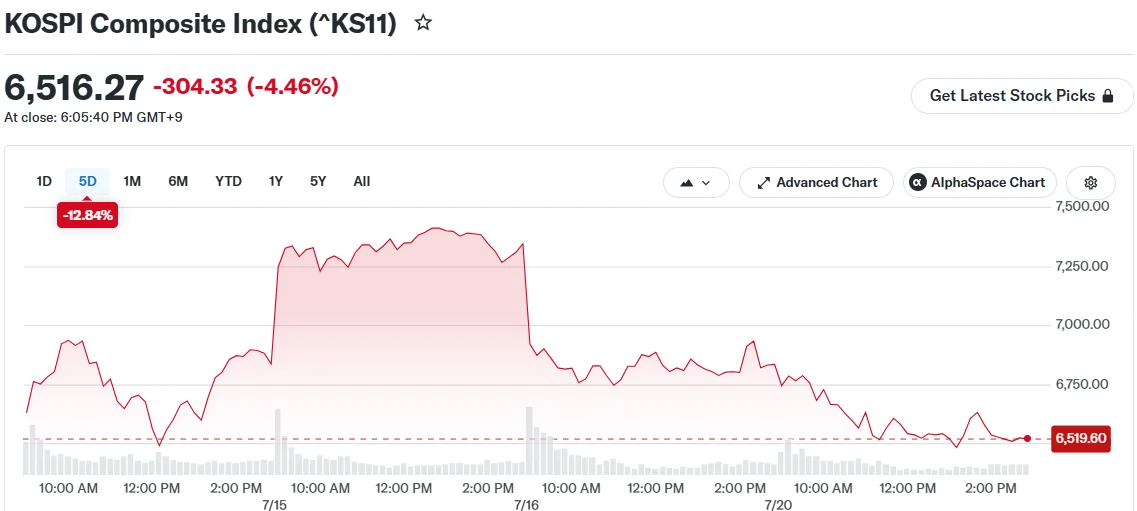
Monday’s selloff confirmed the index has now fallen more than 25% from its June zenith. This milestone officially marks the transition into bear market territory, a threshold the index first approached in early July.
Semiconductor heavyweights Samsung Electronics and SK Hynix suffered opening losses exceeding 5% each. The two chip manufacturers ranked among the day’s poorest performers, with Samsung ultimately finishing the session down approximately 4.1% while SK Hynix declined roughly 3.5%.
The semiconductor industry has faced sustained downward momentum over recent weeks. Market participants have been liquidating memory chip and semiconductor holdings to realize gains accumulated during the extended artificial intelligence-fueled bull run.
On Friday, during Korean market closure, the Philadelphia Semiconductor Index tumbled 4.3%. Despite TSMC delivering robust quarterly results, the positive news failed to halt the sector’s downward trajectory.

Multiple Headwinds Challenge Chip Sector
Growing skepticism regarding the sustainability of AI-powered expansion in the semiconductor industry has pressured stock valuations. Worries about elevated capital expenditure requirements across the sector have intensified selling activity.
Analysts at KB Securities recently observed that investors are now evaluating AI-related investments through the lens of financing expenses rather than future expansion potential. The firm highlighted that climbing interest rates are compounding challenges for semiconductor equities in the current environment.
Competition from China’s artificial intelligence sector has emerged as another headwind. Intensifying rivalry from Chinese AI models has created additional downward pressure on memory chip valuations.
International institutional investors entered the market during morning trading hours, acquiring a net 278.4 billion won ($187.1 million) concentrated in electronics equities. Conversely, domestic retail participants offloaded a net 300.8 billion won during the identical timeframe.
Exchange Rate Weakness and Regional Tensions Amplify Decline
South Korea’s currency also experienced depreciation, with the won-dollar exchange rate beginning the session at 1,488.3. Crude oil values advanced amid concerns that intensifying tensions between the United States and Iran might threaten shipping routes through the Strait of Hormuz.
Dollar appreciation creates upward pressure on import costs for South Korean businesses. The Bank of Korea’s decision to increase interest rates for the first time since 2023 has introduced an additional headwind for economic momentum.
Han Ji-young, an analyst at Kiwoom Securities, observed that Samsung Electronics, SK Hynix, and Samsung Electro-Mechanics have each experienced declines ranging from 30% to 40% measured from their recent peaks.
Notwithstanding recent setbacks, the KOSPI maintains its position as the globe’s top-performing major equity market in 2026, registering a 51% advance year-to-date.
Alphabet is scheduled to release quarterly results on July 22, with Microsoft, Meta, and Amazon following before month-end. Investment guidance around capital expenditures from these technology giants is anticipated to provide crucial direction for semiconductor stock valuations.
Get 3 Free Stock Ebooks
Discover top-performing stocks in AI, Crypto, and Technology with expert analysis.
- Top 10 AI Stocks - Leading AI companies
- Top 10 Crypto Stocks - Blockchain leaders
- Top 10 Tech Stocks - Tech giants



