



Key Takeaways
- Samsung’s second-quarter operating profit surged nineteenfold year-over-year, fueled by artificial intelligence demand, yet investor anxiety over capital expenditure plans sparked a semiconductor sector retreat
- Tuesday’s trading session saw the Nasdaq decline 1.4%, while the S&P 500 shed 0.6% and the Dow Jones lost 0.1%
- The decline followed Monday’s milestone when the Dow surpassed 53,000 for the first time
- Crude prices climbed after Iranian forces targeted merchant vessels in the Strait of Hormuz, lifting Brent above $73 per barrel
- Wolfe Research increased its S&P 500 profit projections and established an 8,000 fair value target for year-end
Samsung unveiled impressive quarterly earnings on Tuesday, yet the announcement paradoxically triggered weakness throughout the chip industry instead of providing support.
The South Korean technology giant’s second-quarter operating earnings multiplied nineteen times versus the comparable quarter in the previous year. Artificial intelligence infrastructure demand powered the exceptional performance.
However, the stellar figures failed to comfort market participants. Anxiety surrounding Samsung’s planned artificial intelligence capital investments and uncertainty about sustained demand momentum pressured the stock lower. The weakness quickly contaminated the wider semiconductor space.
Technology Index Bears Brunt of Selling
The Nasdaq Composite experienced a 1.4% decline on Tuesday, marking it as the session’s weakest major benchmark. The S&P 500 retreated 0.6% while the Dow Jones Industrial Average edged down approximately 0.1%.
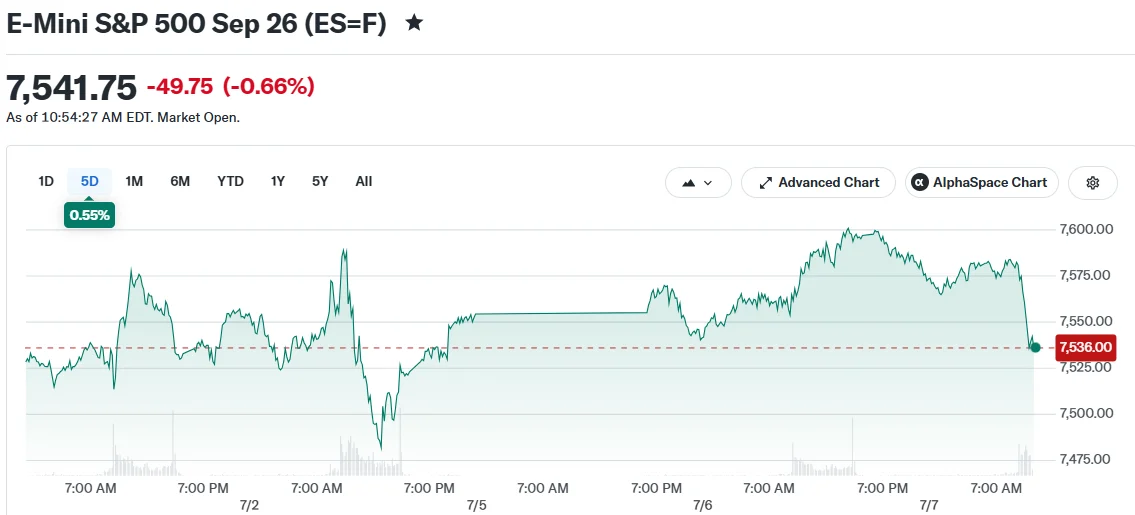
The weakness materialized merely 24 hours after the Dow established a new all-time peak, finishing above 53,000 in Monday’s session.

Semiconductor equities had posted gains during previous trading days. Tuesday’s action erased a substantial portion of that upward progress in one session.
Technology names dominated the decline list. The reversal proved both aggressive and widespread, impacting numerous companies connected to artificial intelligence infrastructure and chip manufacturing.
Crude Advances on Geopolitical Escalation
While equities retreated, oil prices pushed higher. Iranian military forces engaged commercial shipping vessels within the Strait of Hormuz, among the globe’s most critical maritime corridors.
Brent crude futures advanced beyond $73 per barrel. West Texas Intermediate crude climbed to $70 per barrel.
Vessel traffic through the strategic waterway had been recovering in recent weeks. Tuesday’s military action reignited concerns regarding the durability of the US-Iran diplomatic framework.
Investors have been monitoring that agreement carefully. Any indication of its deterioration could interrupt oil transportation and elevate prices further.
Treasury yields expanded as geopolitical tensions intensified. The US dollar appreciated in tandem with the yield increase.
Corporate Reporting Period Approaches
Despite the session’s losses, certain market strategists maintain optimistic views about the index’s trajectory.
Wolfe Research analyst Chris Senyek elevated his S&P 500 operating profit forecasts for both 2026 and 2027. He established an 8,000 fair value target for the benchmark by year’s conclusion.
Senyek highlighted robust earnings delivery thus far in 2026. He expressed confidence that corporations should satisfy elevated expectations as the second-quarter disclosure period unfolds.
The S&P 500 has oscillated within a narrow band since middle May. Senyek anticipates the approaching earnings cycle could provide the impetus required to propel the index upward.
Caterpillar equity also declined on Tuesday after disclosure of a new mining sector transaction. The stock contributed to the session’s widespread weakness.
As of Tuesday midday, the Dow registered 52,866. The S&P 500 stood at 7,489 and the Nasdaq had descended to 25,745.
Get 3 Free Stock Ebooks
Discover top-performing stocks in AI, Crypto, and Technology with expert analysis.
- Top 10 AI Stocks - Leading AI companies
- Top 10 Crypto Stocks - Blockchain leaders
- Top 10 Tech Stocks - Tech giants



