


Key Takeaways
- Approximately 988,905 TRUMP memecoin investors — representing 66% of all purchasers — suffered combined losses exceeding $3.81 billion by June’s end
- Former President Trump personally profited more than $630 million from the cryptocurrency while its value plummeted 97% from its all-time high
- An exclusive cohort of early-entry, sophisticated investors secured approximately $4 billion in gains before the market collapse
- World Liberty Financial token holders fared similarly poorly, with 85% of monitored wallets recording $83 million in aggregate losses
- Securities and Exchange Commission ended memecoin oversight in 2025, though legal analysts suggest civil litigation remains viable
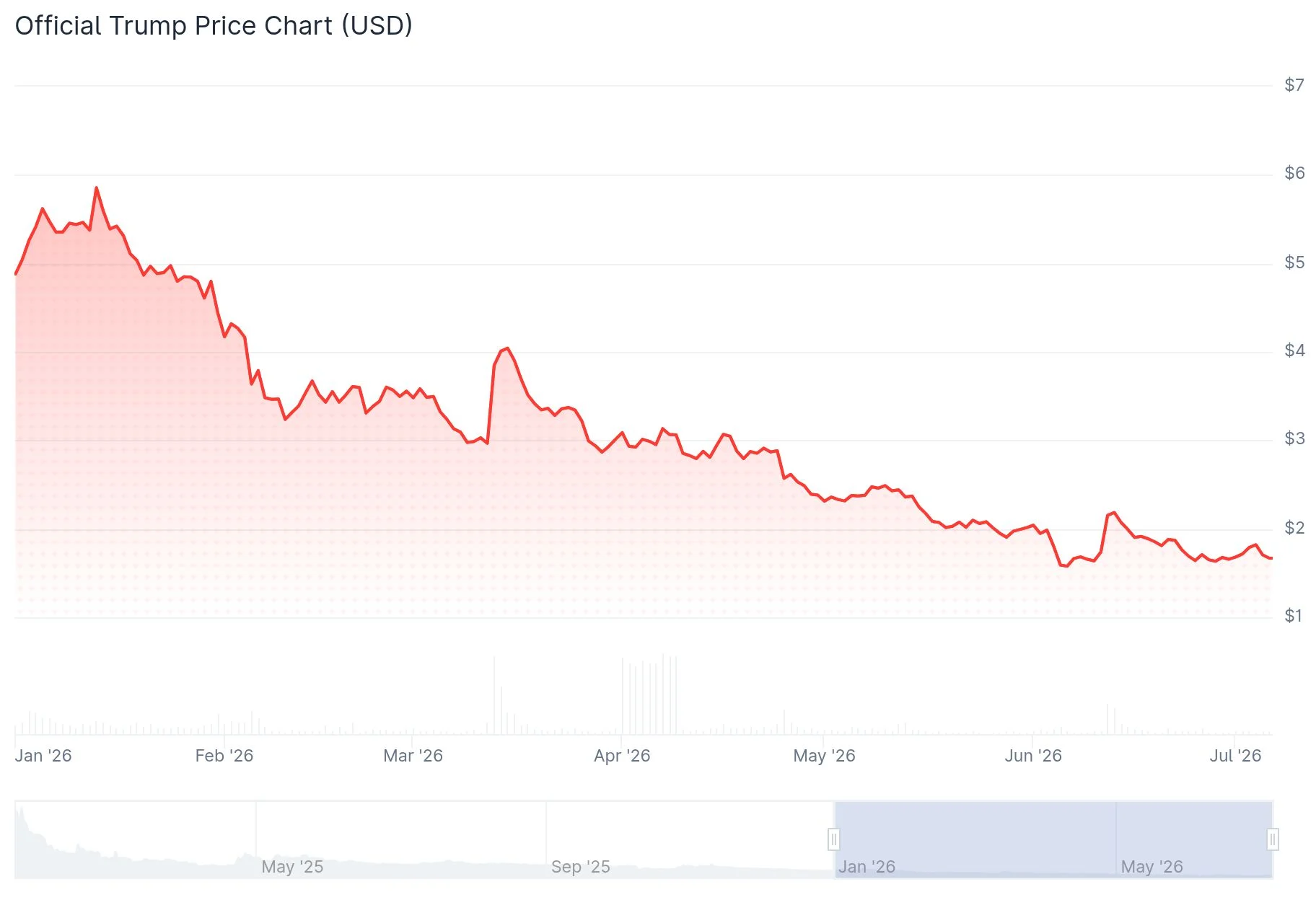
The former president unveiled his eponymous memecoin merely 72 hours before assuming office in January 2025. The token surged past $73 during its initial frenzy but has since collapsed to approximately $1.70 — representing a devastating 97% decline.
Blockchain intelligence platform Nansen’s comprehensive analysis reveals that 988,905 individual wallets — approximately 66% of all participants — experienced financial losses on the cryptocurrency. The aggregate deficit reached $3.81 billion through June 2026.
Trump’s official financial disclosure documents, made public in late June, confirmed he generated upward of $630 million from the TRUMP token alone. His comprehensive cryptocurrency earnings for the period exceeded $1.4 billion.
Nansen characterized the situation as “a concentrated group of early participants securing massive returns while the broader retail investor base absorbed substantial losses.” Approximately 500,000 early-stage and experienced traders collectively realized $4 billion in profits.
The token’s architecture enabled Trump to generate revenue through transaction fees independent of price performance. Following the launch, Trump actively promoted the digital asset through multiple posts on his Truth Social platform.

Nicholas Pinto, who voted for Trump in 2024 and subsequently lost approximately $250,000 of his $500,000 stake, characterized the situation to the New York Times as: “It is almost a legal scam.”
White House representatives rejected this interpretation. Press Secretary Anna Kelly stated that Trump “proudly made the United States the crypto capital of the world” and emphasized that all decisions were made “in the best interest of the American people.”
World Liberty Financial Investors Experience Similar Outcomes
Nansen’s investigation also examined World Liberty Financial, a cryptocurrency venture associated with Trump and his three sons. The platform markets a token designated WLFI, initially priced at 1.5 cents before increasing to 5 cents.
Among approximately 27,000 monitored wallets, 85% documented losses aggregating $83 million. The remaining 15% achieved combined profits of $23 million.
The WLFI token has declined 82% since becoming accessible on secondary trading platforms in September. A World Liberty Financial representative attributed the losses to widespread cryptocurrency market deterioration.
Trump’s financial disclosure indicated he earned just under $800 million from the World Liberty Financial platform. A Trump-affiliated entity receives 75% of all WLFI token sales irrespective of secondary market performance.
Potential Legal Ramifications Persist
The Securities and Exchange Commission announced in February 2025 its decision to discontinue memecoin transaction investigations, potentially restricting immediate regulatory intervention regarding Trump’s activities.
The TRUMP memecoin’s official website featured a disclaimer characterizing the token as an “expression of support” rather than an investment instrument.
Nevertheless, New York University legal ethics authority Stephen Gillers indicated that such disclaimers may prove insufficient to prevent future civil litigation from investors seeking recovery of losses.
Addressing conflict of interest concerns during a CNBC interview, Trump maintained there was “nothing illegal” and “nothing wrong” with his cryptocurrency earnings, asserting that third parties managed his investment activities.
Get 3 Free Stock Ebooks
Discover top-performing stocks in AI, Crypto, and Technology with expert analysis.
- Top 10 AI Stocks - Leading AI companies
- Top 10 Crypto Stocks - Blockchain leaders
- Top 10 Tech Stocks - Tech giants



