


Key Takeaways
- Nvidia maintains a $4.71 trillion market cap with only 4.5% gains this year, while Apple has rallied 14% to reach $4.51 trillion
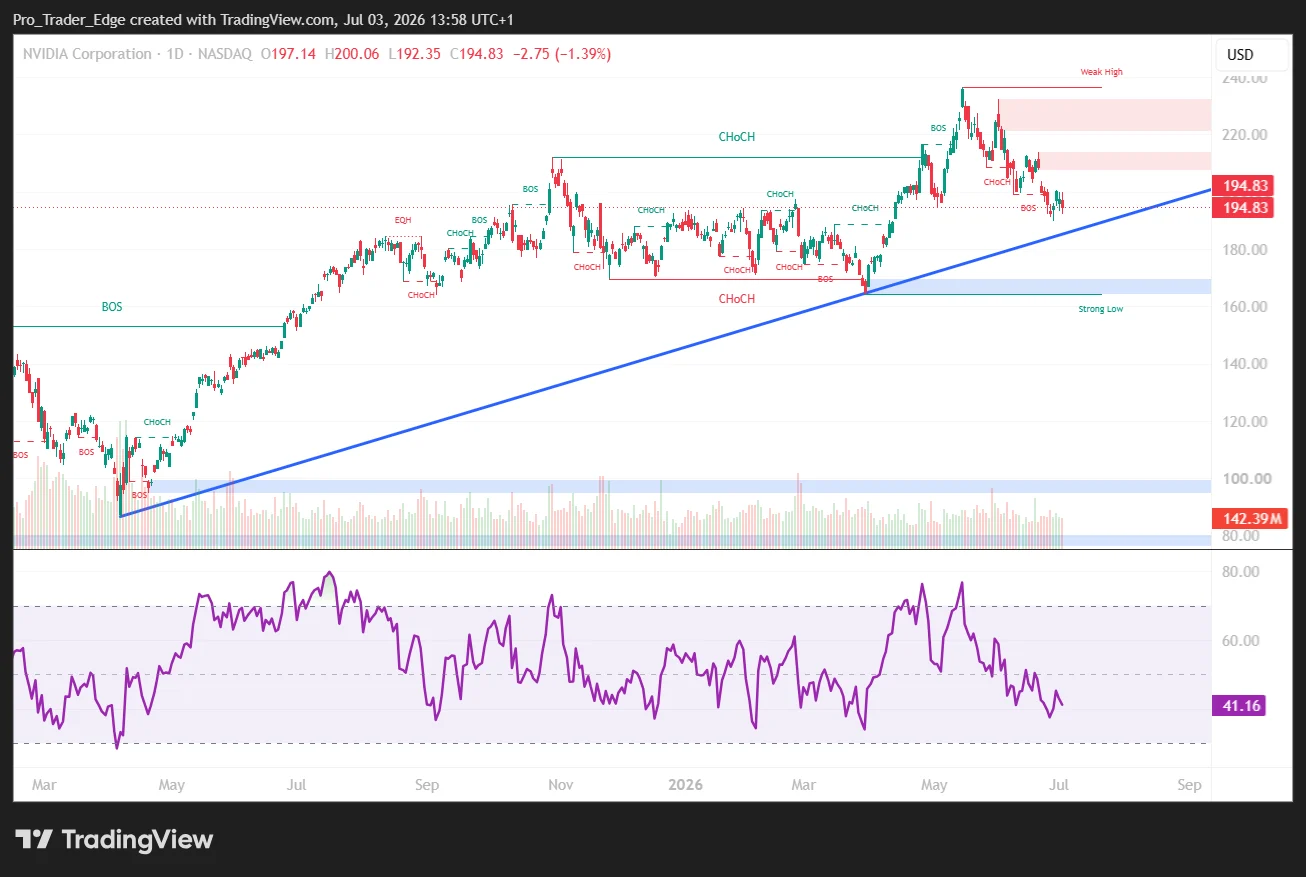
- Trading at $194.83 on Friday, NVDA declined 1.4% and sits beneath its 50-day moving average of $210.37
- The company targets returning 50% of free cash flow through buybacks and dividends, supported by an $80 billion share repurchase program
- Institutional investors hold 65.27% of shares, with several funds expanding positions, though directors sold over $189 million worth in June
- Analysts maintain a Buy consensus with a $303.84 mean price target, including Goldman Sachs’ $285 projection
Nvidia (NVDA) stock dropped 1.4% to open at $194.83 on Friday, as the semiconductor giant’s position atop global market valuations faces intensifying pressure from Apple.
Apple has surged 14% since the beginning of the year, pushing its market capitalization to $4.51 trillion. Meanwhile, Nvidia has advanced just 4.5% during the same timeframe, maintaining a valuation of $4.71 trillion. The distance between them continues to contract.
Nvidia has occupied the number-one position for 258 straight days after seizing it back from Microsoft in late June 2024. While this represents the seventh-longest streak this century, Apple has previously dominated for periods extending as long as 1,344 days.
The critical question facing investors is whether Nvidia can develop the staying power Apple has demonstrated. Achieving that goal may require adopting strategies from Apple’s proven blueprint.

Apple’s winning strategy — tightly integrated hardware and software ecosystems, aggressive share repurchases, and a devoted customer base with exceptional retention — has sustained its position near the summit for years. Nvidia is pursuing similar initiatives across these areas, though with mixed results so far.
Capital Allocation and Share Repurchases
Regarding shareholder returns, Nvidia is making strides but hasn’t matched Apple’s benchmark. Apple distributes virtually all its free cash flow to investors. Nvidia has committed to returning 50% through share buybacks and dividends, with ambitions to escalate that percentage going forward.
The $80 billion buyback program unveiled in May demonstrates serious commitment. Additionally, the company elevated its quarterly dividend to $0.25 per share, a substantial jump from the previous $0.01 — translating to a $1.00 annual dividend with a 0.5% yield.
In its latest quarterly report, Nvidia exceeded earnings projections with $1.87 EPS compared to the $1.76 consensus forecast. Revenue reached $81.61 billion, reflecting 85.2% year-over-year growth and surpassing the $78.42 billion analyst projection.
CUDA Ecosystem and Rising Competition
Nvidia’s CUDA platform has traditionally served as the adhesive keeping customers locked into its hardware ecosystem. This strategy proved effective during AI model training phases. The critical challenge ahead is whether this competitive advantage persists during inference — when AI models are deployed for production use.
Competitors such as Cerebras Systems assert their processors deliver superior inference performance compared to Nvidia’s offerings. Simultaneously, Alphabet and Amazon are engineering proprietary chips, despite continuing to purchase Nvidia hardware in substantial volumes.
This dynamic — where major customers simultaneously represent potential competitors — constitutes the primary uncertainty overhanging the equity.
On the institutional ownership front, the narrative remains predominantly positive. Generali Investments expanded its NVDA position by 8.6% during Q1 to 59,500 shares valued at $10.4 million, establishing it as their second-largest holding. Brighton Jones increased its stake by 12.4%. Hudson Value Partners boosted its allocation by 30.7%.
However, two board members executed significant sales in June. Stephen C. Neal divested 15,500 shares at $215.73. Mark A. Stevens sold 885,000 shares at $210.17 for approximately $186 million. Company insiders have liquidated $410.6 million in stock over the past quarter.
Nvidia’s 52-week trading range spans from $157.34 to $236.54. The shares currently trade beneath the 50-day moving average of $210.37, while remaining above the 200-day moving average of $193.50.
Wall Street analysts maintain a strong Buy rating, with a consensus price target of $303.84. Goldman Sachs projects a $285 target, while Rothschild & Co Redburn recently elevated its forecast to $300.
Get 3 Free Stock Ebooks
Discover top-performing stocks in AI, Crypto, and Technology with expert analysis.
- Top 10 AI Stocks - Leading AI companies
- Top 10 Crypto Stocks - Blockchain leaders
- Top 10 Tech Stocks - Tech giants



