



Key Takeaways
- XRP processes cross-border payments in 3–5 seconds with minimal transaction costs, establishing genuine utility
- Approximately 33–34 billion XRP tokens stay in escrow, representing significant future supply release
- Ripple’s SEC litigation concluded in 2025 with a $125 million settlement; programmatic XRP sales were deemed non-securities
- RLUSD, Ripple’s proprietary stablecoin, offers an alternative payment rail that may reduce XRP’s indispensability
- With a market capitalization hovering around $65.9 billion, XRP presents a viable but not undervalued long-term position
XRP carries a track record substantial enough to evaluate objectively. The network completes settlement within 3 to 5 seconds, maintains minimal transaction fees, and serves as the backbone of Ripple’s international payment infrastructure. These characteristics represent verifiable functionality rather than speculative promises.
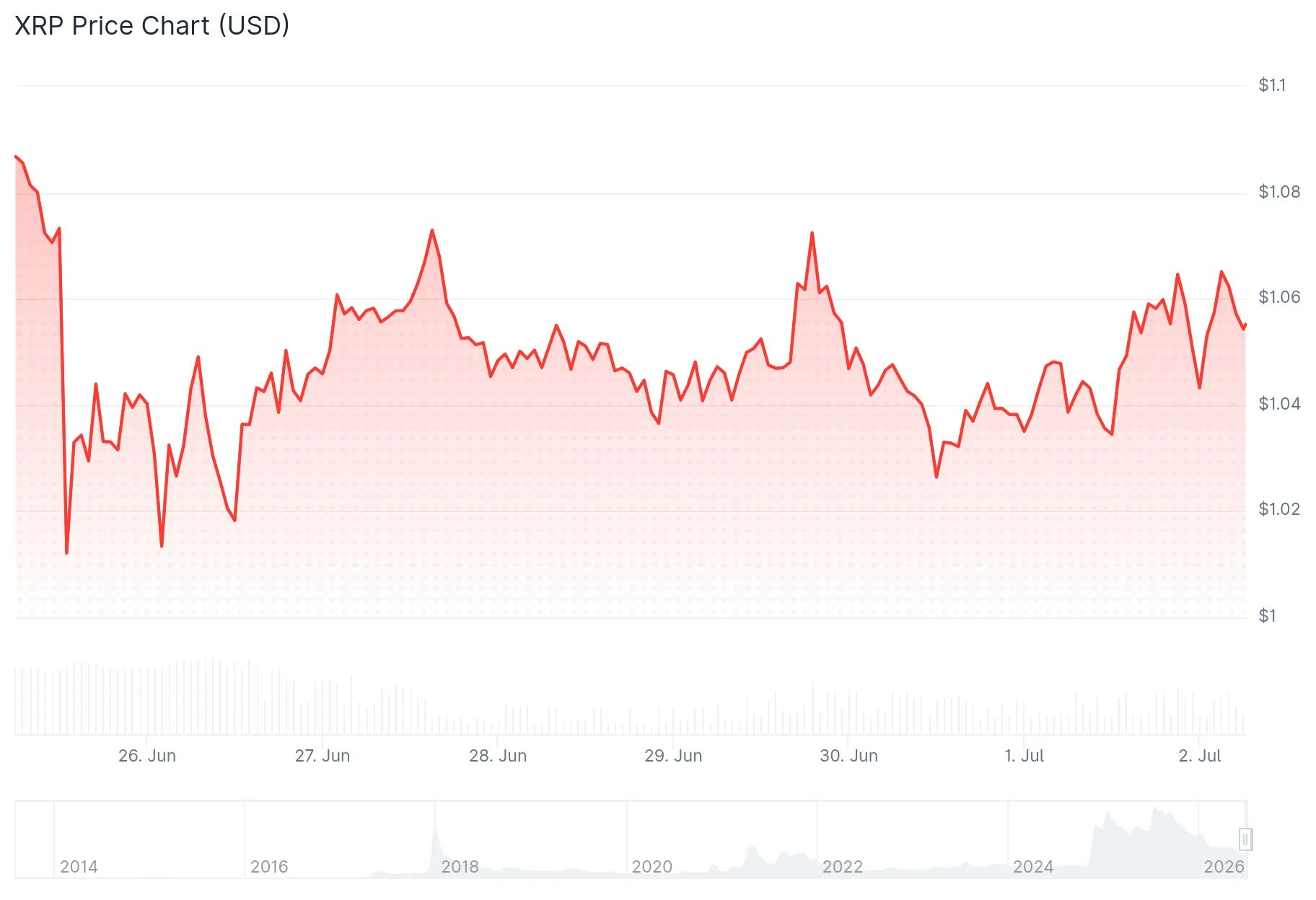
On June 16, 2026, the XRP Ledger (XRPL) processed 769,646 transactions within a 24-hour window. During earlier peak periods in 2026, successful payment transactions exceeded 2.7 million. These metrics demonstrate active network utilization rather than theoretical capacity.
Beyond fundamental payment functionality, the XRPL has incorporated additional features including native automated market makers (AMMs) and oracle integration capabilities, broadening the network’s infrastructure to support decentralized finance applications.
Supply Overhang Considerations
A critical factor for prospective long-term holders involves token supply dynamics. According to CoinGecko, current circulating supply stands at approximately 62 billion XRP, while total supply approaches 100 billion tokens. Between 33 and 34 billion XRP remains secured in escrow arrangements.
Ripple’s escrow structure permits monthly releases of up to 1 billion XRP. Tokens not distributed during each release period return to escrow, creating a more transparent unlock mechanism than typical vesting schedules. Nevertheless, this substantial reserve creates persistent potential supply expansion that undermines scarcity narratives.

The Value Capture Challenge
This dimension introduces complexity into the long-term investment thesis. Ripple’s payment infrastructure enables clients to settle transactions using either XRP or RLUSD, Ripple’s proprietary stablecoin. When Ripple expands its institutional partnerships but channels settlement through RLUSD, XRP token demand remains unaffected.
By August 2025, RLUSD had already achieved a market capitalization exceeding $611 million, with continued expansion since that milestone. This growth trajectory indicates RLUSD is establishing itself as a credible settlement alternative within Ripple’s own ecosystem.
For investors evaluating XRP’s long-term prospects, this presents the fundamental question: what proportion of Ripple’s operational success translates into XRP token value appreciation?
Regulatory Resolution
The regulatory environment surrounding XRP improved substantially during 2025. Reuters documented that the SEC litigation concluded with Ripple agreeing to a $125 million settlement. The court determination established that XRP transactions conducted on public exchanges did not constitute securities offerings, though specific institutional sales executed by Ripple were found to violate securities regulations.
This resolution provides XRP with greater regulatory definition than the majority of alternative cryptocurrencies currently possess within United States jurisdiction.
Governance of the XRPL has similarly matured. Ripple currently operates just 1 validator among the 35 validators comprising the default trusted node list, with governance responsibilities increasingly transferred to the XRPL Foundation.
With a market capitalization approximating $66 billion, XRP ranks among the larger digital assets by valuation. This established position suggests that much of the appreciation potential from its documented strengths may already reflect in current pricing.
Get 3 Free Stock Ebooks
Discover top-performing stocks in AI, Crypto, and Technology with expert analysis.
- Top 10 AI Stocks - Leading AI companies
- Top 10 Crypto Stocks - Blockchain leaders
- Top 10 Tech Stocks - Tech giants



