


TLDR
- The U.S. currency touched a four-decade peak versus the yen, climbing as high as 162.84 yen mid-week.
- Climbing Treasury yields propelled greenback gains against key global currencies.
- Traders now assign a 67% probability to a September Federal Reserve rate increase, jumping from 20.5% four weeks prior.
- Japanese financial authorities may be positioning for another currency market intervention to bolster the yen.
- Middle East tensions are bolstering dollar appetite, though some strategists caution about possible reversal risks.
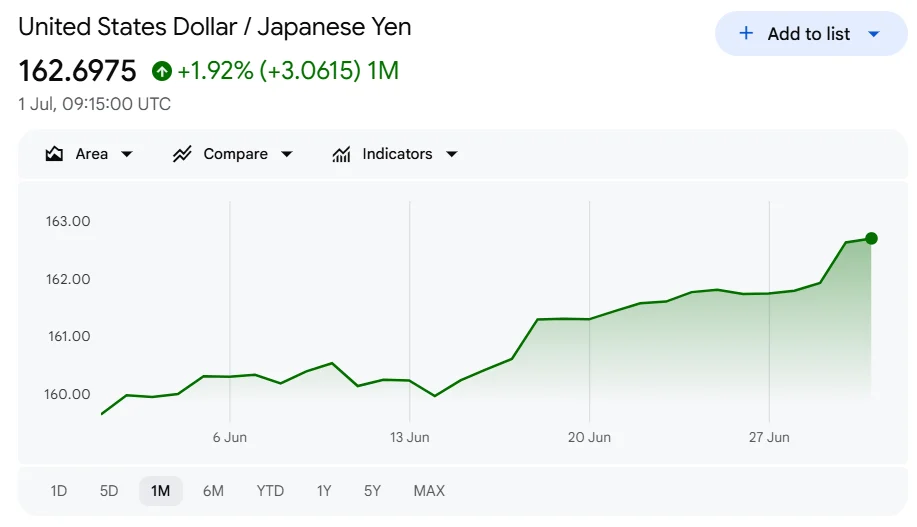
The greenback advanced to its most powerful position against Japan’s currency in four decades on Wednesday, July 1, 2026, propelled by ascending bond yields and intensifying expectations for Federal Reserve monetary tightening.
The dollar peaked at 162.84 yen during Wednesday’s session, reaching a threshold that previously triggered Japanese authorities to enter foreign exchange markets. The pair settled near 162.71 yen, registering approximately 0.1% gains for the session.
Bond Market Movements Power Greenback Rally
U.S. government bond yields advanced considerably on Tuesday, with the benchmark 10-year note climbing as much as 9 basis points during peak trading before moderating. By midweek, the yield stood 4 basis points higher at 4.465%, surpassing movements observed in European sovereign debt markets.
Market strategists indicated no singular catalyst drove the Treasury selloff. End-of-month portfolio adjustments likely contributed to the volatility.
The yield surge provided additional momentum to the already robust dollar. The common European currency declined 0.14% to $1.1404, while the British pound retreated 0.2% to $1.3240. The dollar gauge remained essentially flat at 101.31.

Market participants currently price in a 67% likelihood of Federal Reserve tightening in September, based on CME FedWatch tool calculations. This represents a dramatic shift from the 20.5% probability assessed just one month earlier.
Overnight economic releases revealed U.S. job vacancies climbed to a two-year peak in May. Nevertheless, subdued recruitment activity dampened worker sentiment regarding employment conditions. The more significant non-farm payrolls data arrives Thursday.
Tokyo Officials Monitor Market Conditions for Potential Action
The yen’s depreciation is intensifying pressure on Japan’s financial authorities to respond. Japanese officials executed a currency intervention roughly two months ago, with the nation’s senior currency official characterizing that action as successful and noting it received support from certain U.S. policymakers.
Wells Fargo analyst Chidu Narayanan suggested markets are “close to potential action.” He emphasized that authorities may need to intervene to maintain policy credibility, despite the absence of any predetermined exchange rate that automatically triggers intervention.
Market participants view Friday’s U.S. public holiday as a possible opportunity for Tokyo to purchase yen, as reduced trading volumes could magnify intervention impact.
HSBC strategist Joey Chew suggested Japanese authorities might await Thursday’s disappointing U.S. employment data, which could organically weaken the dollar. She additionally floated the possibility that officials are permitting short positions to accumulate, potentially enhancing the effectiveness of any subsequent intervention.
Meanwhile, geopolitical uncertainty continues supporting dollar strength. Commerzbank analysts noted the greenback will likely maintain firmness while Iranian tensions persist. The bank cautioned, however, that once geopolitical concerns subside, rate hike expectations may prove unsustainable, creating conditions for dollar weakness.
Federal Reserve Chair Kevin Warsh is slated to address the ECB Forum on Central Banking in Portugal later Wednesday. Market analysts anticipate limited concrete policy guidance, consistent with his communication style demonstrated in June.
The dollar’s strength reflects both elevated U.S. yields and global market uncertainty, with Japanese authorities closely monitoring for an opportune intervention moment.
Get 3 Free Stock Ebooks
Discover top-performing stocks in AI, Crypto, and Technology with expert analysis.
- Top 10 AI Stocks - Leading AI companies
- Top 10 Crypto Stocks - Blockchain leaders
- Top 10 Tech Stocks - Tech giants



