



Key Takeaways
- Cardano touched $0.148, its deepest level since 2020, before recovering 12% to approximately $0.167
- June 23 marks the scheduled debut of the Leios testnet, designed to amplify transaction capacity by 33 times
- Santiment on-chain metrics reveal dormant wallet activity, suggesting veteran holders are re-engaging
- DeFi total value locked on Cardano decreased by 41.9 million ADA over a five-day span
- Charles Hoskinson admits Cardano is struggling with perception despite technical achievements
Cardano’s native token ADA has endured significant downward pressure in recent weeks. The asset plunged to $0.148 on June 6, marking its weakest valuation in six years, before staging a modest comeback to approximately $0.167 by June 9, 2026. This represents a three-day gain of roughly 12%.
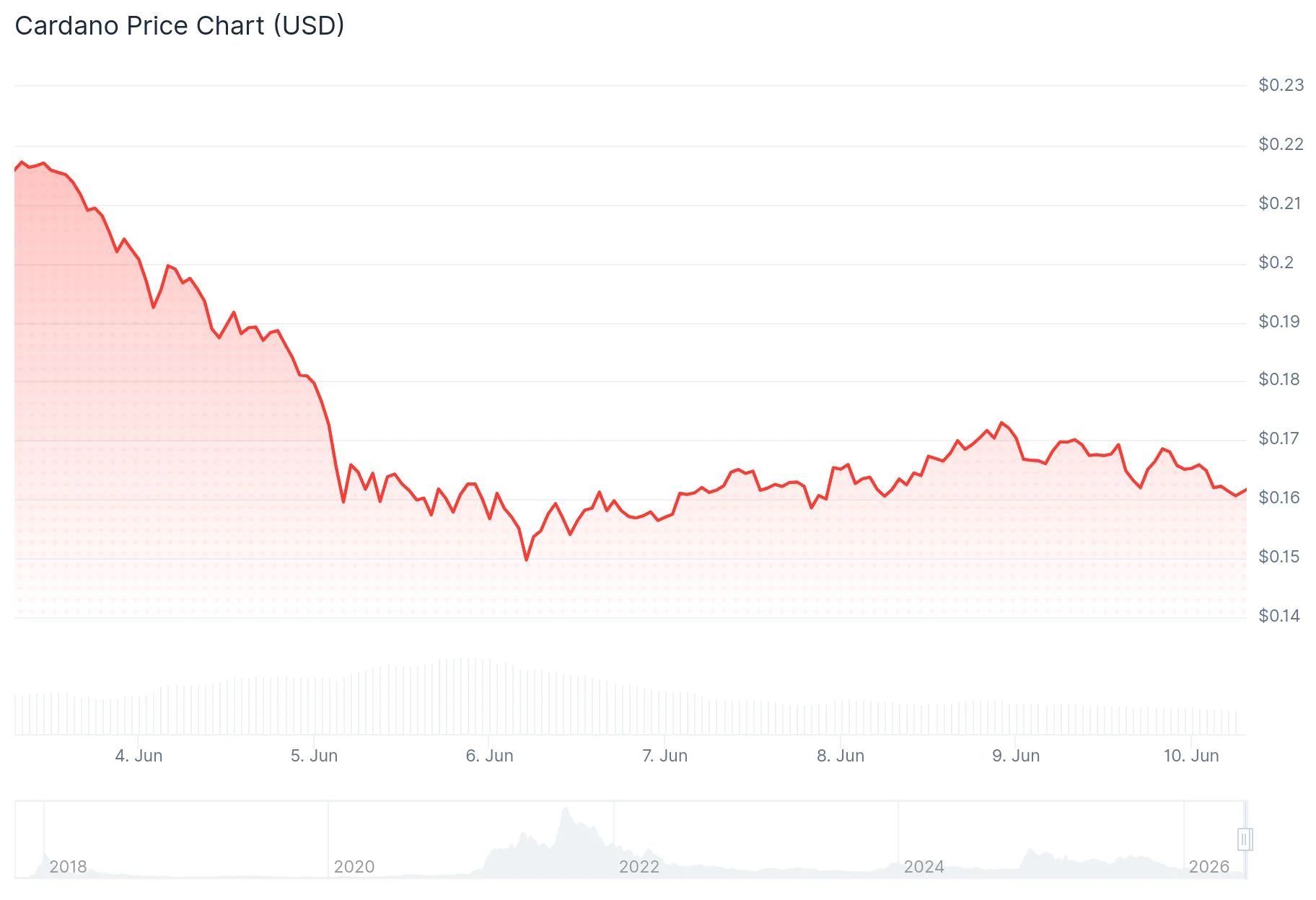
The decline occurred amid widespread turbulence across cryptocurrency markets. From its cycle high of $1.20, ADA has now retreated 87%.
While price action has disappointed investors, the Cardano ecosystem has been preparing for a pivotal network enhancement. The Leios testnet deployment is confirmed for June 23, following community governance approval secured on May 25.
Leios represents one of the most substantial technical improvements in Cardano’s development timeline. The upgrade targets an expansion of network throughput from approximately 800,000 transactions monthly to around 27 million — effectively multiplying capacity by 33 times.
According to the Cardano Foundation’s roadmap, the complete mainnet implementation is projected for the fourth quarter of 2026, specifically between October and December.

Long-Term Holders Becoming Active
Blockchain analytics platform Santiment identified noteworthy patterns in ADA wallet behavior during the recent price movements. Data reveals that ADA’s Mean Dollar Invested Age metric had been ascending consistently before older wallets initiated substantial transactions.
The Age Consumed indicator — which monitors the movement of coins held for extended periods — recorded several prominent spikes across four to five consecutive days, including the most significant surge observed since April.
Santiment emphasized that while these patterns don’t definitively signal price recovery, historical precedent shows that concentrated Age Consumed activity has frequently coincided with significant market inflection points.
Declining DeFi Metrics Present Concerns
Not every indicator suggests optimism. Total value locked in Cardano’s DeFi ecosystem contracted from 593.93 million ADA on June 4 to 552.01 million ADA by June 9, representing a decline of approximately 42 million ADA within five days, per DeFiLlama data.
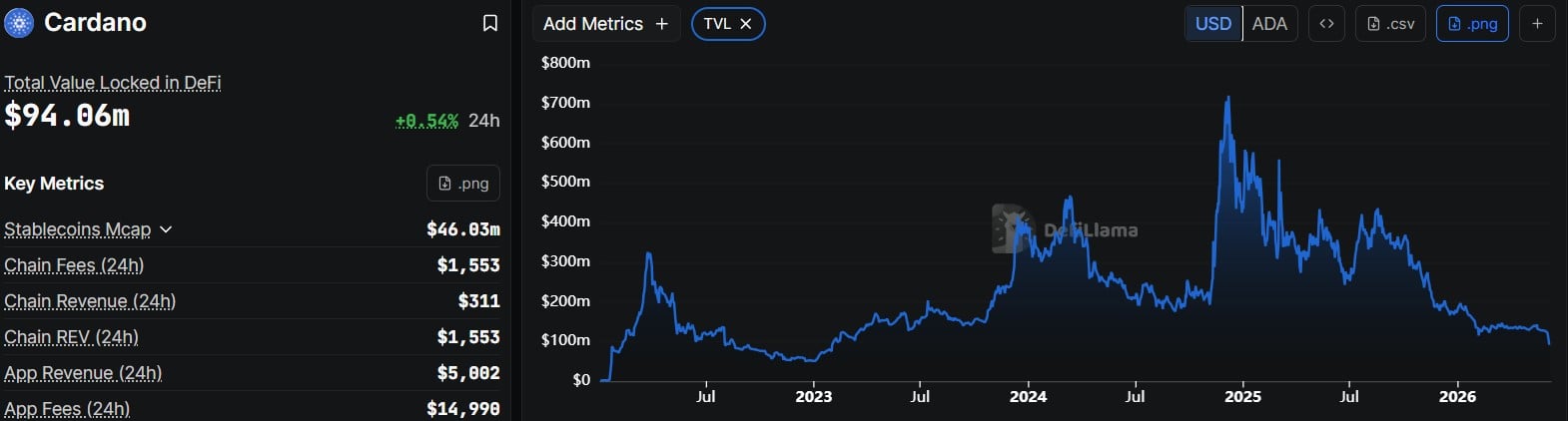
Decentralized exchange volume on Cardano similarly contracted from $10.77 million on June 5 to just $2.43 million on June 9. Concurrently, the network’s stablecoin circulation diminished from $54 million to $46 million during this timeframe.
Adding to ecosystem concerns, two prominent Cardano applications — TapTools and JPG Store — ceased operations between May 27 and June 3.
In a recent podcast appearance, founder Charles Hoskinson conceded that Cardano has underperformed in the “narrative war,” despite maintaining his position that the network remains the sole blockchain to successfully address the trilemma of throughput, security, and decentralization.
The Relative Strength Index on the four-hour timeframe registered 46 as of June 9, indicating continued bearish dominance, though the metric has been climbing from severely oversold territory near 12.
Chart patterns suggest a potential rounding bottom formation that could propel ADA toward $0.195 if the token successfully breaches resistance at $0.174.
Get 3 Free Stock Ebooks
Discover top-performing stocks in AI, Crypto, and Technology with expert analysis.
- Top 10 AI Stocks - Leading AI companies
- Top 10 Crypto Stocks - Blockchain leaders
- Top 10 Tech Stocks - Tech giants



