


Key Highlights
- The company secured $1.68 billion through its public offering, selling 28 million shares at $60 apiece, exceeding the anticipated $53–$55 price band
- Shares began trading at $68 on June 4, marking a 13.3% gain over the offering price and establishing a $17.63 billion valuation
- The quantum computing division of Honeywell now trades publicly on the Nasdaq exchange using ticker symbol “QNT”
- Competitor IonQ (IONQ) has surged approximately 52% year-to-date, reaching a valuation around $25.47 billion
- The company recently entered into a memorandum of understanding with Mitsubishi Electric and submitted a letter of intent to the CHIPS R&D Office at the US Department of Commerce
On June 4, Quantinuum—the quantum computing division spun out from Honeywell—commenced public trading on the Nasdaq exchange with ticker symbol “QNT,” successfully raising $1.68 billion through its initial public offering.
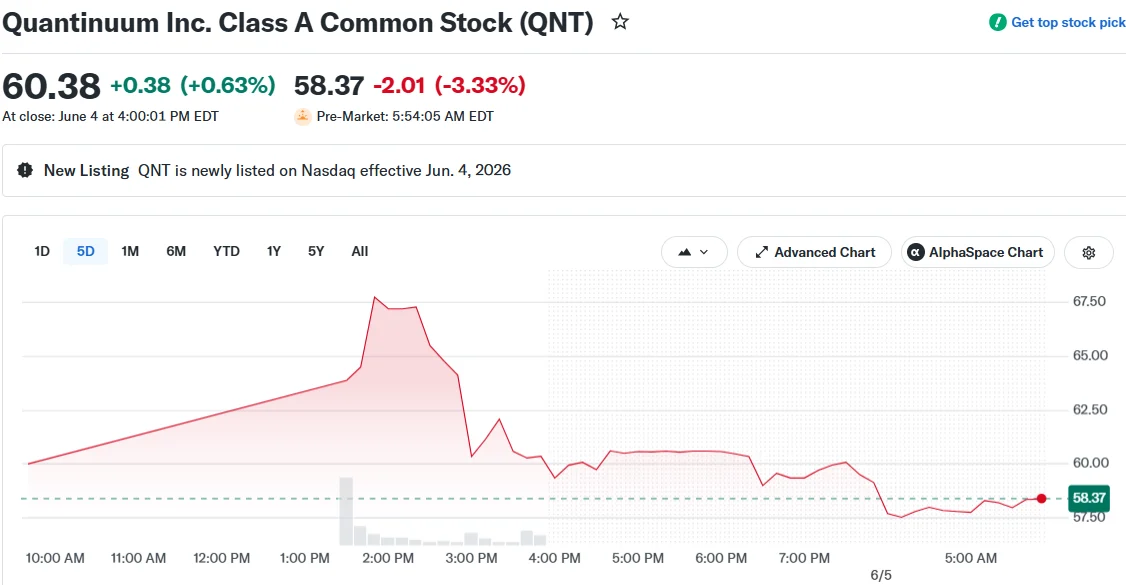
The firm set its offering price at $60 for each share, distributing 28 million shares to investors. This pricing exceeded the company’s initial guidance of $53 to $55 per share.
Shares launched at $68 during the opening bell, representing a 13.3% premium over the IPO pricing. When trading concluded on its inaugural session, Quantinuum’s total market capitalization reached $17.63 billion.
The offering was led by J.P. Morgan and Morgan Stanley serving as joint lead book-running managers, with participation from Jefferies, Evercore ISI, and additional financial institutions.
The underwriting syndicate received a standard 30-day greenshoe option enabling the purchase of up to 4.2 million additional shares at the IPO price to satisfy excess demand.

Competitive Landscape With IonQ
The public offering arrives during a period of heightened market enthusiasm for quantum computing technologies. IonQ (IONQ), a key competitor, has experienced approximately 52% appreciation this year, commanding a market capitalization near $25.47 billion—substantially higher than Quantinuum’s debut valuation.
Quantinuum positions itself as an integrated quantum computing provider, delivering a comprehensive platform designed for practical quantum applications. The company’s technology relies on QCCD architecture and claims to have recorded the industry’s highest average two-qubit gate fidelity as of December 31, 2025.
The customer base includes organizations across pharmaceutical development, materials research, financial services, and government applications. Headquartered in Broomfield, Colorado, the company maintains operations throughout the United States, United Kingdom, Germany, Japan, Qatar, and Singapore.
The entity was established in late 2021 when Honeywell Quantum Solutions combined with Cambridge Quantum.
Strategic Partnerships and Government Support Initiatives
In September 2025, Honeywell orchestrated a fundraising round of approximately $600 million for Quantinuum at a $10 billion pre-investment valuation. Those proceeds were designated for expanding quantum capabilities and introducing the Helios next-generation system, which became operational in November 2025.
Immediately prior to the public offering, Quantinuum revealed a non-binding memorandum of understanding with Mitsubishi Electric. The partnership aims to investigate quantum computing applications within industrial engineering and design workflows, with initial efforts concentrating on computer-aided engineering and simulation technologies.
In May 2025, the company also formalized a letter of intent with the CHIPS R&D Office within the US Department of Commerce. This agreement outlines prospective federal support for developing fault-tolerant trapped-ion quantum computing systems.
The initiative encompasses partnerships with supply chain participants such as GlobalFoundries and Monarch Quantum for producing semiconductor and photonic components.
The initial public offering officially concluded on June 5, 2026, as scheduled.
Get 3 Free Stock Ebooks
Discover top-performing stocks in AI, Crypto, and Technology with expert analysis.
- Top 10 AI Stocks - Leading AI companies
- Top 10 Crypto Stocks - Blockchain leaders
- Top 10 Tech Stocks - Tech giants



