



Key Takeaways
- BitMEX co-founder Arthur Hayes liquidated 247,334 HYPE tokens valued at approximately $18 million despite earlier bullish projections of $150
- The token retreated from all-time highs around $75 to approximately $67 in the wake of Hayes’ exit announcement
- Hayes pointed to escalating energy costs, anticipated AI company listings, and broader market timing concerns as rationale for his departure
- Market analyst Markus Thielen from 10xResearch cautioned that HYPE’s valuation had reached excessive levels at roughly 25 times estimated fee income
- The token maintains a 166% gain year-to-date while Hyperliquid captured an unprecedented 6.63% share of worldwide perpetual futures trading in May
The Hyperliquid HYPE token experienced a notable decline following an announcement from BitMEX co-founder Arthur Hayes that he had liquidated his complete holdings, only days after publicly forecasting the asset would climb to $150.
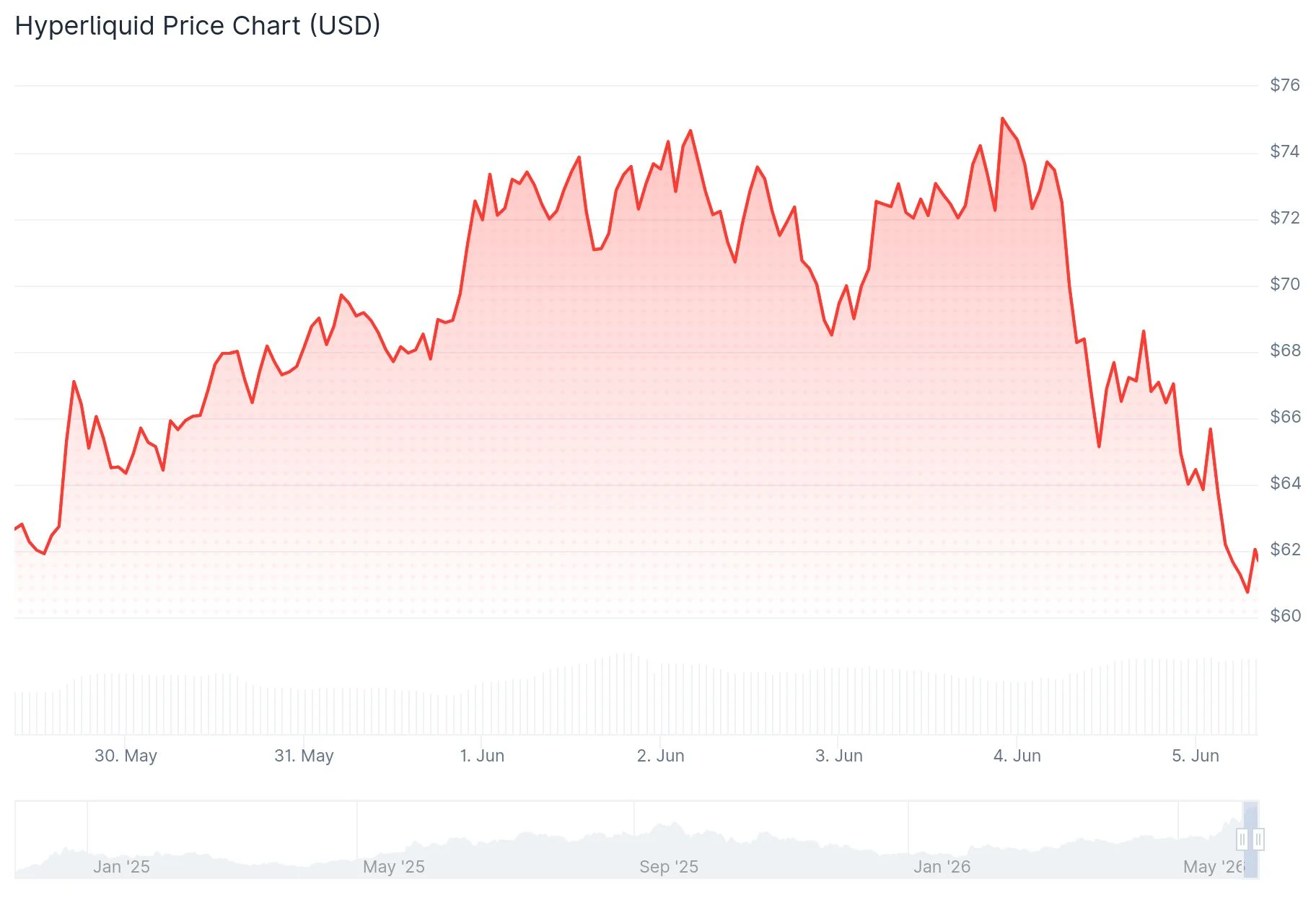
According to blockchain analytics platform Lookonchain, Hayes disposed of 247,334 HYPE tokens for roughly $18.02 million. The transaction triggered a price correction from peak levels near $75 down to the $67 range.
In a social media post on X, Hayes outlined three primary catalysts for his decision: surging energy costs connected to geopolitical tensions involving Iran, three substantial AI company initial public offerings scheduled before the third quarter, and apprehensions that cryptocurrency markets might reach their apex between the present and September. He indicated a comprehensive rationale would follow in a forthcoming piece titled “Reality Test.”
“Time to take profit,” Hayes declared, subsequently adding in a follow-up comment: “I’ll be back.”
The decision sparked swift criticism within the crypto community. Arthur Cheong, who founded DeFiance Capital, characterized it as “the epitome of a guy that over-trades his position.” Prominent crypto trader TraderSZ, commanding an audience exceeding 683,000 followers, highlighted that Hayes had recently championed HYPE as potentially among the year’s strongest performers.
Valuation Concerns Surface Among Analysts
Prior to Hayes’ exit, Markus Thielen from 10xResearch had identified warning signals regarding the token’s momentum. While acknowledging Hyperliquid as “one of the most impressive businesses in crypto,” citing approximately 77% gross profit margins and its blockchain-based trading architecture, he expressed valuation concerns.
At the $75 price point, HYPE carried a valuation multiple approaching 25 times anticipated fee-based revenue — representing one of its steepest valuations over the past twelve months. Thielen additionally observed that protocol revenue figures remain beneath historical peaks, while a significant token unlock event scheduled for June could introduce additional downward pressure.
Despite near-term headwinds, the token continues to show a robust 166% appreciation since the beginning of the year.

Platform Metrics Reach New Heights
Hyperliquid’s core business metrics demonstrated continued strength even as token prices moderated. The platform achieved a milestone in May, capturing 6.63% of aggregate global centralized exchange perpetual futures volume. Its trading activity relative to industry leader Binance reached 14.4%, marking another record.
Institutional adoption momentum is accelerating. Grayscale’s Hyperliquid ETF, which will trade under the ticker HYPG, is preparing to launch with a 0.29% management fee. Previously launched ETF products THYP and BHYP have collectively attracted $141 million in net capital inflows. Bitwise CEO Hunter Horsley disclosed that more than 7.7 million HYPE tokens have been delegated to Bitwise validators.
From a technical analysis perspective, HYPE’s critical support level is established at $59–$60. A decisive breakout and sustained close above the $83–$95 resistance band would be necessary to reinitiate the upward trajectory toward the $110–$130 price zone.
Data tracking large holder positioning revealed the spread between long and short exposures had compressed to merely $0.01 billion, indicating that significant market participants may be adjusting their strategic allocations.
Get 3 Free Stock Ebooks
Discover top-performing stocks in AI, Crypto, and Technology with expert analysis.
- Top 10 AI Stocks - Leading AI companies
- Top 10 Crypto Stocks - Blockchain leaders
- Top 10 Tech Stocks - Tech giants



