



Key Takeaways
- Bitcoin has declined to $67,000 as capital flows toward artificial intelligence sector equities
- Bitcoin spot ETFs experienced their second-largest three-week withdrawal period ever, losing 62,794 BTC
- K33 Research cautions that increasing leverage combined with weakening institutional appetite may drive bitcoin lower
- Bitwise’s Matt Hougan describes crypto’s transformation from momentum play to “contrarian investment”
- Alternative cryptocurrencies with solid fundamentals including Hyperliquid, Zcash, and Stellar demonstrate comparative resilience
Bitcoin is experiencing downward pressure toward $67,000 as capital exits cryptocurrency markets in favor of artificial intelligence equities, according to warnings from two prominent research organizations forecasting continued market challenges.
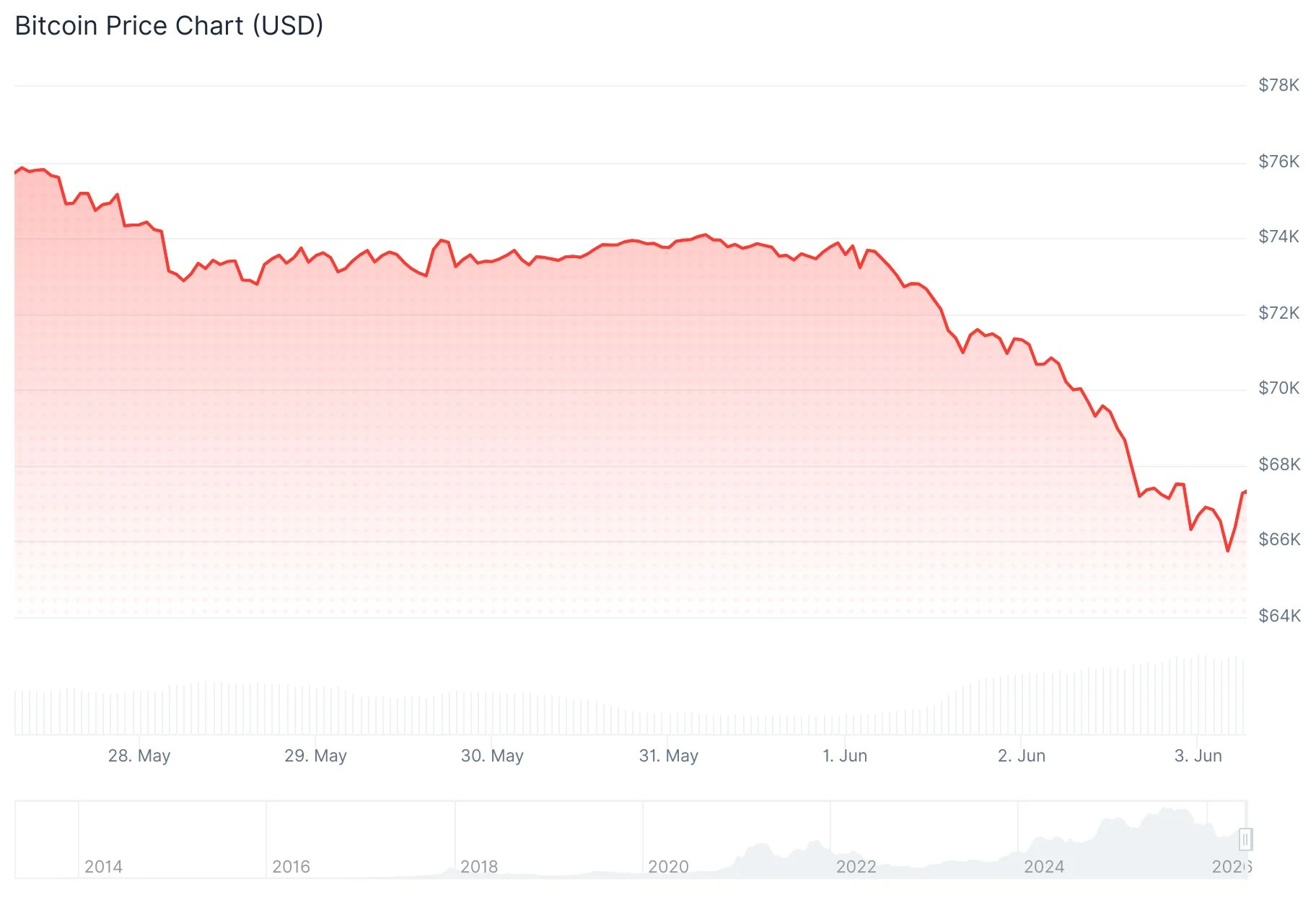
Vetle Lunde, who leads research at K33, attributed bitcoin’s declining performance to a straightforward market dynamic: investors perceive the opportunity cost of maintaining bitcoin positions as excessive while AI stocks continue their upward trajectory.
“Much of the market views the opportunity cost of holding BTC as too high while anything AI-related soars,” Lunde wrote in a Tuesday report.
Market data supports this assessment. Bitcoin spot ETFs have witnessed withdrawals totaling 62,794 BTC across the previous three-week period, marking the second-most severe outflow episode recorded.
The sell-off intensified following bitcoin’s unsuccessful attempt to surpass its 200-day moving average during the previous month. Bitcoin remains confined beneath this technical threshold while both the Nasdaq and S&P 500 indices continue establishing new all-time highs.
Market participants are also anticipating potential public offerings from enterprises such as SpaceX and Anthropic. According to K33’s analysis, this IPO pipeline may be siphoning additional capital from cryptocurrency markets.

Derivatives Markets Flash Caution Signals
Derivatives trading activity is displaying concerning indicators as well. Open interest in CME bitcoin futures contracts has contracted to levels not observed since October 2023, suggesting institutional market participants are reducing exposure.
Concurrently, funding rates within perpetual futures markets have climbed despite bitcoin’s price deterioration. This indicates an accumulation of leveraged long positions against a weakening market backdrop, which K33 identifies as a troubling development.
K33 had previously projected that bitcoin’s February descent to approximately $60,000 likely represented the cycle’s bottom. The research firm now expresses reduced confidence in that assessment.
“We read the latent selling pressure in those leveraged longs as a warning of possible deeper lows and advise caution,” the report said.
Cryptocurrency Markets Shift to Contrarian Territory
Matt Hougan, Chief Investment Officer at Bitwise, framed the situation directly: cryptocurrency no longer represents the market’s most compelling opportunity.
“AI stocks, robotics companies, SpaceX… who needs crypto when the Nasdaq-100 is up 43% year-over-year?” Hougan wrote.
He noted that crypto has transitioned from a momentum-driven trade into a contrarian position. This evolution fundamentally alters investor psychology. Momentum strategies thrive on enthusiasm and market energy, while contrarian positions demand patience and emphasis on underlying fundamentals.
Nvidia stock has appreciated approximately 1,500% since ChatGPT’s debut in late 2022. Such extraordinary performance makes attracting attention to bitcoin considerably more challenging.
Hougan observed that this cycle differs markedly from previous downturns. Rather than bitcoin functioning as a defensive asset, capital is rotating into smaller-cap tokens offering genuine utility, such as Hyperliquid, Zcash, and Stellar.
He further suggested that this reorientation toward fundamentals may indicate the bear market is approaching its conclusion rather than its beginning.
The total cryptocurrency market capitalization has contracted to $2.38 trillion, representing a 46% decline from its October zenith.
Get 3 Free Stock Ebooks
Discover top-performing stocks in AI, Crypto, and Technology with expert analysis.
- Top 10 AI Stocks - Leading AI companies
- Top 10 Crypto Stocks - Blockchain leaders
- Top 10 Tech Stocks - Tech giants



