



Key Takeaways
- Federal Reserve’s April policy meeting minutes revealed most members are prepared to implement rate increases if inflationary pressures persist.
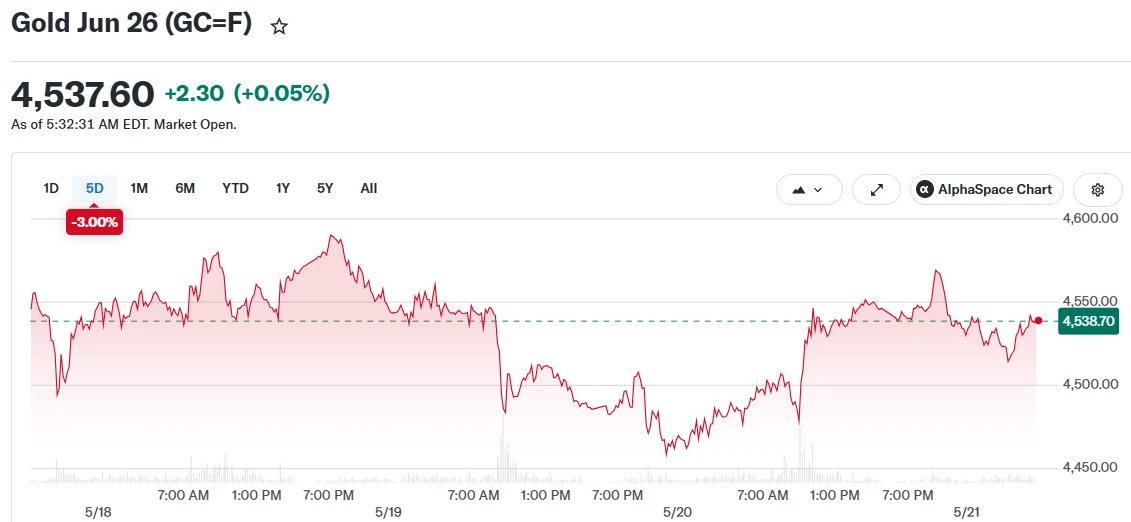
- Gold declined approximately 0.4% to roughly $4,526 per ounce during Thursday’s Asian trading session.
- Consumer price pressures have intensified significantly in recent months, primarily fueled by elevated energy costs stemming from the ongoing U.S.-Iran conflict.
- Tehran indicated it is examining Washington’s most recent diplomatic proposal, as President Trump cautioned that additional military operations may proceed without a settlement.
- The Strait of Hormuz continues to experience significant disruptions, maintaining upward pressure on crude oil valuations.
Precious metal prices experienced downward pressure during Thursday’s Asian session following the release of Federal Reserve policy meeting minutes that indicated potential interest rate increases. The decline occurred against a backdrop of ongoing geopolitical tensions in the Middle East.
Spot gold decreased 0.4% to reach $4,526.48 per ounce. Gold futures contracts similarly retreated 0.4% to trade near equivalent levels.
Federal Reserve Signals Potential Policy Tightening
The readout from the central bank’s late-April gathering indicated a substantial majority of committee members were receptive to “some policy firming.” This suggests interest rate increases could materialize should inflation fail to moderate.
Price pressures have accelerated considerably throughout the past eight weeks. Elevated energy costs, resulting from the protracted military engagement with Iran, represent the primary catalyst.
Escalating inflation has driven bond yields upward. This development negatively impacts gold, which generates no yield. As interest rates climb, the opportunity cost of maintaining gold positions increases, diminishing its appeal among market participants.

Gold has experienced approximately a 14% decline since hostilities commenced in late February. Recent trading has been characterized by range-bound movement without definitive directional momentum.
Additional precious metals also registered losses Thursday. Spot platinum declined 0.8% to $1,938.92 per ounce, while silver retreated 0.4% to $75.53 per ounce.
Research analysts at MUFG suggested gold would probably require either diminishing inflationary pressures or more concrete indications that economic deceleration is superseding inflation as the predominant concern before prices can mount a sustained recovery.
Iranian Negotiations Maintain Market Uncertainty
Regarding geopolitical developments, Iranian officials confirmed they are evaluating the United States’ newest diplomatic overture. This announcement followed President Trump’s earlier statements this week suggesting negotiations were progressing favorably.
Trump characterized the military campaign as entering its “final stages” and expressed willingness to allow “a few days” for Tehran to engage constructively. However, he simultaneously cautioned that absent a diplomatic resolution, American military operations would recommence.
Trump emphasized that Washington’s principal objective continues to be preventing Iran from acquiring nuclear weapons capability.
The Strait of Hormuz, a critical chokepoint for international petroleum transport, has remained substantially disrupted. This situation has prevented crude oil prices from declining substantially despite temporary relief observed earlier in the week.
Gold traditionally receives support during periods of geopolitical turmoil, though such safe-haven demand was overshadowed Thursday by anxieties surrounding monetary policy tightening.
Market analysts indicated gold’s subsequent trajectory hinges upon whether inflationary dynamics subside or growth apprehensions begin assuming prominence in investor calculations.
Currently, market participants are closely monitoring both Federal Reserve communications and Iranian conflict developments for fresh directional catalysts.
Get 3 Free Stock Ebooks
Discover top-performing stocks in AI, Crypto, and Technology with expert analysis.
- Top 10 AI Stocks - Leading AI companies
- Top 10 Crypto Stocks - Blockchain leaders
- Top 10 Tech Stocks - Tech giants



