


Key Takeaways
- Major indexes declined Tuesday with the Nasdaq falling approximately 1.2% and the S&P 500 dropping 0.8% as bond yields climbed.
- Long-term Treasury yields reached concerning levels, with the 30-year briefly hitting 5.2%, creating headwinds for technology and growth stocks.
- Market participants are questioning whether the Federal Reserve might need to raise interest rates to combat inflation fueled by rising oil prices.
- President Trump announced a pause in military operations against Iran, referencing “serious negotiations,” though market sentiment remained cautious.
- All eyes turn to Nvidia’s Wednesday earnings release, viewed as a critical indicator for the AI sector’s health.
Technology stocks experienced significant selling pressure Tuesday as bond yields continued their upward trajectory, overshadowing tentative diplomatic progress in the Iran conflict.
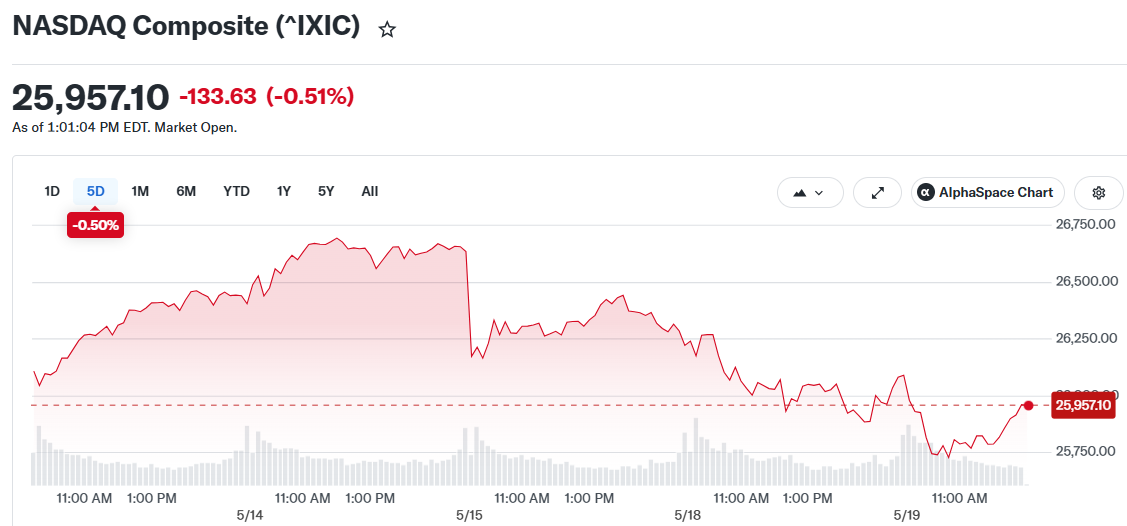
The benchmark indexes suffered broad declines, with the Nasdaq Composite shedding approximately 1.2% of its value. The S&P 500 retreated 0.8%, while the Dow Jones Industrial Average gave up roughly 0.5%. These declines marked consecutive losing sessions across major market gauges.
Bond markets saw the 10-year Treasury yield push beyond the 4.6% threshold during early trading hours. More dramatically, the 30-year yield temporarily breached 5.2%. Higher bond yields typically pressure equity valuations, with high-growth technology companies particularly vulnerable.
An unusual correlation emerged as both stocks and bonds declined simultaneously—a pattern that has unnerved market participants. Traditional market dynamics usually see bonds provide a counterbalance when equities fall, but this relationship has been deteriorating.
Inflation Concerns and Bond Yield Pressure Weigh on Markets
Inflation anxieties remain central to current market volatility. Supply disruptions in the Strait of Hormuz have elevated crude oil prices, sparking fears of broader inflationary pressures across the economy.

Market focus has intensified on Federal Reserve policy. A growing contingent of analysts believes the central bank might be compelled to implement interest rate increases if inflationary trends persist. Such monetary tightening would particularly impact growth-oriented and artificial intelligence stocks that rely heavily on accommodative financial conditions.
Treasury Secretary Scott Bessent heightened tensions Tuesday during remarks in Paris. He urged international partners to implement financial sanctions against Iran, specifically advocating for designating Iranian financial operatives and closing their banking operations. His statements came shortly before U.S. market opening.
Equity futures immediately reflected the pressure, with the Dow declining 0.5% at the opening bell, matched by the S&P 500. The Nasdaq opened down 0.6% in initial trading.
Despite prevailing market headwinds, Deutsche Bank’s strategist team observed that worldwide economic indicators have “continued to surprise on the upside, particularly in the last couple of weeks.” This economic resilience has provided some support to risk assets.
Diplomatic Developments and Nvidia’s Critical Earnings Release
President Trump announced Monday that “serious negotiations” are underway regarding Iran’s nuclear ambitions, suggesting a “very good chance” for a diplomatic resolution. He confirmed suspending planned military strikes against Iran scheduled for Tuesday at the behest of regional Gulf partners.
Markets responded with measured optimism to the diplomatic news. However, bond yields maintained their upward momentum, and technology shares continued their downward trajectory.
Investor attention is also directed toward recent data from Bank of America’s fund manager survey regarding bond positioning. The survey revealed investor bond allocations have reached a four-year nadir in May, with capital flowing instead toward commodities, utility sectors, and emerging market equities. Notably, fifty percent of surveyed fund managers still anticipate a Federal Reserve rate reduction within the coming twelve months.
The week’s most significant event remains Nvidia’s quarterly earnings announcement scheduled for Wednesday. The semiconductor giant serves as a critical benchmark for artificial intelligence investment sentiment. Expectations are elevated, and the results will likely establish the trajectory for technology stocks through week’s end.
At the most recent reading, the Dow traded around 49,562, the S&P 500 near 7,380, and the Nasdaq at approximately 25,960.
Get 3 Free Stock Ebooks
Discover top-performing stocks in AI, Crypto, and Technology with expert analysis.
- Top 10 AI Stocks - Leading AI companies
- Top 10 Crypto Stocks - Blockchain leaders
- Top 10 Tech Stocks - Tech giants



