


Key Highlights
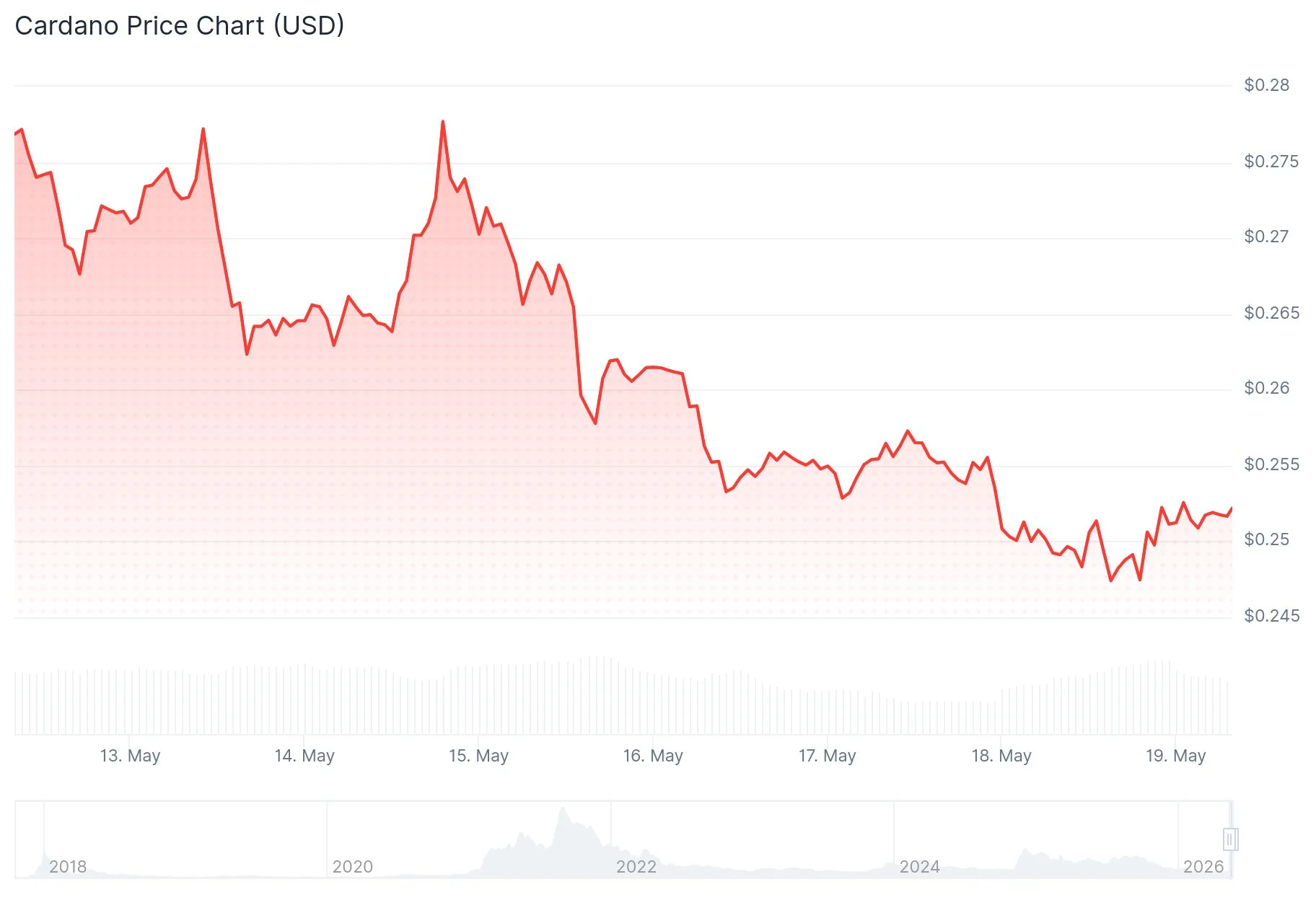
- Cardano trades at $0.2520 with a 1.88% decline over 24 hours and maintains a $9.12 billion market capitalization
- Price maintains support above critical descending triangle boundary with potential breakout targets reaching $2.67
- Daily trading volume exploded 106.17% to reach $624.58 million, indicating significant market participation
- CME Group partners with Nasdaq to launch crypto index futures featuring ADA on June 8
- Founder Charles Hoskinson revealed quantum resistance roadmap with formal research proposal coming soon
Cardano (ADA) maintains a price level of $0.2520 while experiencing remarkable trading activity with volume reaching $624.58 million—a 106.17% jump—despite the modest 1.88% price decline. The network’s market capitalization stands at $9.12 billion.
Market analyst Jonathan Carter observed that ADA persistently maintains its position above the critical lower boundary of a weekly descending triangle formation. This consistent defense of the support level indicates potential accumulation activity by strategic investors.
Should ADA successfully breach the triangle pattern’s upper boundary, market watchers have identified resistance targets at $0.330, $0.515, $0.810, and $1.275. Extended projections point toward $2.67 for longer-term price movements.
Derivatives data shows open interest decreased 1.55% to $508.64 million, indicating some traders are scaling back leveraged positions despite the surge in spot market activity.
Crypto market analyst CryptoPatel presented a compelling argument for long-term Cardano holders, revealing that whales now control 67% of all circulating ADA—marking the highest concentration level observed since 2020. He maintains a $10 long-term price target, suggesting that large holders are strategically accumulating tokens while smaller investors exit positions.

CME and Nasdaq Futures Index Adds ADA
CME Group is collaborating with Nasdaq to introduce a comprehensive crypto index futures product scheduled for June 8. This index encompasses Bitcoin, Ethereum, Solana, XRP, Cardano, Chainlink, and Stellar within a single contract weighted by market capitalization.
Analyst Mintern emphasized this development as a significant opportunity for institutional investors including hedge funds and asset management firms to access diversified cryptocurrency exposure through one regulated financial instrument. Cardano’s selection positions it among the elite digital assets chosen for this institutional-grade product.
Cardano also captured attention this week regarding network security developments. Charles Hoskinson detailed the blockchain’s proactive strategy for addressing potential quantum computing threats, characterizing the approach as advance preparation rather than reactive crisis management.
Cardano’s Quantum Resistance Plan Takes Shape
Hoskinson disclosed that the Cardano community is currently voting on implementing a dedicated quantum security framework. A comprehensive research proposal is anticipated next week that will detail migration pathways and cryptographic standard upgrades.
He characterized this initiative as fundamentally a governance exercise, emphasizing that Cardano’s established hard fork mechanism enables a methodical transition without causing network disruption. “The quantum threat is like an asteroid coming towards Earth,” Hoskinson explained.
Hoskinson suggested that Cardano might adopt elements from Bitcoin’s BIP-361 framework, which outlines a gradual migration strategy to quantum-resistant address formats. He stressed that the network’s governance infrastructure was designed specifically for coordinating complex challenges of this magnitude.
ADA fluctuated within the $0.258–$0.28 price corridor during intraday trading. The network’s future direction will hinge on the governance vote results and the specifics contained in the forthcoming research documentation.
Get 3 Free Stock Ebooks
Discover top-performing stocks in AI, Crypto, and Technology with expert analysis.
- Top 10 AI Stocks - Leading AI companies
- Top 10 Crypto Stocks - Blockchain leaders
- Top 10 Tech Stocks - Tech giants



