



Key Takeaways
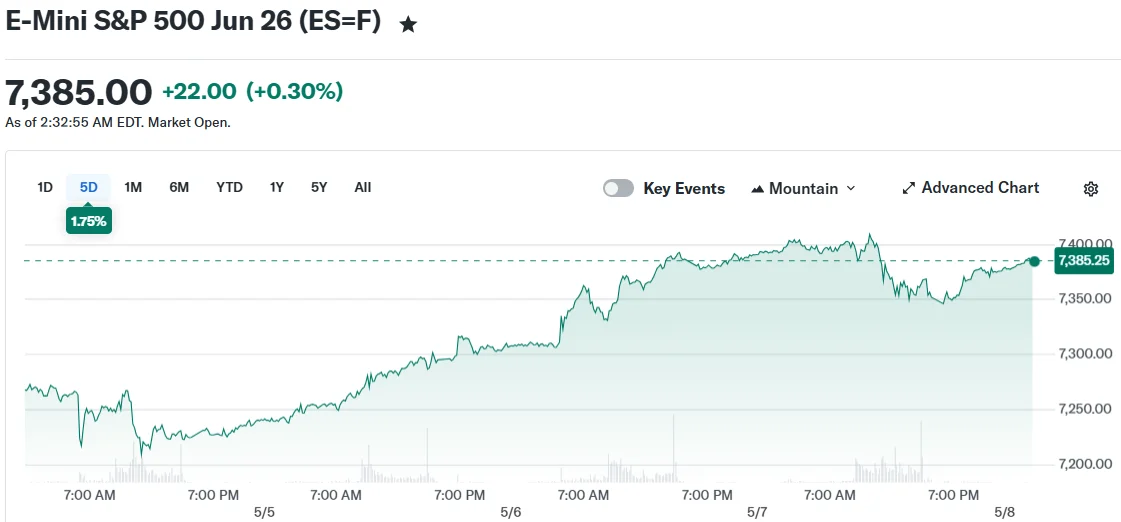
- Futures for the S&P 500, Nasdaq, and Dow Jones all advanced Friday morning even as US-Iran military confrontations unfolded near the Strait of Hormuz
- Iranian forces deployed missiles, unmanned aerial vehicles, and small watercraft against American naval vessels; US forces retaliated with strikes on Iranian installations
- President Trump characterized the Iranian actions as a minor incident and reaffirmed that the ceasefire agreement continues, providing reassurance to investors
- Energy markets showed restrained reactions, with Brent climbing 1.1% and WTI advancing 0.7%, indicating limited concern over supply disruptions
- Market attention centers on the April employment situation report, with projections calling for 65,000 new positions and unemployment remaining at 4.3%
Equity markets demonstrated resilience Friday as investors downplayed a military confrontation between the United States and Iran, with futures contracts advancing ahead of crucial employment statistics.
Contracts tied to the S&P 500 gained 0.5%, while those tracking the Nasdaq 100 jumped 0.7%. Dow futures increased 0.3%, representing approximately 137 points. The three benchmark indices had retreated Thursday, with the Dow momentarily surpassing the 50,000 threshold but unable to maintain that milestone at closing for the second consecutive session.
Iranian military forces executed missile launches, drone deployments, and small-vessel assaults targeting US naval destroyers operating in the Strait of Hormuz Thursday. US Central Command characterized these actions as “unprovoked” while emphasizing American forces did not pursue further escalation.
American military assets responded with precision strikes against Iranian military infrastructure connected to the initial attacks. President Trump communicated via Truth Social that US destroyers sustained no damage and emphasized the measured nature of the response.
Trump further minimized Iran’s offensive actions as a “trifle” and confirmed the bilateral ceasefire agreement remains operational. This messaging appeared to ease concerns among market participants.

Financial Markets Display Composure Amid Regional Conflict
Deutsche Bank’s macro strategist Henry Allen acknowledged the obvious intensification but observed that markets continue to discount a catastrophic outcome.
Oil prices registered gains while remaining relatively controlled. Brent crude increased 1.1% to reach $101.15 per barrel. West Texas Intermediate added 0.7% to settle at $95.50 per barrel.
The measured response in petroleum markets indicates traders anticipate minimal disruption to global energy distribution networks.
The US dollar strengthened 0.1% relative to a currency basket. The benchmark 10-year Treasury yield declined one basis point to 4.38%.
Employment Figures Command Market Attention
Friday’s release of April’s nonfarm payrolls data represents the primary catalyst for market direction. Consensus estimates from Bloomberg’s economist survey project 65,000 employment additions during the month.
The jobless rate is anticipated to remain unchanged at 4.3%. Such results would indicate labor market stability persisting through geopolitical turbulence.
Corporate earnings announcements scheduled for Friday include Toyota Motor, Sony, and Brookfield Asset Management.
Bitcoin retreated below the $80,000 level following reports of the US-Iran military engagement, based on earlier session trading data.
Treasury yields dipped during early morning trading as investors anticipated potential de-escalation in Middle Eastern tensions.
The Dow Jones, S&P 500, and Nasdaq indices remain positioned for weekly gains provided premarket momentum continues through the trading session.
Get 3 Free Stock Ebooks
Discover top-performing stocks in AI, Crypto, and Technology with expert analysis.
- Top 10 AI Stocks - Leading AI companies
- Top 10 Crypto Stocks - Blockchain leaders
- Top 10 Tech Stocks - Tech giants



