



Key Takeaways
- BTC is hovering around $77,000, experiencing a roughly 3% pullback as market participants await critical U.S. economic reports and the Federal Reserve’s upcoming rate announcement
- Crude oil prices holding above the $100 threshold continue to fuel inflationary pressures, diminishing expectations for imminent Fed rate reductions
- Large Bitcoin holders controlling 1,000–10,000 BTC have collectively acquired approximately 240,000 BTC since December, marking a five-month accumulation peak
- Signs of cooling AI sector demand, highlighted by OpenAI’s revenue shortfalls, may eventually ease selling pressure from Bitcoin miners
- Technical analysis suggests near-term downside risk toward $73,700 liquidity zones, while medium-term projections point to potential rallies between $85,000–$88,000 in May
Bitcoin is currently changing hands around $77,000, reflecting a modest 3% decline during Asian trading hours. The pullback appears to stem from pre-event caution rather than fundamental deterioration in market structure.
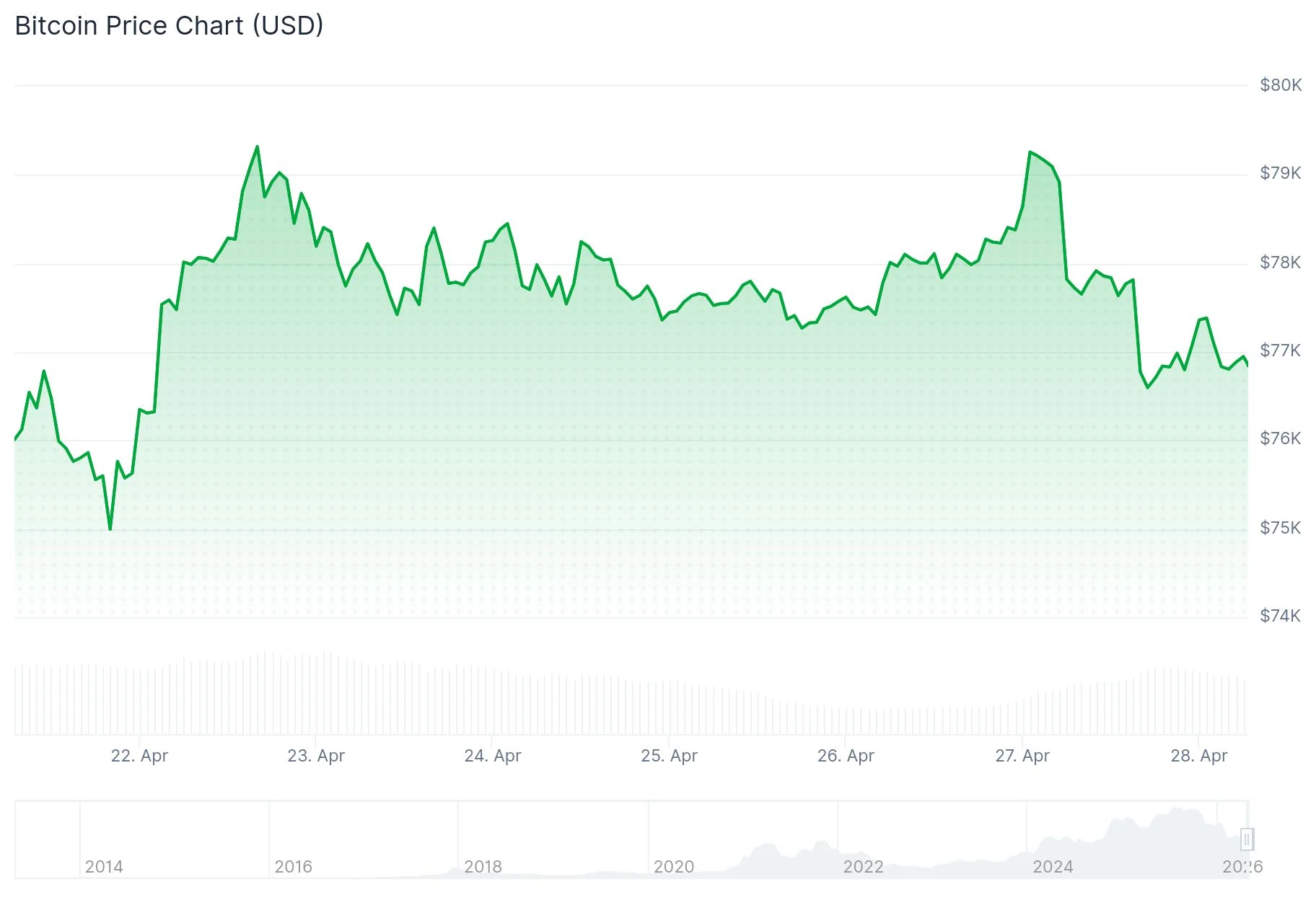
According to Singapore-based liquidity provider Enflux, market participants are adopting a wait-and-see stance before Wednesday’s Federal Reserve policy announcement. The upcoming week features several high-impact data releases including GDP figures, the PCE inflation gauge, and Employment Cost Index readings.
Persistently elevated crude oil prices remain the primary headwind. With Brent crude maintaining levels above $100 per barrel, inflationary conditions continue to constrain the Federal Reserve’s policy flexibility regarding potential rate cuts.
Polymarket prediction markets currently assign a 95% probability to the Fed maintaining its current rate stance at the June meeting. This uncertainty has rippled through risk-sensitive assets, with cryptocurrencies experiencing heightened volatility.
Bitcoin’s current price sits approximately 4% beneath the short-term holder cost basis estimated at $80,700. This metric frequently serves as an indicator of conviction among recent market entrants.

Enflux anticipates continued range-bound trading until Thursday’s economic releases, suggesting that significant price movements will more likely stem from macroeconomic data surprises than from the Fed’s policy statement itself.
Large Holder Accumulation Trends
Despite near-term price weakness, substantial holders continue building positions. Addresses containing between 1,000 and 10,000 BTC have accumulated roughly 240,000 BTC since December, pushing collective holdings to 3.09 million BTC — levels not observed since November 2025.
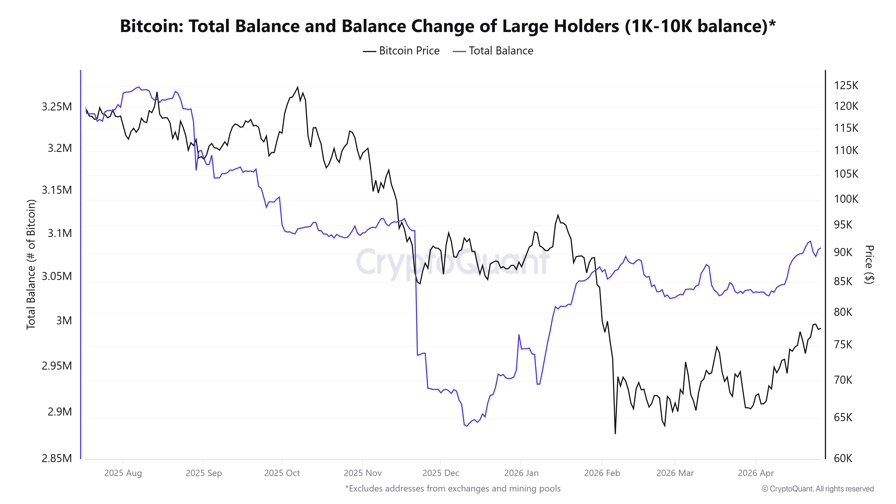
Long-term holders have demonstrated exceptional restraint in selling activity. Distribution from this cohort totaled just 42,100 BTC over the trailing 30 days, representing one of the lowest monthly outflows recorded throughout 2026. Meanwhile, institutional investors have absorbed approximately 92,900 BTC during the past month, per Bitwise’s Crypto Market Compass analysis.
Critical Technical Zones
From a technical perspective, Bitcoin has established a potential double top formation on the four-hour timeframe near $79,400 following two consecutive rejections last week. Near-term price action may gravitate toward liquidity concentrations at $74,700 and $73,700.
MN Capital’s Michaël van de Poppe maintains that upside objectives in the $85,000–$88,000 range remain achievable for May, contingent upon maintaining critical support thresholds.
Crypto analyst Ali Charts highlighted on social platforms that Bitcoin is developing a Morning Star candlestick configuration on the monthly chart — a pattern historically associated with major trend reversals for BTC. He referenced over $1 billion in net taker volume on Binance as evidence of buying conviction, identifying $73,000 as the critical support threshold.
On-chain analyst Willy Woo estimates a 30% probability that BTC successfully breaches the $79,000 cost basis of recent buyers on the current attempt, emphasizing that the next three to six weeks will prove decisive in determining whether a sustainable bottom is taking shape.
Current derivatives data reveals funding rates at -7% on a 30-day basis, representing one of the most extreme negative readings on record — a condition historically associated with short squeeze potential should BTC climb above $80,000.
Get 3 Free Stock Ebooks
Discover top-performing stocks in AI, Crypto, and Technology with expert analysis.
- Top 10 AI Stocks - Leading AI companies
- Top 10 Crypto Stocks - Blockchain leaders
- Top 10 Tech Stocks - Tech giants



