


Key Takeaways
- KelpDAO’s rsETH bridge suffered a $292–$293 million security breach, sparking massive withdrawals from Aave totaling over $15 billion.
- Critical lending pools on Aave reached 100% utilization rates, trapping approximately $5 billion in USDT and USDC without withdrawal options.
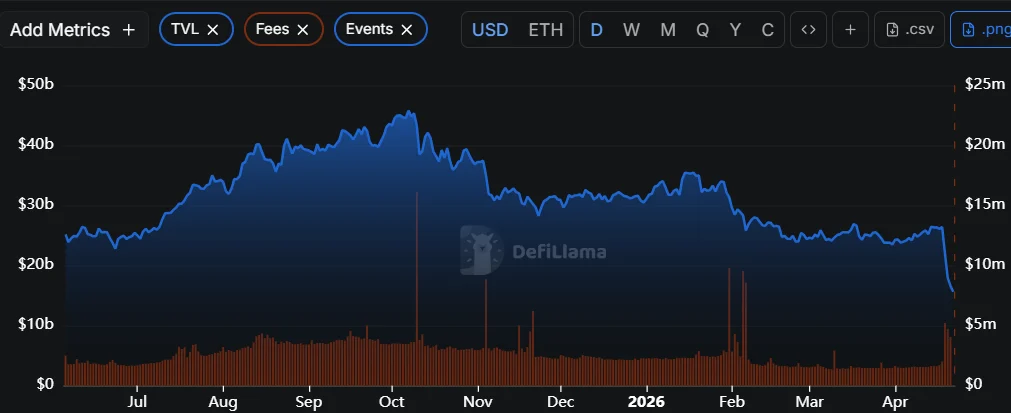
- The protocol’s total value locked plummeted from $48.5 billion to approximately $30.7 billion — representing a roughly 37% decline within days.
- Security expert Natalie Newson from CertiK cautioned that Aave’s “self-defense systems are down,” enabling potential bad debt accumulation.
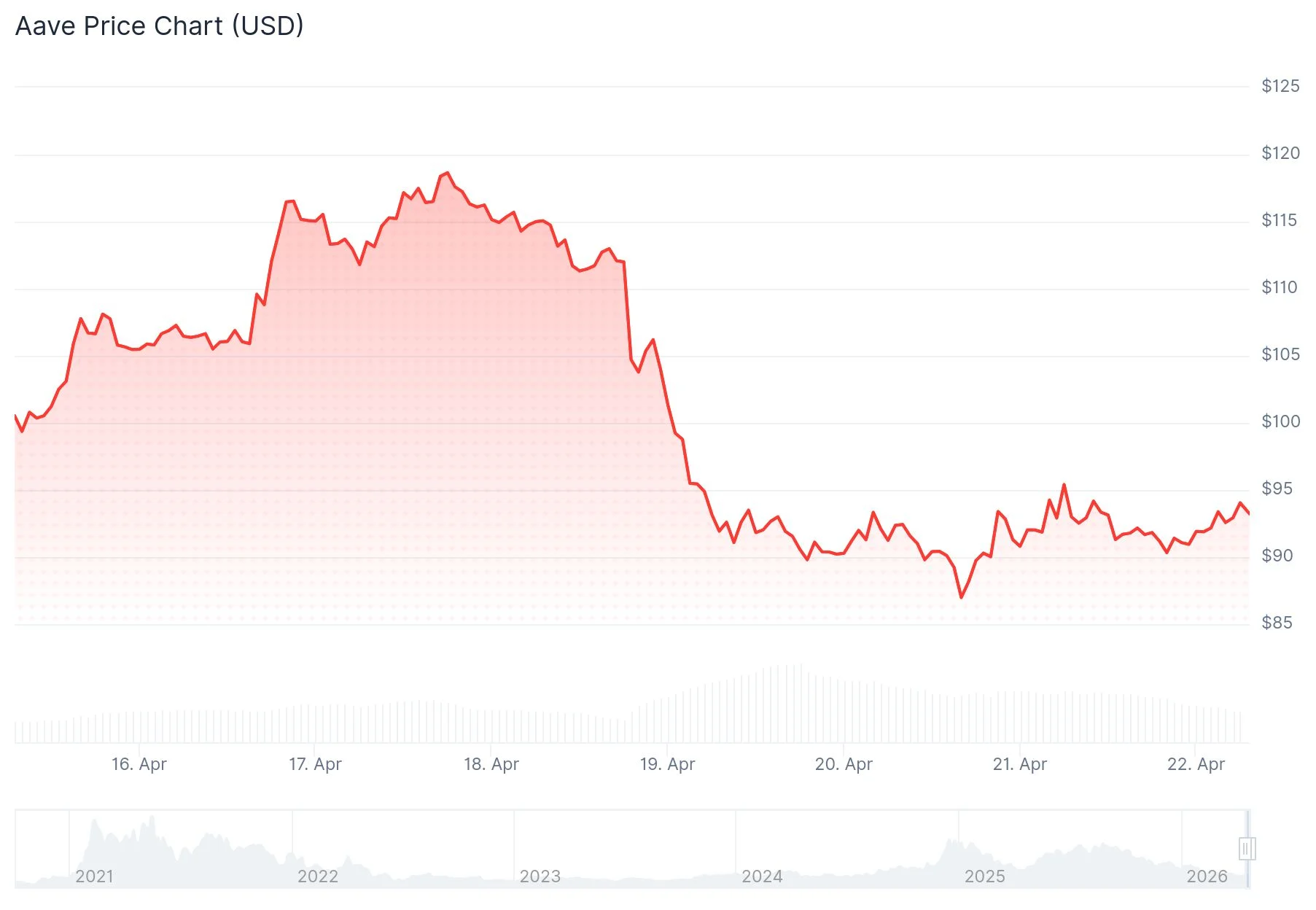
- The AAVE token currently trades near $91, maintaining position slightly above the $90.47 support threshold, facing resistance at $98.80.
One of decentralized finance’s premier lending protocols, Aave, finds itself grappling with an acute liquidity emergency following a security incident on an unrelated platform that set off a devastating cascade effect across its primary markets.
The crisis began unfolding on April 18 when malicious actors identified and exploited a critical security flaw within a LayerZero V2 bridge connecting Unichain to Ethereum. The exploit enabled attackers to extract approximately $293 million in rsETH from Kelp DAO while failing to burn matching tokens on the originating blockchain.
These compromised assets were subsequently deposited into Aave V3 where they served as collateral. The perpetrator leveraged them to secure loans totaling nearly $200 million in WETH. Once word spread about the unsecured collateral backing these positions, a rapid withdrawal frenzy commenced.
Within a single 24-hour period, Aave experienced outflows exceeding $6.6 billion. High-profile entities such as Justin Sun and cryptocurrency exchange MEXC were identified among those extracting substantial amounts. The ETH lending market reached complete utilization initially, with USDT and USDC markets following suit shortly after.
When a lending protocol achieves 100% utilization, all available liquidity has been exhausted. This critical state prevents user withdrawals and halts the protocol’s ability to execute liquidation procedures.

DeFi analyst DeFi Warhol articulated the situation clearly: “It actually means no liquidity available for withdrawals. Liquidations can’t be processed.” He noted that approximately $3 billion in USDT and $2 billion in USDC remain trapped without viable exit mechanisms.
Protocol Defense Mechanisms Compromised
Natalie Newson, serving as senior blockchain security researcher at CertiK, characterized the circumstances as placing Aave in precarious territory.
“100% utilization doesn’t just mean a lack of liquidity; it means the protocol’s self-defense systems are down,” she explained. In the absence of available liquidity, insufficiently collateralized positions cannot be liquidated, allowing bad debt to accumulate continuously.
Newson emphasized that Aave itself experienced no direct security compromise. “It got stuck due to the fallout from someone else’s bridge failure,” she noted. According to LlamaRisk projections, potential bad-debt scenarios range between $123.7 million and $230.1 million.
Aave’s governance structure responded swiftly — implementing freezes on rsETH reserves, reducing loan-to-value ratios to zero, and modifying interest rate parameters. However, the damage to total value locked had already materialized.
Funds Migrate to Rival Platforms
AmberCN documented on April 22 that cumulative outflows from Aave across three and a half days totaled $15.1 billion. Total value locked contracted from $48.5 billion down to $30.7 billion.
Morpho similarly experienced $1.5 billion in withdrawals. SparkLend, conversely, attracted $1.3 billion in new deposits — with speculation suggesting portions originated from the same large holders who withdrew from Aave.
Aave’s blockchain-generated revenue declined from $1.1 million in early February to $625,000 as of Monday.
When approached by CoinDesk for commentary, Aave founder Stani Kulechov responded: “I do not have anything useful to say.”
The AAVE token currently changes hands around $91.22, positioned marginally above the critical support zone at $90.47. Upside resistance remains established at the 20-day EMA approaching $98.80.
Get 3 Free Stock Ebooks
Discover top-performing stocks in AI, Crypto, and Technology with expert analysis.
- Top 10 AI Stocks - Leading AI companies
- Top 10 Crypto Stocks - Blockchain leaders
- Top 10 Tech Stocks - Tech giants



