



TLDR
- Iran’s top diplomat announced the complete restoration of commercial vessel access through the Strait of Hormuz throughout the ceasefire period
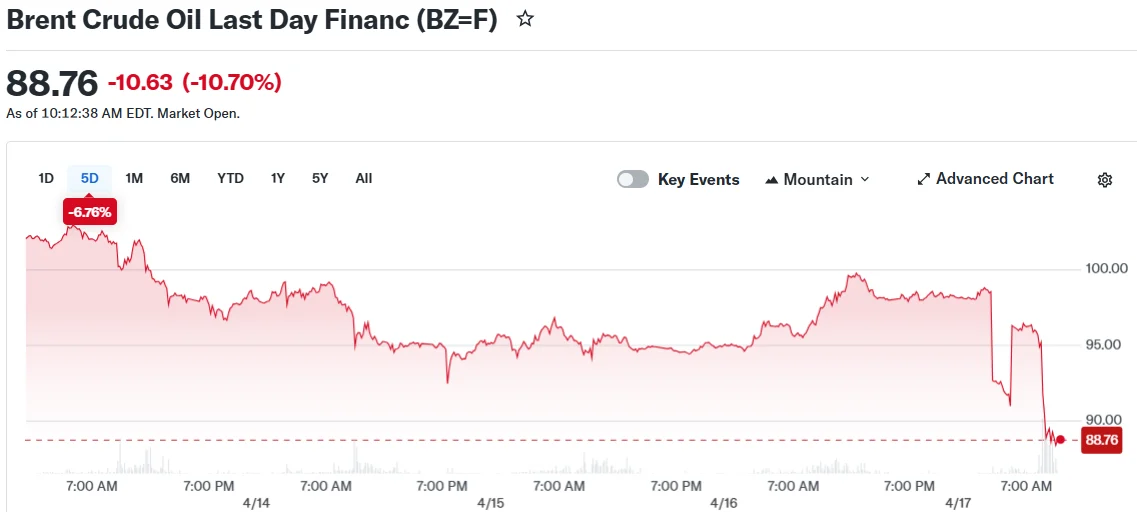
- Brent crude plummeted more than 10% to trade beneath $90 per barrel; WTI declined to under $82
- A 10-day truce between Israel and Lebanon commenced Thursday at 5 p.m. ET
- Reports suggest Washington is evaluating the release of $20 billion in Iranian frozen assets in exchange for enriched uranium
- Trump verified that U.S. naval forces continue their blockade of Iran notwithstanding the waterway’s reopening
Crude oil markets experienced a dramatic downturn on Friday following Foreign Minister Abbas Araghchi’s declaration that the Strait of Hormuz would permit full commercial navigation during the ongoing Israel-Lebanon ceasefire period.
Brent crude benchmark prices tumbled over 10% to approximately $88.65 per barrel. The West Texas Intermediate benchmark experienced comparable losses, falling beneath $82. Both oil standards had exceeded $100 earlier in the week.
Araghchi shared the announcement via X, stating that navigation was “completely open for all commercial vessels” utilizing a predetermined route established by Iranian officials.
President Trump subsequently issued his own statement on Truth Social, acknowledging the waterway’s accessibility. However, he emphasized that the American naval blockade surrounding Iran “will remain in full force and effect” pending the completion of negotiations with Tehran.
This situation generated ambiguity for maritime transport operators. Iranian state television indicated that vessels traversing the strait must establish coordination with the Islamic Revolutionary Guard Corps. Questions remained regarding the precise shipping lanes vessels would be obligated to follow.
What the Ceasefire Means for Negotiations
On Thursday, Trump revealed that Israel and Lebanon had reached consensus on a 10-day cessation of hostilities beginning at 5 p.m. ET. Trump indicated he had conducted conversations with Lebanese President Joseph Aoun and Israeli Prime Minister Benjamin Netanyahu to secure the arrangement.

Israel had maintained military campaigns in Lebanese territory targeting Hezbollah throughout the U.S.-Iran ceasefire discussions, creating complications in the broader diplomatic engagement between Washington and Tehran.
The Lebanese ceasefire eliminated one barrier, though a comprehensive agreement between the United States and Iran remains incomplete.
A Possible Deal Takes Shape
Axios disclosed Friday that American and Iranian representatives are examining a three-page framework to resolve the confrontation. One component involves Washington unfreezing $20 billion in Iranian assets in return for Tehran surrendering its stockpile of enriched uranium.
Trump informed journalists that both nations were “very close” to finalizing an agreement. He noted that Iran had committed to refraining from nuclear weapon possession for over 20 years and had offered compromises regarding its uranium enrichment activities.
Iran has demanded the elimination of international economic sanctions as a condition of any final accord.
Oil prices had been declining from peak levels near $120 per barrel, reached following the outbreak of hostilities with U.S. and Israeli military strikes on Iran in late February. Prior to the conflict, crude was valued around $70 per barrel.
The Strait of Hormuz facilitates approximately one-fifth of global petroleum supplies. ING analysts calculated that roughly 13 million barrels daily were interrupted by the waterway’s effective shutdown.
France and Britain were scheduled to convene a Friday gathering of approximately 40 nations to address strategies for reopening the strait. Pakistan’s foreign minister confirmed Thursday that no timeline has been established for additional U.S.-Iran diplomatic sessions. European and Gulf state officials privately anticipate that achieving a final deal could require up to six months.
Get 3 Free Stock Ebooks
Discover top-performing stocks in AI, Crypto, and Technology with expert analysis.
- Top 10 AI Stocks - Leading AI companies
- Top 10 Crypto Stocks - Blockchain leaders
- Top 10 Tech Stocks - Tech giants



