



Key Takeaways
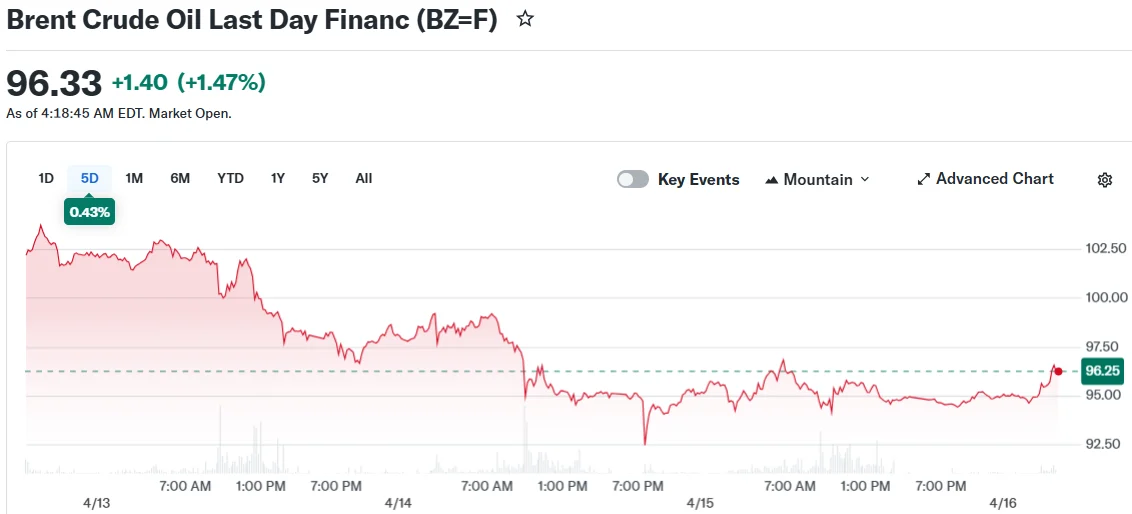
- Brent crude maintains its position close to $95 per barrel, while WTI fluctuates between $88 and $91
- Washington and Tehran are exploring a 14-day extension to their current ceasefire before it lapses on April 21
- Approximately 3.8 million barrels of daily oil transit through the Strait of Hormuz face continued disruption
- First-quarter GDP figures from China showed 5% annual growth, providing modest optimism for crude demand
- International energy agencies including the IEA and OPEC project weakening demand due to conflict-related uncertainties
Crude oil markets have found stability in recent trading sessions as the United States and Iran contemplate prolonging their current ceasefire by an additional two weeks, allowing negotiators additional time to pursue a comprehensive peace settlement that has thus far remained elusive.
Brent crude continues to trade in the vicinity of $95 per barrel. West Texas Intermediate has been fluctuating within the $88 to $91 range. These benchmarks remain approximately one-third elevated compared to pre-conflict levels from late February, although significantly beneath the $120 highs witnessed during the initial stages of hostilities.
The current truce arrangement between Washington and Tehran is scheduled to conclude on April 21. Diplomatic discussions conducted in Pakistan over the previous weekend failed to produce a breakthrough. Mediators are currently focused on organizing technical-level conversations addressing the most contentious points, particularly the resumption of passage through the Strait of Hormuz and Tehran’s uranium enrichment activities.
Ali Abdollahi, who leads Iran’s joint military headquarters, issued a statement cautioning that should Washington’s blockade persist, Tehran will prohibit all commercial traffic through the Persian Gulf, the Sea of Oman, and the Red Sea.
Washington has implemented a naval blockade designed to halt Iranian maritime traffic. In response, Iran has maintained the strait predominantly closed to international shipping. This strategic waterway serves as the critical connection between Persian Gulf oil producers and international energy markets.

Vivek Dhar, an analyst with Commonwealth Bank of Australia, noted that the blockade jeopardizes approximately 3.8 million barrels of crude oil and refined products that transited the waterway during the previous month.
Physical Market Diverges from Futures Pricing
Kaes Van’t Hof, who serves as chief executive of Diamondback Energy, observed that oil futures markets are failing to accurately capture actual conditions in physical trading. According to Van’t Hof, futures contracts are increasingly incorporating expectations of de-escalation that don’t align with developments on the ground.
Warren Patterson, a commodities strategist at ING Groep, reinforced this assessment, noting that any ceasefire agreement will likely prove unstable given the substantial gap between American and Iranian positions, creating significant upward pressure on future prices.
Both the International Energy Agency and OPEC issued warnings this week regarding the conflict’s dampening effect on worldwide oil consumption.
Chinese Economic Data Provides Limited Support
China’s economy expanded by 5% on an annual basis during the first quarter of 2026, achieving the top end of Beijing’s yearly growth objectives. The figure exceeded analyst projections and provided some encouragement regarding oil consumption in the planet’s leading crude importing nation.
Nevertheless, economic growth decelerated as the quarter progressed. China sources a substantial portion of its crude requirements from Iran, introducing additional uncertainty to future demand projections.
In related developments, Thailand is pursuing emergency procurement agreements for oil and fertilizers through Oman. Meanwhile, Australia faces reduced domestic fuel availability following a fire at Viva Energy’s Geelong processing facility. Indian officials have cautioned that the conflict’s economic ramifications could rival the disruption caused by the pandemic.
President Donald Trump indicated this week that resolution of the conflict appears imminent, suggesting additional diplomatic discussions could commence within the coming days.
Get 3 Free Stock Ebooks
Discover top-performing stocks in AI, Crypto, and Technology with expert analysis.
- Top 10 AI Stocks - Leading AI companies
- Top 10 Crypto Stocks - Blockchain leaders
- Top 10 Tech Stocks - Tech giants



