



Key Takeaways
- Brent crude tumbled 13% to approximately $94 per barrel; WTI plunged 15% to roughly $96 per barrel
- Washington and Tehran reached a two-week truce agreement late Tuesday
- President Trump announced U.S. assistance in facilitating maritime passage through the Strait of Hormuz
- Iran’s top diplomat verified Tehran will permit unimpeded vessel transit through the waterway
- Approximately 20% of worldwide petroleum shipments pass through the Strait of Hormuz
Crude oil markets experienced a dramatic selloff Wednesday following the announcement of a temporary truce between Washington and Tehran, alleviating concerns about potential disruptions to international petroleum supplies.
Brent crude benchmark tumbled approximately 13% to reach $94.77 per barrel. The West Texas Intermediate index plummeted roughly 15% to settle at $96.23 per barrel. Trading sessions saw both indicators touch intraday bottoms beneath the $92 threshold during morning hours.
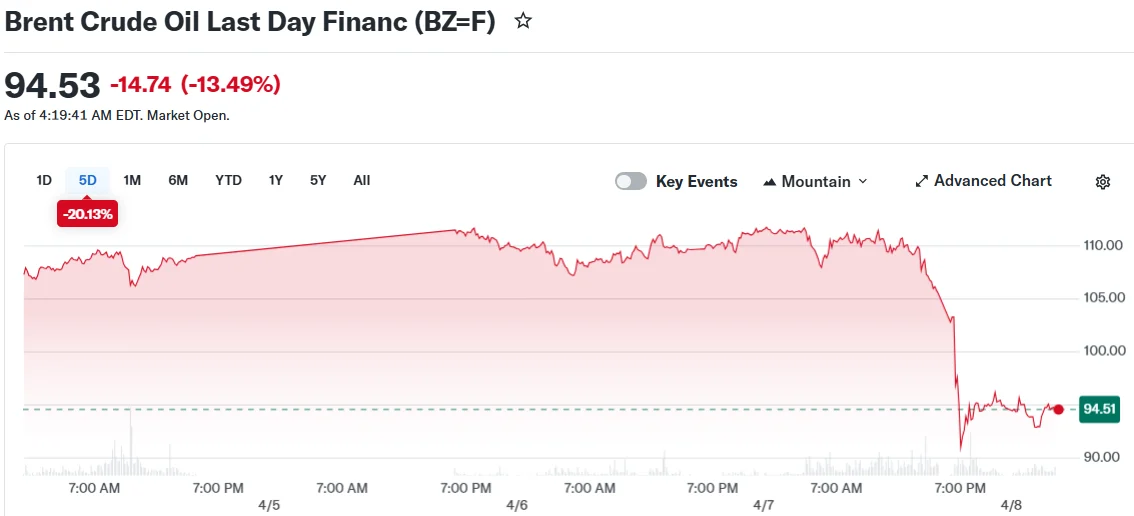
Negotiators finalized the agreement late Tuesday, moments ahead of President Trump’s 8:00 p.m. Eastern time ultimatum. Throughout the preceding days, oil prices had climbed to multi-month peaks as investors braced for potential military escalation.
The president had issued stark warnings that non-compliance could trigger devastating outcomes. He characterized the stakes as potentially catastrophic, stating that “a whole civilization could die.”
Terms of the Temporary Truce
President Trump revealed the military operations suspension through his Truth Social platform. He indicated that American forces had already accomplished their primary strategic goals and noted that Iranian officials had presented a comprehensive proposal that might serve as groundwork for broader diplomatic resolution.

Iranian Foreign Minister Seyed Abbas Araghchi verified that Tehran’s Supreme National Security Council authorized a halt to military operations. He stated that maritime vessels would receive “safe passage” authorization through the Strait of Hormuz, contingent upon cessation of combat activities and vessel coordination with Iranian naval authorities.
Pakistani diplomats served as crucial intermediaries, facilitating negotiations between both parties during the critical final hours preceding the deadline.
President Trump characterized the arrangement as a “double-sided pause.” He emphasized that its continuation depends on Iran guaranteeing prompt restoration of strait accessibility.
Strategic Waterway Reopens
The Strait of Hormuz had remained essentially blocked for several weeks amid the escalating tensions. This narrow passage facilitates roughly 20% of worldwide petroleum transportation, establishing it as among the planet’s most vital maritime corridors.
The president posted to social platforms Wednesday morning announcing American assistance in managing the “traffic buildup” throughout the strait. His statement read: “There will be lots of positive action! Big money will be made. Iran can start the reconstruction process.”
The strait’s reopening represents the primary catalyst behind the dramatic market response. While the passage remained obstructed, supply anxiety had driven prices significantly higher. The truce eliminated that immediate threat, though only temporarily.
The ceasefire duration extends for two weeks. Iranian officials confirmed they will facilitate unrestricted passage throughout this window, assuming all parties honor the agreement’s conditions.
Get 3 Free Stock Ebooks
Discover top-performing stocks in AI, Crypto, and Technology with expert analysis.
- Top 10 AI Stocks - Leading AI companies
- Top 10 Crypto Stocks - Blockchain leaders
- Top 10 Tech Stocks - Tech giants



