



TLDR
- Futures contracts for the S&P 500 climbed 0.4% while Nasdaq 100 futures advanced 0.6% during Monday trading
- Reports of Pakistan-mediated ceasefire negotiations between Washington and Tehran boosted investor confidence
- President Trump extended his ultimatum to Tuesday evening, warning of strikes on Iranian power infrastructure
- Approximately 20% of worldwide oil shipments face disruption as the Strait of Hormuz stays mostly blocked
- Crude prices declined following diplomacy news, with Brent falling roughly 1.6% to $107 per barrel
Equity futures in the United States climbed Monday morning following emerging reports of potential diplomatic breakthrough between Washington and Tehran, offering traders a measure of reassurance after a weekend marked by military escalation and presidential warnings.
S&P 500 futures contracts advanced approximately 0.4%. Nasdaq 100 futures showed stronger performance with a 0.6% increase. Dow Jones Industrial Average futures posted more modest gains of 0.1%.
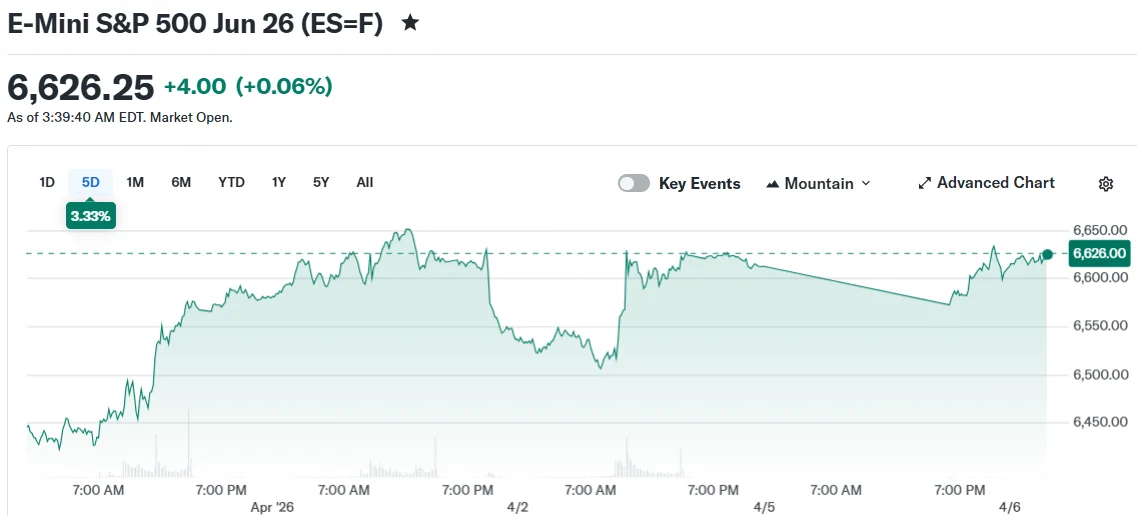
Initially, markets dipped during overnight sessions following renewed aggressive rhetoric from President Trump toward Iran. However, sentiment reversed as news emerged of potential diplomatic channels opening.
According to Reuters reporting, both Washington and Tehran have been presented with a preliminary ceasefire framework facilitated through Pakistani intermediaries. The proposed agreement calls for an immediate cessation of hostile actions. To date, neither government has officially acknowledged or endorsed the framework.
Concurrently, American officials alongside regional diplomatic partners are pursuing a more comprehensive 45-day ceasefire arrangement that could potentially bring a complete end to hostilities. Sources close to negotiations caution that prospects for success remain uncertain.

President Trump’s initial 10-day ultimatum technically reached its expiration Monday. Nevertheless, Trump announced a postponement via social media, declaring the revised deadline as “Tuesday, 8:00 P.M. Eastern Time.” In statements to the Wall Street Journal, he warned that American forces would target all Iranian electrical generation facilities should the Strait of Hormuz remain closed beyond that point.
Crude Prices Retreat Following Diplomacy Reports
The strategically critical Strait of Hormuz, a waterway that typically handles roughly one-fifth of global petroleum transport, continues to operate under severe restrictions for most tanker vessels. This ongoing blockade has maintained upward pressure on oil prices throughout recent trading sessions.
Crude prices had surged nearly 3% during Sunday evening market opening. However, momentum reversed following the ceasefire-related news flow. Brent crude declined approximately 1.6% to settle near $107 per barrel. West Texas Intermediate experienced a steeper drop of roughly 2% to approximately $109.
A noteworthy market anomaly: WTI pricing currently exceeds Brent pricing levels. Such inversions are uncommon. Market observers attribute this phenomenon to contract timing disparities, with WTI remaining on May delivery contracts while Brent has transitioned to June.
Research analysts at Gavekal Research suggested that Iranian authorities are leveraging their control over the strait to impose substantial transit fees on commercial shipping. They characterized this approach as an emerging economic strategy for the region.
Additional Market Movements
Gold advanced 0.9% to approximately $4,720 per ounce in Monday trading. The benchmark 10-year US Treasury yield edged higher to 4.362%.
American military personnel successfully extracted a US aviator who had been stranded within Iranian territory during the weekend. Iranian forces maintained missile and drone attacks targeting Gulf region nations and Israel throughout Monday morning hours.
Circumstances remain volatile, with Tuesday evening’s deadline representing the next critical juncture for both financial markets and diplomatic efforts.
Get 3 Free Stock Ebooks
Discover top-performing stocks in AI, Crypto, and Technology with expert analysis.
- Top 10 AI Stocks - Leading AI companies
- Top 10 Crypto Stocks - Blockchain leaders
- Top 10 Tech Stocks - Tech giants



