


Key Highlights
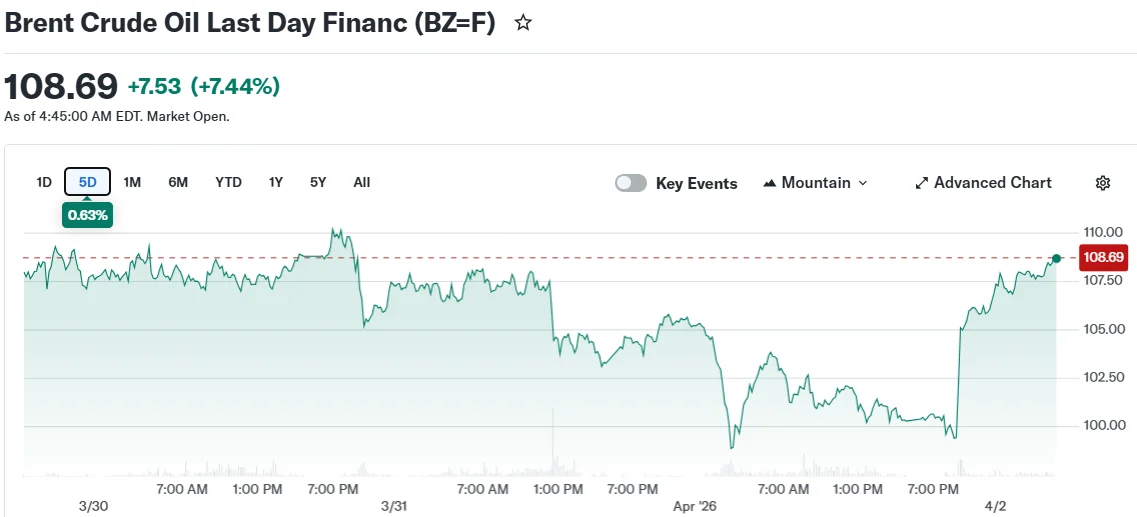
- Crude oil rallied nearly 7%, pushing Brent above $107 and WTI close to $106 per barrel
- President Trump vowed to strike Iran “extremely hard” within the next two to three weeks
- Equity futures declined over 0.8% following Trump’s primetime remarks on Wednesday evening
- Trump indicated foreign nations should lead efforts to reopen the Strait of Hormuz
- Tehran’s Foreign Ministry rejected Trump’s assertion that Iran had sought a ceasefire
Crude oil markets experienced a sharp rally of nearly 7% on Thursday following President Trump’s declaration that the United States would intensify military strikes against Iran during the next two to three weeks. The dramatic price movement followed his Wednesday evening national address.
Brent crude reached approximately $107.86 per barrel after starting the session below the $100 threshold. West Texas Intermediate crude climbed to around $106.77 per barrel. Both oil benchmarks initially opened with losses on Thursday before staging a significant reversal.
Equity index futures tumbled more than 0.8% in the aftermath of the presidential speech. Contracts tied to the S&P 500, Dow Jones Industrial Average, and Nasdaq 100 all registered declines as of 10:15 p.m. ET on Wednesday.
During his address, Trump declared the United States would launch powerful strikes against Iran in the weeks ahead. He emphasized that the primary objective is preventing Tehran from acquiring nuclear weapons capability.
“We’re going to hit them extremely hard over the next two to three weeks. We’re going to bring them back to the Stone Ages where they belong,” Trump stated during his national address.
Trump had earlier indicated to journalists on Tuesday that U.S. forces might withdraw from Iran within two to three weeks, potentially without a formal diplomatic settlement. He reiterated this timeframe during Wednesday’s speech while offering no indication that a ceasefire agreement was imminent.

Prior to delivering his address, Trump claimed via social media that Iran’s “new regime president” had requested a ceasefire. Iran’s Foreign Ministry swiftly refuted this claim, with state-controlled media reporting that Tehran had made no such overture.
Strait of Hormuz Concerns
Trump emphasized that foreign governments should assume primary responsibility for securing the reopening of the Strait of Hormuz. This narrow 21-mile waterway serves as a vital energy transit point, handling roughly one-fifth of global oil shipments.
“We will be helpful, but they should take the lead,” Trump declared, emphasizing that other nations “must cherish it” and “must grab it.” He also floated the possibility that the strait might “open up naturally.”
The strategic waterway continues to face disruptions with no definitive timeline established for restoring normal oil transportation. Market participants remain anxious about future supply availability.
Energy Markets and Equity Response
Trump additionally asserted the United States maintains “total independence” from Middle Eastern oil supplies. Energy analysts have challenged this characterization, noting how oil prices function within an interconnected global marketplace.
The Energy Information Administration disclosed that domestic crude stockpiles increased by approximately 5.5 million barrels during the week ending March 27, surpassing market forecasts.
Stock index futures maintained their negative trajectory as market participants assessed the potential for an extended conflict and its implications for worldwide petroleum supplies.
Get 3 Free Stock Ebooks
Discover top-performing stocks in AI, Crypto, and Technology with expert analysis.
- Top 10 AI Stocks - Leading AI companies
- Top 10 Crypto Stocks - Blockchain leaders
- Top 10 Tech Stocks - Tech giants



