



Key Highlights
- Aster perpetuals exchange has transitioned from linear monthly unlocks to a staking-focused emission framework
- ASTER token releases decline from 78.4 million monthly to approximately 1.8–2.25 million — representing a 97% decrease
- Community allocations account for more than 80% of the 8 billion total token supply
- The overhaul addresses user concerns regarding token dilution and complements the platform’s active buyback initiative
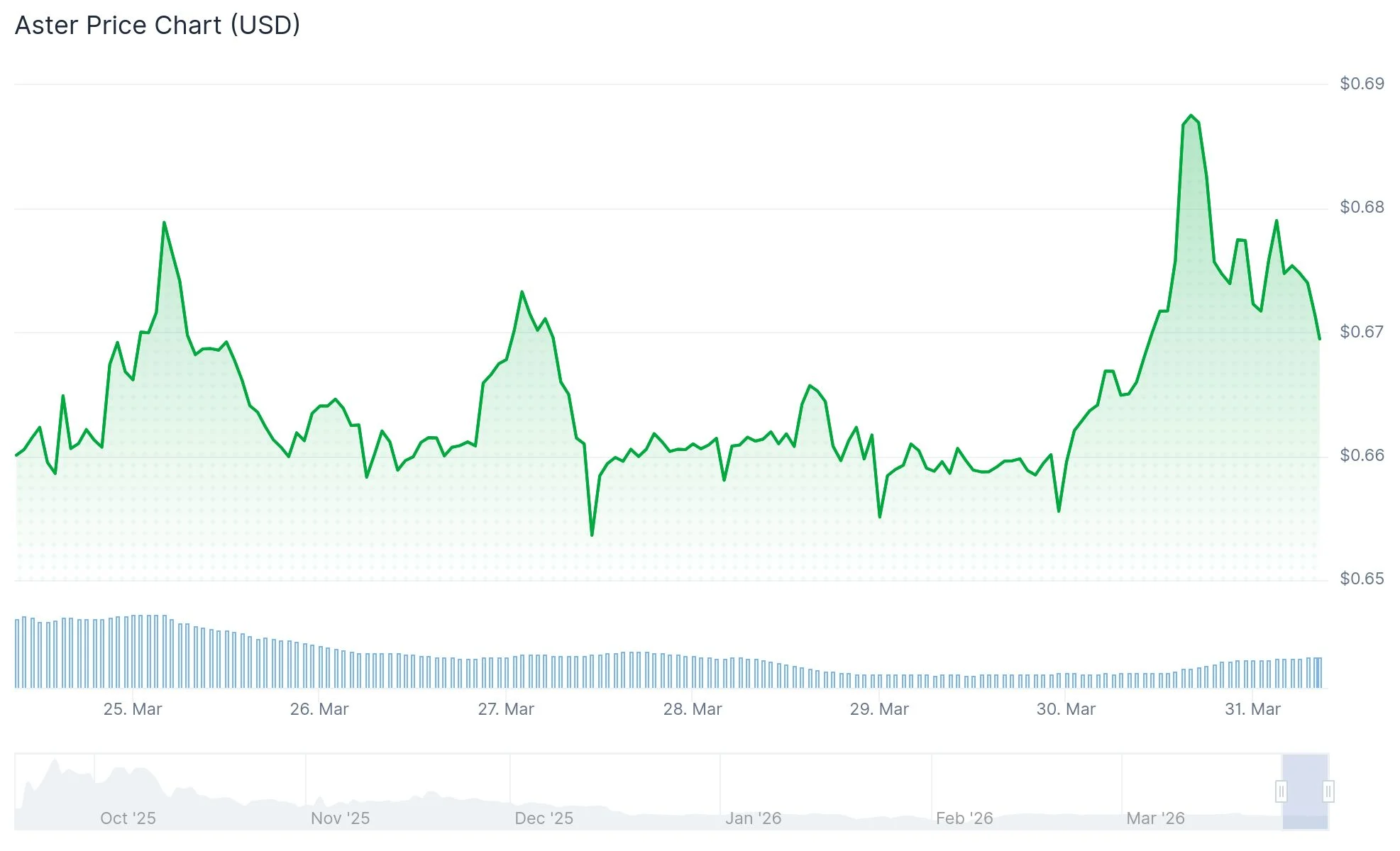
- ASTER has gained close to 3% over the last 24 hours
Aster, the decentralized derivatives platform supported by Binance founder Changpeng Zhao, has executed a comprehensive restructuring of its token distribution mechanism. The exchange revealed it is transitioning away from a predetermined monthly release schedule toward a staking-exclusive framework.
Under the previous system, Aster distributed 78.4 million ASTER tokens monthly — equivalent to approximately 1% of the 8 billion total supply — following a linear timetable. This figure will now decrease to a range of 1.8 million to 2.25 million tokens each month.
This represents a month-over-month reduction exceeding 97% in fresh token circulation.
The restructuring emerged as a direct response to stakeholder concerns surrounding token dilution. According to Aster, the primary objective is minimizing downward price pressure on ASTER.
Moving forward, ecosystem-designated tokens will exclusively enter circulation through staking incentives. The present distribution rate stands at 450,000 ASTER per weekly epoch.

Breaking Down the Revised Emission Framework
The 30% supply allocation designated for Ecosystem & Community purposes — initially subject to a 20-month linear vesting timeline — now serves as the exclusive reservoir for staking distributions. This pool additionally funds APX-to-ASTER conversions, development grants, promotional activities, and liquidity initiatives.
Aster operates a two-tier staking incentive structure. This encompasses a 150,000 ASTER Base APY component alongside a 300,000 ASTER Loyalty Rewards mechanism that increases payouts based on token lock duration and platform engagement levels.
The Aster Foundation’s 7% treasury reserve remains completely locked pending governance-sanctioned release protocols. Team allocations, representing 5% of supply, adhere to a 12-month cliff period followed by 40 months of gradual vesting.
Airdrop allocations consumed over 53% of total supply. During the token generation event on September 17, 2025, 8.8% became immediately accessible. Remaining airdrop tokens vest across 80 months.
Buyback Initiative Introduces Deflationary Mechanism
Aster simultaneously maintains a buyback program launched in December 2024. As much as 80% of daily platform revenue is allocated toward purchasing ASTER from secondary markets.
When paired with the dramatically reduced emission schedule, Aster indicates the token economics could shift toward net deflationary territory.
Aster unveiled its proprietary Layer-1 blockchain infrastructure earlier this month, dubbed Aster Chain. The network emphasizes privacy and throughput optimization for derivatives markets.
The platform faces competition from Hyperliquid and Lighter, both operating on proprietary blockchain architectures.
ASTER has climbed nearly 3% during the previous 24-hour period as of this writing.
Get 3 Free Stock Ebooks
Discover top-performing stocks in AI, Crypto, and Technology with expert analysis.
- Top 10 AI Stocks - Leading AI companies
- Top 10 Crypto Stocks - Blockchain leaders
- Top 10 Tech Stocks - Tech giants



