


Key Highlights
- Brent crude climbed above $115 per barrel, marking a nearly 60% increase throughout March, following missile strikes on Israel by Yemen’s Iran-aligned Houthi forces
- Bitcoin retreated to a monthly low of $64,991 before bouncing back to $67,347, registering a 1.2% gain
- Gold experienced a decline exceeding 13% in March despite a modest 0.9% recovery, pressured by dollar strength and rising crude prices
- Equity markets across Asia declined, with Japan’s Nikkei falling 2.8% and South Korea’s Kospi sliding 3%
- Trump indicated a potential agreement with Iran “could be soon,” though Tehran dismissed direct negotiations and alleged U.S. plans for ground operations
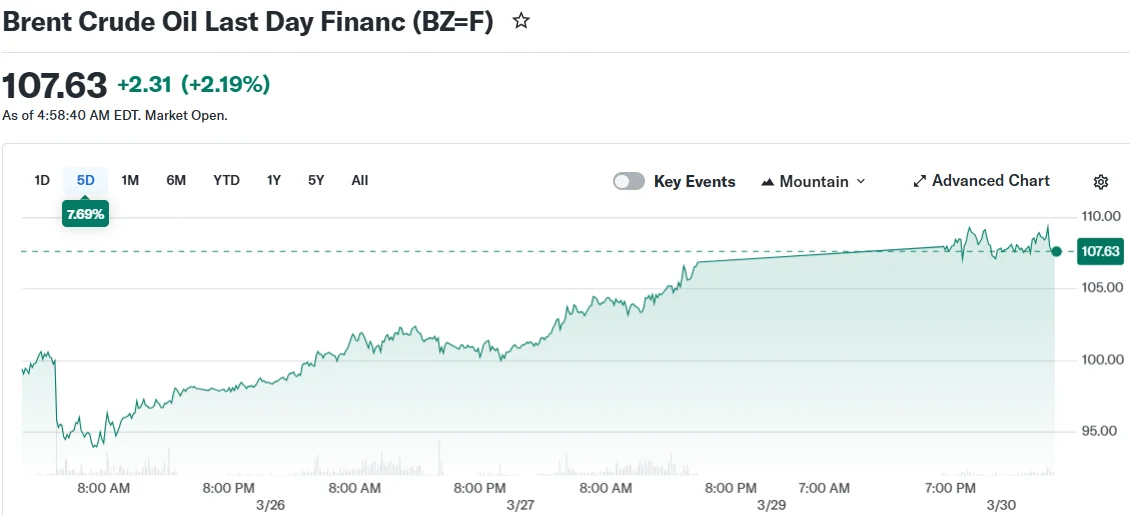
Crude oil markets surged past the $115 per barrel threshold on Monday following weekend missile launches by Yemen’s Houthi militia targeting Israel, significantly expanding the regional conflict in the Middle East. Brent crude advanced 2.7% to reach $115.55, while West Texas Intermediate climbed 1.8% to settle at $101.41.
The Iranian-supported Houthis announced they had unleashed a series of missiles and pledged additional strikes. Their involvement in the escalating tensions sparked renewed worries regarding maritime traffic navigating the Red Sea and the strategically vital Bab al-Mandeb strait, which serves as a crucial alternative pathway for petroleum exports from the Gulf region.
Brent has now registered an extraordinary climb of nearly 60% during March alone. This dramatic surge in petroleum prices comes on the heels of Iran’s decision to obstruct the Strait of Hormuz, a critical waterway responsible for transporting approximately 20% of the world’s oil supply.
The United States confirmed the deployment of 3,500 military personnel to the area via the USS Tripoli warship. Israeli defense forces reported conducting offensive operations against Iranian targets in the capital city during the weekend.
Iran retaliated by targeting aluminum production facilities in both Bahrain and the United Arab Emirates. Aluminium Bahrain acknowledged that its operations came under attack. Emirates Global Aluminium disclosed that its Abu Dhabi facility suffered substantial damage from coordinated drone and missile assaults. Three-month aluminum contracts on the London Metal Exchange surged 5.4% to reach $3,461 per metric ton, accumulating over 10% gains for the month.

Equity Markets Face Downward Pressure
Asian stock indices predominantly declined. South Korea’s Kospi tumbled 3%, pulled down by semiconductor and automotive sector losses. Japan’s Nikkei descended 2.8%. Hong Kong’s Hang Seng retreated 0.9%.
European trading sessions showed mixed results. Germany’s DAX dipped 0.2% while France’s CAC 40 remained unchanged. The UK’s FTSE 100 inched up 0.1%, bolstered by energy and commodity-related equities.
U.S. equity futures diverged from the global trend, with contracts linked to the Dow, S&P 500, and Nasdaq all advancing approximately 0.4%.
U.S. Treasury yields declined amid mounting economic growth apprehensions. The 10-year yield retreated 5.2 basis points to 4.387%. LBBW analysts projected that economies across the Atlantic could forfeit roughly a quarter percentage point in annual growth.
Cryptocurrency and Precious Metals Movement
Bitcoin plunged to a monthly nadir of $64,991 during overnight trading before staging a comeback. The digital currency traded 1.2% higher at $67,347 by early Monday sessions.
Gold futures advanced 0.9% to $4,533.30 per ounce, although the precious metal remains down over 13% for the month. ANZ analysts noted that gold has declined more than 15% in March, influenced partly by liquidations of gold-backed exchange-traded funds and strengthening of the U.S. dollar.
Trump informed reporters aboard Air Force One that an arrangement with Iran “could be soon,” referencing what he characterized as “very reasonable” emerging Iranian leadership. He mentioned that Iran had permitted 20 oil tankers to transit through the Strait of Hormuz. Pakistan announced its readiness to facilitate negotiations between the U.S. and Iran.
Tehran rebuffed direct diplomatic engagement and charged Washington with covertly preparing for ground military operations. Trump also disclosed to the Financial Times his willingness to assume control of Iranian petroleum assets, while the Wall Street Journal documented U.S. consideration of seizing Iran’s uranium reserves.
OCBC analysts projected Brent crude to maintain levels around $100 per barrel through the middle of the year before gradually moderating during the latter half of 2026.
Get 3 Free Stock Ebooks
Discover top-performing stocks in AI, Crypto, and Technology with expert analysis.
- Top 10 AI Stocks - Leading AI companies
- Top 10 Crypto Stocks - Blockchain leaders
- Top 10 Tech Stocks - Tech giants



