


Key Takeaways
- SK Hynix submitted a confidential filing to the SEC for an American Depositary Receipt listing, with plans to finalize by 2026
- The memory chip manufacturer aims to generate between $6.7 billion and $10 billion through the U.S. offering
- Capital raised will support AI-driven growth initiatives, including the Yongin HBM production cluster and the Indiana advanced packaging plant
- During the annual shareholder gathering, CEO Kwak Noh-Jung announced plans to accumulate over 100 trillion won in net cash for strategic long-term investments
- Shares of SK Hynix climbed more than 5% in Seoul trading on Wednesday; the stock has rallied approximately 60% since the start of the year
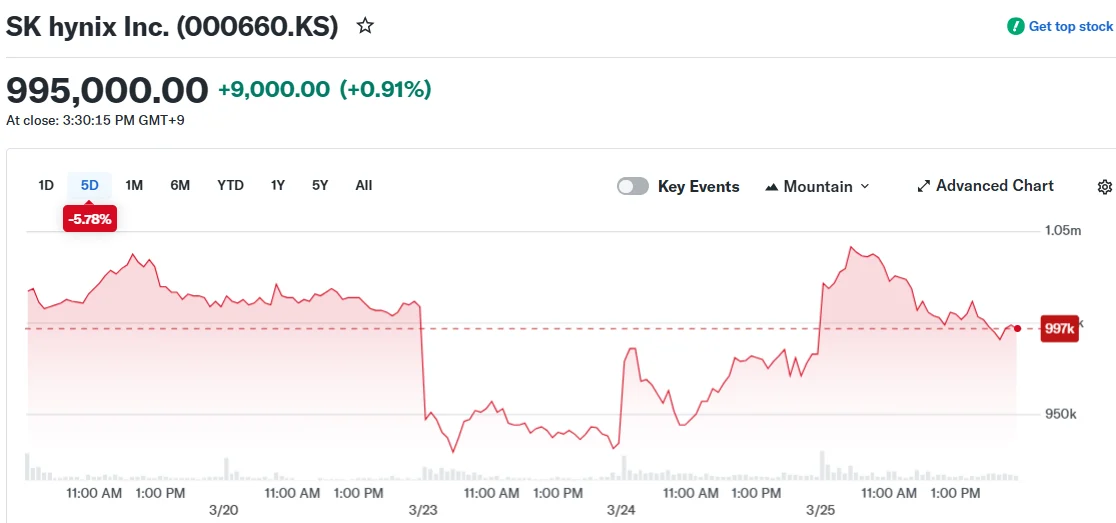
Shares of SK Hynix jumped over 5% during Wednesday’s Seoul trading session following confirmation that the memory chip manufacturer had submitted a confidential filing to the U.S. Securities and Exchange Commission for a potential American market debut. The stock has climbed approximately 60% year to date and skyrocketed 274% throughout 2025.
The company intends to list American Depositary Receipts on a U.S. exchange and is working toward finalizing the offering before the end of 2026. According to SK Hynix, precise details regarding the offering size and timeline remain under development.
Reports from South Korean financial media indicate the chipmaker is seeking to raise between 10 trillion won and 15 trillion won — approximately $6.7 billion to $10 billion based on current foreign exchange rates.
SK Hynix initially disclosed its intentions to pursue a U.S. market listing in December. The strategic initiative aims to secure additional capital for manufacturing capacity expansion as global appetite for artificial intelligence memory chips continues to accelerate.
As the dominant global provider of high-bandwidth memory technology, SK Hynix supplies critical components for AI processing units manufactured by clients including Nvidia. The surge in HBM demand has created significant supply constraints worldwide while driving pricing upward.

Major Capital Investments Underway
The capital generated from the U.S. listing is slated to finance the company’s HBM semiconductor production complex in Yongin, South Korea, including the $15 billion facility currently under construction, along with its advanced chip packaging operation in Indiana. Leadership is also evaluating the establishment of an AI-focused investment division in Silicon Valley.
During Wednesday’s annual shareholder assembly, Chief Executive Kwak Noh-Jung revealed that SK Hynix intends to accumulate more than 100 trillion won in net cash reserves to support long-range strategic capital deployment.
The manufacturer’s newest M15X fabrication facility in Cheongju, South Korea, reached completion earlier than originally projected. Development continues on both the Yongin manufacturing cluster and the Indiana packaging site.
In a communication to investors, company leadership highlighted “unprecedented growth” throughout the memory semiconductor sector, characterizing memory as “a key-value product that determines the performance of AI systems.”
Record-Breaking Equipment Purchase from ASML
Merely 24 hours prior to announcing the SEC filing, SK Hynix disclosed plans to acquire 11.95 trillion won ($7.97 billion) in cutting-edge semiconductor manufacturing equipment from ASML — representing one of the largest publicly announced equipment orders in industry history.
The sequential timing of the ASML equipment deal and the regulatory filing signals an aggressive strategy to cement the company’s dominance in the HBM sector while competitors Samsung and Micron work to expand their market positions.
Samsung Electronics is actively working to regain competitive standing in the HBM market, while Micron has expanded its footprint as a domestically-based U.S. supplier in the artificial intelligence memory segment.
SK Hynix indicated it will provide additional disclosure once final terms of the American listing are determined, or no later than six months following the initial regulatory submission.
The planned ADR offering will utilize existing shares rather than issuing new equity, a structure designed to protect current shareholder value.
Get 3 Free Stock Ebooks
Discover top-performing stocks in AI, Crypto, and Technology with expert analysis.
- Top 10 AI Stocks - Leading AI companies
- Top 10 Crypto Stocks - Blockchain leaders
- Top 10 Tech Stocks - Tech giants



