


Key Takeaways
- Elon Musk announced Terafab, a collaborative semiconductor manufacturing initiative involving Tesla, SpaceX, and xAI, planned for construction at Giga Texas in Austin.
- The facility will focus on producing 2-nanometer chips designed for Tesla’s Full Self-Driving technology, Optimus humanoid robots, and SpaceX satellite systems.
- Preliminary cost projections sit at $20–$25 billion, with these expenses excluded from Tesla’s current 2026 capital expenditure forecasts.
- Morgan Stanley analysts estimate the complete investment could balloon to $35–$45 billion, with production unlikely to commence before mid-2028.
- Tesla shares gained 3.5% on Monday, finishing at $380.85.
During a Saturday evening presentation at a decommissioned power facility in Austin, Texas, Elon Musk introduced Terafab. This ambitious semiconductor manufacturing project represents a collaboration among Tesla, SpaceX, and xAI, designed to consolidate the entire chip production process within a single location.
Musk delivered a direct message: existing semiconductor manufacturers such as TSMC and Samsung cannot scale production quickly enough to meet the requirements of Tesla and SpaceX. “We either build the Terafab or we don’t have the chips,” he declared.
The proposed facility will occupy the North Campus section of Giga Texas, housed in a structure that would surpass even the current Giga Texas building — already recognized as one of the planet’s largest manufacturing facilities.
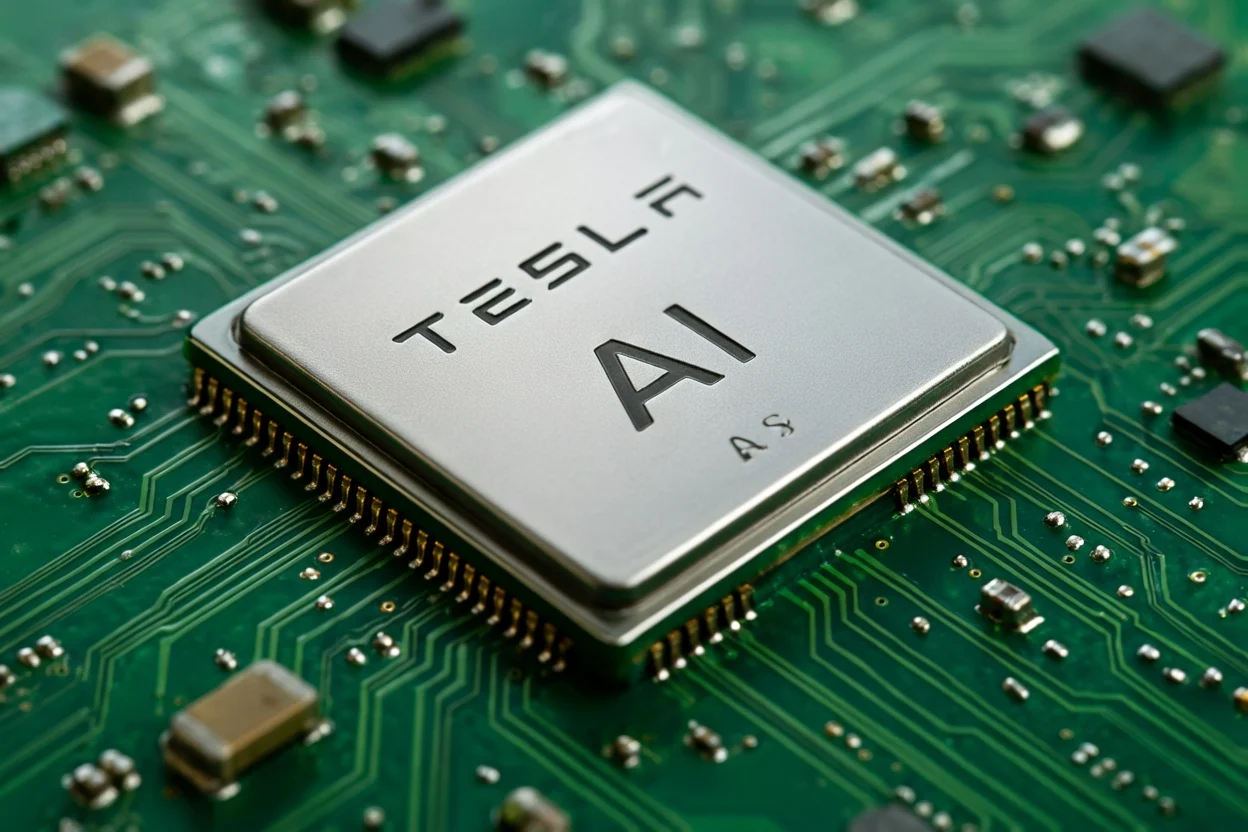
Terafab is designed to manufacture two distinct chip categories. The first is an edge-inference processor intended for Tesla’s Full Self-Driving capabilities, Optimus humanoid robots, and Robotaxi operations. The second variant features space-hardened specifications for SpaceX satellites and orbital computing infrastructure.
Tesla shares finished Monday’s trading session at $380.85, reflecting a 3.5% increase. Meanwhile, the S&P 500 advanced 1.2% and the Dow Jones Industrial Average rose 1.4%, as broader markets rallied following President Trump’s announcement regarding diplomatic discussions between the U.S. and Iran aimed at reducing Middle East tensions.

Humanoid Robot Production Fuels Chip Demand
The projections surrounding Optimus are striking. Morgan Stanley’s Andrew Percoco highlighted that Giga Texas is anticipated to possess manufacturing capacity for 10 million humanoid robots annually. This production volume would necessitate 20 million chips — approximately six times Tesla’s present chip requirements across its entire vehicle lineup.
Should Tesla achieve its extended goal of producing 100 million Optimus robots per year, chip demand would surge to over 200 million units — exceeding 50 times the company’s current combined automotive and Robotaxi chip consumption.
Musk articulated his vision to generate more than one terawatt of AI computing capacity annually. His projection suggests that 80% of Terafab’s production will eventually support space-based operations, where SpaceX intends to deploy AI computing infrastructure currently managed by terrestrial hyperscale providers.
Wall Street Response Remains Measured but Optimistic
Barclays analyst Dan Levy characterized the magnitude of Musk’s objectives as dramatically exceeding market expectations. “With a target of 1 terawatt of compute capacity, it would be 50 times current global AI compute,” Levy observed.
Morgan Stanley’s Percoco endorsed Terafab as a sound strategic initiative while highlighting significant financial considerations. His analysis projects total capital requirements between $35–$45 billion. The initial $20–$25 billion estimate announced by Musk remains separate from Tesla’s existing 2026 capital expenditure framework.
Terafab aims to implement 2-nanometer fabrication technology — representing the cutting edge of semiconductor manufacturing, which TSMC has only recently begun producing at commercial scale. Morgan Stanley anticipates that even under an accelerated construction timeline, initial chip production would not materialize before mid-2028.
Musk refrained from providing specific construction schedules or production benchmarks. He indicated the initiative would commence with prototyping phases and infrastructure validation.
Prior to Monday’s trading, Tesla stock had declined 18% year-to-date while posting a 48% gain over the trailing twelve months. The shares currently trade at approximately 190 times projected 2026 earnings.
SpaceX completed its merger with xAI earlier this year and could potentially pursue an initial public offering as early as this spring.
Get 3 Free Stock Ebooks
Discover top-performing stocks in AI, Crypto, and Technology with expert analysis.
- Top 10 AI Stocks - Leading AI companies
- Top 10 Crypto Stocks - Blockchain leaders
- Top 10 Tech Stocks - Tech giants



