



TLDR
- Crude markets recovered Tuesday following Monday’s 11% decline, with Brent reaching above $102 per barrel
- Tehran rejected Washington’s assertions that diplomatic discussions were taking place
- The critical Strait of Hormuz continues its blockade, eliminating access to 20% of worldwide crude exports
- Analysts forecast prices will remain within an $85–$110 range until shipping lanes reopen
- Nations including Slovenia, Chile, Japan, and the Philippines have implemented fuel conservation measures
Crude markets experienced a significant recovery Tuesday following the previous session’s dramatic selloff. Brent benchmark prices advanced to approximately $102 per barrel, while the U.S. West Texas Intermediate marker gained roughly 3% to reach around $90.
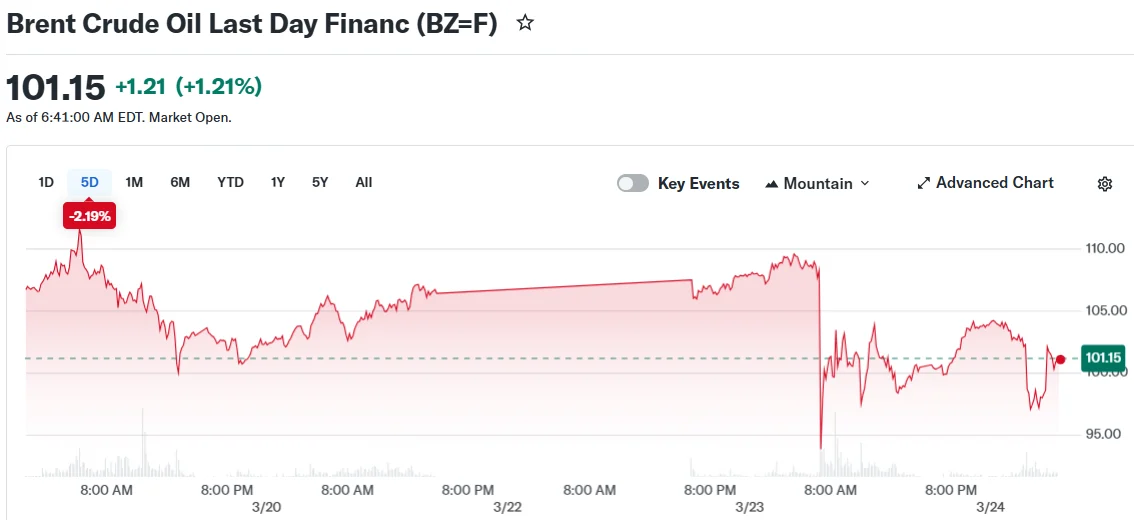
The previous day’s market decline followed President Trump’s announcement suggesting Washington and Tehran had entered discussions. This assertion temporarily pushed crude valuations downward. However, Iran’s Foreign Ministry swiftly rejected these claims, with a prominent Iranian parliamentary official stating unequivocally: “No negotiations have been held with the U.S.”
This contradiction triggered a renewed upward movement in energy markets.
The central challenge continues to be the Strait of Hormuz situation. This critical maritime passage links Persian Gulf production zones to international oil exports and typically facilitates approximately 20% of worldwide crude shipments. Tehran has maintained its blockade since tensions with Washington and Israel intensified.
Brent valuations have increased approximately 40% during the current month, fueled by concerns that ongoing conflict could trigger extended energy supply disruptions. Diesel and aviation fuel costs have accelerated beyond crude price increases.
Worldwide Consequences Intensifying
Nations across continents are confronting the crisis’s effects. Slovenia became the initial European Union member to implement fuel distribution restrictions. Chile announced plans to increase fuel costs by as much as 50%. Japan initiated a comprehensive assessment of its petroleum supply infrastructure.

Throughout Asia, China’s premier refining company announced it would prioritize domestic distribution. The Philippines cautioned that grounding aircraft due to aviation fuel scarcity represented a “distinct possibility.”
New Zealand unveiled weekly financial assistance credits for approximately 150,000 households to offset escalating fuel expenses.
Goldman Sachs cautioned that sustained supply disruptions would ultimately require demand destruction to restore market equilibrium.
Diplomatic Communications Remain Ambiguous
Trump had earlier threatened military strikes against Iran’s energy facilities unless the Strait achieved full operational status within 48 hours. He subsequently extended that deadline by five days. He also floated the possibility of joint U.S.-Iranian administration of the Strait, indicating it might open “very soon.”
Iran’s deputy parliamentary speaker declared the Strait would not return to previous operational conditions and that negotiations with Washington were not occurring.
Tehran is reportedly examining communications from Washington transmitted through third-party channels, according to CBS News citing a senior Iranian representative. Energy installations in Isfahan, located in central Iran, sustained damage during the weekend.
Saudi Arabia informed Washington of its readiness to launch strikes against Iran should its own utilities and water systems face attack. Intelligence suggests Saudi Crown Prince Mohammed bin Salman is approaching a decision regarding potential military participation.
RBC Capital Markets analysts observed that physical vessel movements — rather than diplomatic rhetoric — would ultimately shape actual petroleum market conditions.
A limited number of tankers have successfully navigated through the Persian Gulf recently, though the majority of Strait traffic remains suspended.
Macquarie Group energy analyst Vikas Dwivedi suggested that even with de-escalation, crude prices would likely maintain a floor between $85 and $90, with upward drift toward $110 until the Strait achieves complete reopening.
Get 3 Free Stock Ebooks
Discover top-performing stocks in AI, Crypto, and Technology with expert analysis.
- Top 10 AI Stocks - Leading AI companies
- Top 10 Crypto Stocks - Blockchain leaders
- Top 10 Tech Stocks - Tech giants



