


Key Takeaways
- GameStop (GME) announces quarterly results Tuesday following a 13% gain in 2026, with Michael Burry recently taking a stake
- Major U.S. equity indexes have all turned negative for the year, with the Nasdaq down approximately 7%
- Conflict in Iran has driven oil prices past $100 per barrel, with Brent crude hovering near $107
- While the Federal Reserve maintained current rates, bond market pricing now suggests a 50% probability of a rate increase by October
- Nvidia (NVDA) and Micron (MU) shares declined following earnings beats, signaling AI sector skepticism
GameStop (GME) will unveil its quarterly financial performance on Tuesday. Shares have climbed 13% year-to-date in 2026, receiving a boost after word emerged that prominent investor Michael Burry established a position in the gaming retailer. The company’s previous quarterly filing showed declining revenue.
Additional earnings reports this week include pet product seller Chewy, payroll services company Paychex, and residential builder KB Home. Two Chinese autonomous vehicle firms, Pony AI and Weride, will also announce results. Both companies have seen their stock values plummet nearly 30% since January.
The week concludes Friday with the University of Michigan’s consumer sentiment index. This data will provide insight into American consumer confidence as fuel costs climb and tariff policies remain unchanged.
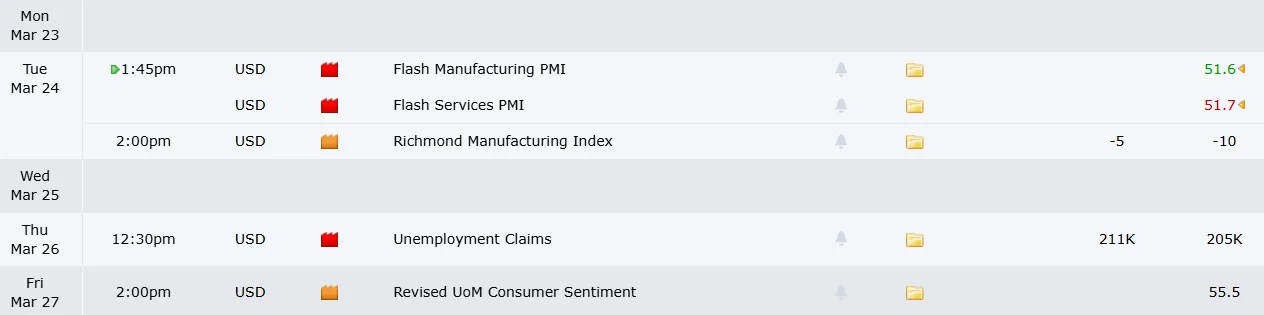
Wednesday delivers the import price index reading. This follows the previous week’s producer price data, which revealed an unexpected surge in wholesale inflation.
Crude Markets Maintain Triple-Digit Levels
The Iranian military conflict has now reached its fourth week. Shipping activity through the Strait of Hormuz has essentially ceased. Brent crude finished Friday trading near $107 per barrel, representing a 3% weekly increase. West Texas Intermediate settled around $98.30.

Prices experienced a brief Thursday decline following Israeli Prime Minister Benjamin Netanyahu’s statement that Israel would assist in reopening the Strait of Hormuz. However, the drop proved temporary.
QatarEnergy’s chief executive informed Reuters that repairs to its Ras Laffan LNG facility could require several years. President Trump stated Friday, “We can have a dialogue, but I don’t want to do a ceasefire.”
The virtual shutdown of Strait of Hormuz shipping lanes has disrupted worldwide energy supplies and intensified inflation concerns.
Central Bank Pauses but Messaging Turns Cautious
The Federal Reserve maintained existing interest rates last week, meeting market expectations. However, Chair Jerome Powell’s remarks adopted a more guarded tone than investors anticipated.
Powell acknowledged that escalating oil prices stemming from the Iran situation could elevate inflation. He characterized the upcoming six weeks of economic data as “very important.”
According to Bloomberg data, bond market participants now assign a 50% likelihood to a rate hike arriving by October. This represents a dramatic shift from early-year expectations that favored rate reductions.
The Fed’s official forecasts continue to project one rate cut this year and another in 2027. Yet the messaging clearly points toward an extended holding pattern.
Nvidia finished the week down roughly 4%, despite CEO Jensen Huang’s announcement projecting $1 trillion in revenue from the company’s Grace Blackwell and Vera Rubin chip platforms. Micron similarly fell approximately 5% following disclosure of a $5 billion capital expenditure increase.
Jefferies technology analyst Jeffrey Favuzza observed this marks the second consecutive earnings season where positive results triggered share price declines. Bank of America analyst Neha Khoda characterized the AI sector as entering its “show me” phase, where investors now demand evidence of actual profitability.
Thursday brings initial jobless claims data, providing fresh information on U.S. employment conditions.
Get 3 Free Stock Ebooks
Discover top-performing stocks in AI, Crypto, and Technology with expert analysis.
- Top 10 AI Stocks - Leading AI companies
- Top 10 Crypto Stocks - Blockchain leaders
- Top 10 Tech Stocks - Tech giants



