



Key Takeaways
- Bitcoin declined to approximately $68,652, registering a 0.7% loss on Monday amid heightened Iran conflict concerns.
- President Trump issued a 48-hour ultimatum to Iran regarding the Strait of Hormuz, threatening military action.
- BTC remains down more than 20% year-to-date but has gained approximately 6% over the last 30 days.
- Critical support level established at $67,250, with potential downside targets at $65,000 and $63,500 if breached.
- Spot Bitcoin ETFs attracted $95.18 million in net inflows during the March 16–20 period, continuing a four-week positive streak.
Bitcoin retreated to $68,652 during Monday’s trading session, shedding 0.7% as escalating geopolitical tensions surrounding the U.S.-Israel standoff with Iran triggered a flight from risk assets. The decline continued weekend losses and pushed BTC further from its recent monthly peak above $72,000.
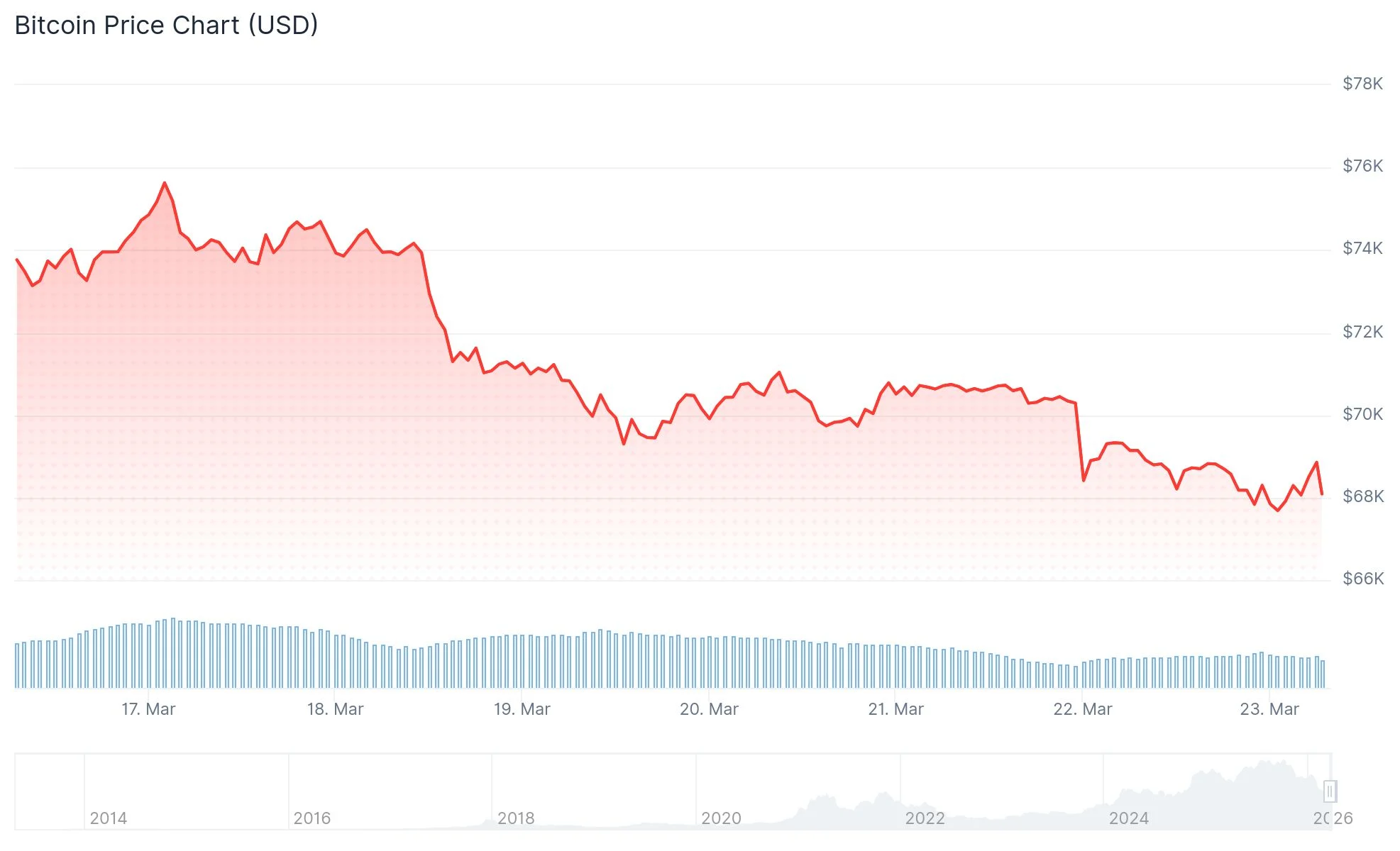
The market downturn affected multiple asset classes. Equities, precious metals, and foreign exchange markets all experienced declines as Middle East conflict concerns intensified.
President Donald Trump delivered a 48-hour deadline to Iran over the weekend, demanding immediate reopening of the Strait of Hormuz or facing strikes on vital energy facilities. Tehran countered with warnings of complete strait closure and potential attacks on energy and water systems throughout Gulf states.
The geopolitical standoff has now persisted for four consecutive weeks without resolution in sight.
Technical Analysis of Bitcoin’s Current Position
Bitcoin breached key levels at $71,200 and $70,000, reaching an intraday low of $67,343 before staging a modest bounce. The cryptocurrency now trades beneath its 100-hour simple moving average, with a descending trend line establishing resistance near $69,200.

For bullish momentum to return, BTC must overcome resistance at $69,200 and establish a foothold above $70,000. Successful breakout scenarios could target $71,650 followed by $72,800.
Should the current weakness persist, immediate support awaits at $67,250. Additional downside levels include $66,500 and $65,000, with $63,500 representing a critical demand zone.
BTC Performance Compared to Gold
While experiencing recent declines, Bitcoin has outperformed gold on a monthly basis. BTC has appreciated roughly 6% over the past 30 days, whereas gold has retreated approximately 18% from its late-January all-time high, pressured by widespread profit-taking.
Gold has notably failed to capture traditional safe-haven flows during the Iran crisis, partially due to investor concerns that conflict escalation could fuel inflation and drive interest rates higher.
On a year-to-date basis, however, Bitcoin remains underwater by more than 20%, while gold trades near breakeven levels.
Alternative cryptocurrencies also posted losses Monday. Ether declined 2.2% to $2,061.77, XRP fell 1.9% to $1.3853, and Dogecoin dropped 1.3%.
According to Wu Blockchain, Bitcoin spot ETF products registered net inflows totaling $95.18 million during the March 16–20 trading week, extending the positive flow streak to four consecutive weeks.
Get 3 Free Stock Ebooks
Discover top-performing stocks in AI, Crypto, and Technology with expert analysis.
- Top 10 AI Stocks - Leading AI companies
- Top 10 Crypto Stocks - Blockchain leaders
- Top 10 Tech Stocks - Tech giants



