



TLDR
- Major U.S. equity indexes are heading toward their fourth consecutive week of declines
- The Dow faces its longest losing streak since early 2023
- Brent crude oil hovers around $108 per barrel amid supply concerns
- Speculation about potential U.S. military action at Iran’s Kharg Island added to market anxiety
- Cryptocurrency markets including Bitcoin and XRP posted losses alongside equities
Major U.S. equity benchmarks tumbled on Friday, March 20, extending their decline into a fourth consecutive week as elevated crude oil prices and escalating Middle East tensions continued to weigh on investor sentiment.
The Dow Jones Industrial Average shed approximately 300 points, representing a decline of roughly 0.7% for the session. The S&P 500 retreated nearly 1%, while the tech-heavy Nasdaq Composite posted a steeper loss of about 1.3%.
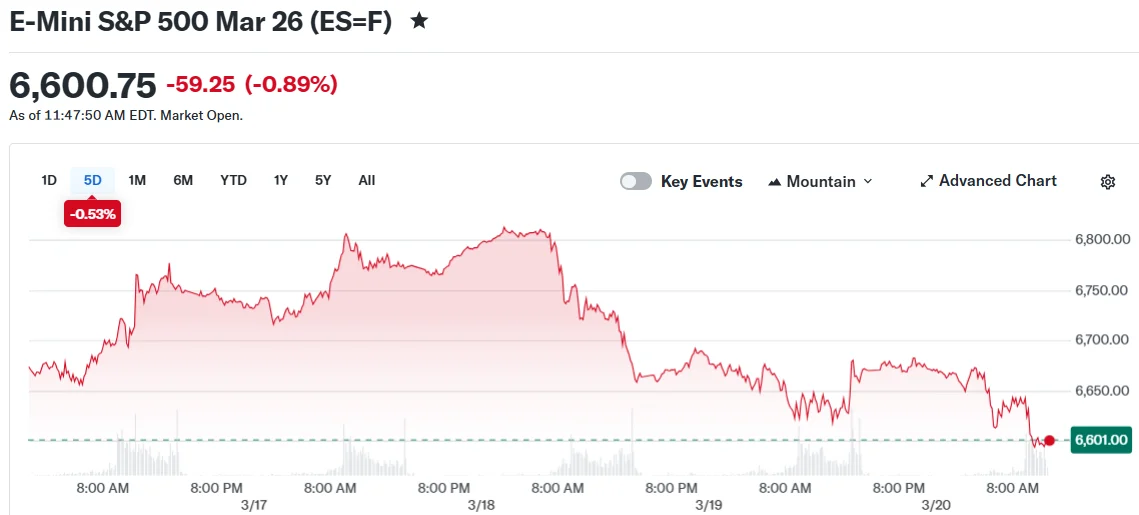
Should the Dow complete a fourth consecutive week in negative territory, it would represent the index’s most prolonged downturn since February 24, 2023. The S&P 500’s last four-week consecutive decline occurred in March 2025.
The Nasdaq previously experienced a five-week slide earlier this year and is once again flirting with correction territory, joining the Dow in this precarious position.
Investor anxiety has persisted since U.S. and Israeli forces launched coordinated military operations against Iran on February 28. Crude oil prices have remained stubbornly high throughout this period, creating a persistent headwind for market sentiment.

Brent crude futures traded near the $108 per barrel mark on Friday, while West Texas Intermediate futures hovered around $96. Both oil benchmarks experienced volatile trading sessions with multiple reversals.
Market jitters intensified following an Axios report suggesting the Trump administration is evaluating strategies to either occupy or blockade Kharg Island, Iran’s critical oil export terminal, as leverage to compel Tehran to reopen the Strait of Hormuz to commercial shipping.
Iran continued launching attacks against neighboring Persian Gulf states on Friday. Market analysts cautioned that existing infrastructure damage will likely sustain elevated oil prices for an extended period.
Why Oil Prices Are Driving Markets
Paul Hickey, co-founder of Bespoke Investment Group, noted that Friday’s market trajectory would “depend almost entirely on the price of oil.” With minimal economic data releases or earnings reports on the calendar, geopolitical developments remained the primary market catalyst.
Friday’s session coincided with triple witching, a quarterly occurrence when stock options, stock index futures, and stock index options simultaneously expire. These events typically generate heightened market volatility.
David Laut, chief investment officer at Kerux Financial, suggested the triple witching phenomenon could amplify volatility given the market’s already fragile condition entering the session.
The S&P 500 breached its 200-day moving average on Thursday, a technical threshold closely monitored by market technicians. Frank Cappelleri of CappThesis observed that while a single breach of this level doesn’t necessarily signal continued losses, it represents a critical juncture where traders reassess their appetite for buying opportunities.
Crypto Also Takes a Hit
Equity markets weren’t alone in their struggles this week. Bitcoin and XRP both posted declines, contributing to broader cryptocurrency market weakness. Meanwhile, the SEC endorsed a Nasdaq proposal for securities tokenization, a development that generated interest within the crypto community but failed to provide meaningful price support.
Both the Dow and Nasdaq concluded the week approaching correction territory, with market participants scrutinizing every Middle East headline for trading signals.
Get 3 Free Stock Ebooks
Discover top-performing stocks in AI, Crypto, and Technology with expert analysis.
- Top 10 AI Stocks - Leading AI companies
- Top 10 Crypto Stocks - Blockchain leaders
- Top 10 Tech Stocks - Tech giants



