



TLDR
- Precious metal advanced Thursday following Israeli military operations in Tehran, though greenback resilience limited the advance
- The yellow metal fluctuated between $5,121 and $5,156 per ounce during Thursday’s session, maintaining a nearly 20% gain for 2026
- January 2026 saw gold reach an all-time peak of $5,594.82, with another surge past $5,400 occurring when U.S.-Israeli military operations against Iran commenced
- Market participants anticipate the Federal Reserve will maintain current interest rates at the March 18 policy meeting
- Kevin Warsh, previously a Fed Governor, received President Trump’s nomination for Federal Reserve chair position on Wednesday
The precious metal market experienced conflicting pressures Thursday as geopolitical uncertainty in the Middle East clashed with currency market dynamics that typically constrain bullion’s advance.
During Thursday’s trading session, spot gold fluctuated within a range of $5,121 to $5,156 per ounce. Intraday trading saw the metal briefly surpass the $5,200 mark before retreating.
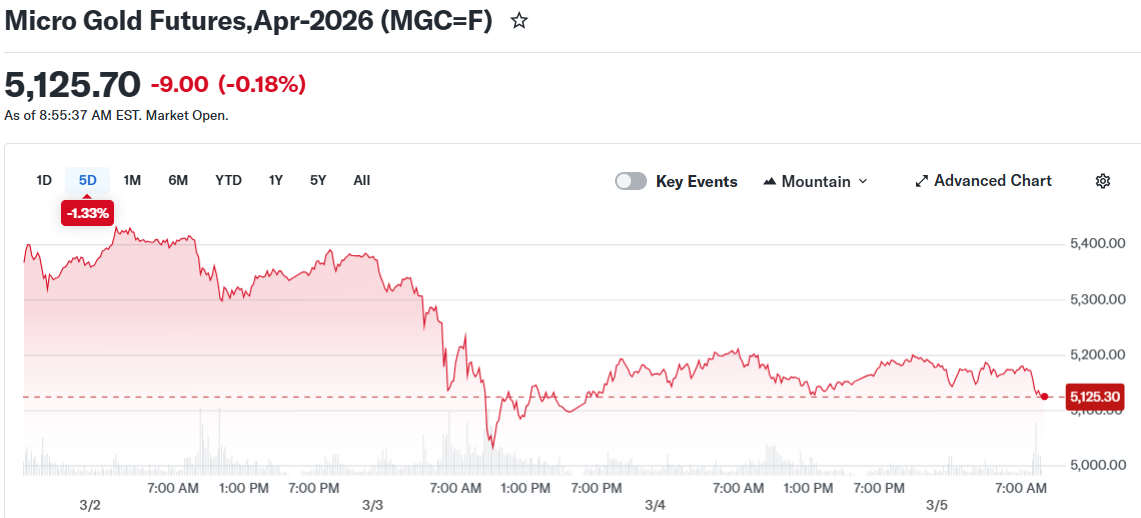
The yellow metal has delivered impressive returns in 2026, advancing nearly 20% since January. Its peak performance came earlier in the year when it touched $5,594.82 per ounce.
Early this week, as military operations between the United States, Israel, and Iran intensified, gold surged beyond $5,400 on Monday. This movement reflected traditional flight-to-quality behavior among market participants seeking portfolio protection.
Thursday witnessed Israel conducting extensive military strikes against Tehran. Israeli officials stated these operations focused on targeting critical infrastructure controlled by Iranian government entities.

These strikes followed Iranian missile launches that forced millions of Israeli civilians to seek shelter.
Safe-Haven Demand vs. Dollar Strength
The U.S. dollar appreciated approximately 0.2% Thursday, momentarily retreating from levels not witnessed in three months. Currency strength typically constrains gold appreciation since it elevates the metal’s cost for international purchasers.
Hamad Hussain, serving as climate and commodities economist at Capital Economics, noted that ongoing hostilities create contradictory market dynamics for bullion. While security concerns elevate demand, potential energy price increases could fuel inflationary pressures and diminish prospects for monetary easing — factors that would negatively impact gold.
Gold generates no yield, making it more attractive during periods of low interest rates.
Fed Policy in Focus
President Trump formally announced his selection of Kevin Warsh, a former Federal Reserve Governor, to lead the central bank on Wednesday.
The Federal Reserve published its current Beige Book Wednesday, revealing modest expansion in U.S. economic activity, continued price increases, and steady labor market conditions.
According to CME Group’s FedWatch tool, market participants broadly anticipate the central bank will maintain its current policy stance at the upcoming March 18 meeting.
Market observers are closely monitoring Thursday’s weekly unemployment claims figures and Friday’s February employment report. These data releases could provide additional insight into future monetary policy direction.
Worries surrounding escalating energy costs are contributing to inflation anxiety throughout international financial markets.
Silver advanced 0.8% to reach $84.10 per ounce Thursday. Platinum posted nearly 1% gains, reaching $2,168.05, while palladium declined 0.9% to $1,659.35.
Get 3 Free Stock Ebooks
Discover top-performing stocks in AI, Crypto, and Technology with expert analysis.
- Top 10 AI Stocks - Leading AI companies
- Top 10 Crypto Stocks - Blockchain leaders
- Top 10 Tech Stocks - Tech giants



