



TLDR
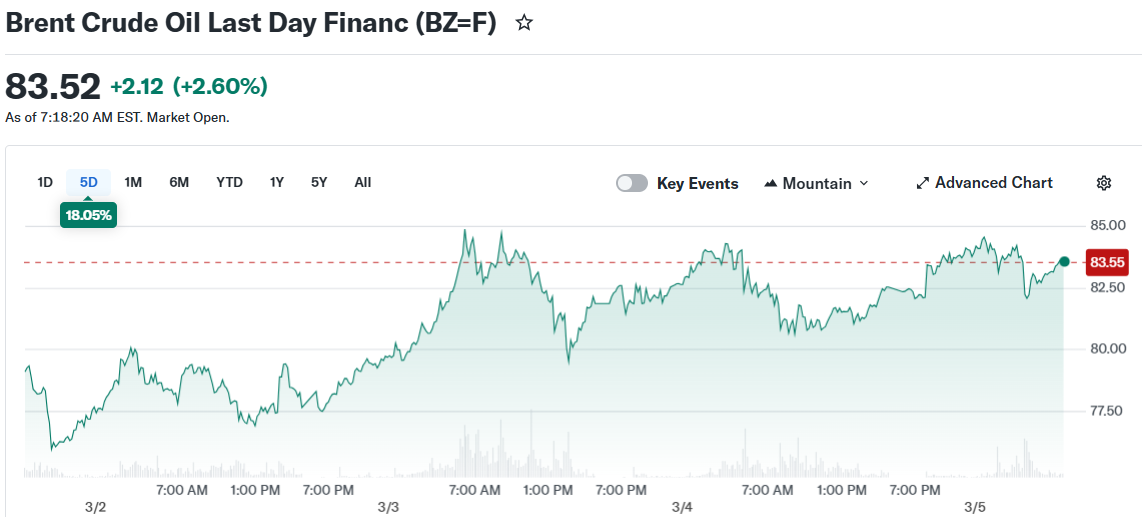
- Brent crude surged 2.6% to reach $83.54 per barrel while WTI jumped 3.1% to $76.96 Thursday
- Shipping activity through the Strait of Hormuz plummeted more than 95% amid Iranian actions
- Iraq invoked force majeure, slashing production by approximately 1.5 million barrels daily
- Market experts project Brent could surge to $140/barrel under full blockade conditions; $100 under partial disruption
- Beijing ordered refiners to stop fuel exports; Tokyo considered tapping emergency oil stockpiles
Global energy markets watched Middle East tensions intensify Thursday as the regional crisis reached its sixth consecutive day, propelling crude oil prices to seven-month peaks not seen since July 2024.
Brent crude benchmark futures advanced 2.6% to settle at $83.54 per barrel. The U.S. West Texas Intermediate benchmark gained 3.1% to close at $76.96. The rally marks the fifth consecutive trading session of gains for both contracts.
Hostilities erupted over the weekend following joint military operations by the United States and Israel targeting Iranian assets. Tensions escalated further when U.S. naval forces destroyed an Iranian military vessel positioned near Sri Lanka in international maritime territory.
Lawmakers in the U.S. Senate rejected a resolution Wednesday that would have mandated Congressional authorization before continuing aerial military operations. The vote proceeded primarily along partisan divisions.
Iranian authorities dismissed media accounts suggesting Tehran’s intelligence apparatus had initiated diplomatic channels with Washington. Officials in Iran characterized these reports as “pure falsehood.”

The Strait of Hormuz Blockade
The strategic Strait of Hormuz waterway stands at the epicenter of the supply disruption. Approximately 20 million barrels of oil and petroleum products transited this chokepoint daily throughout 2025, based on International Energy Agency figures.
Vessel monitoring systems tracked by Bloomberg reveal maritime traffic has collapsed by more than 95% through the critical passage. The overwhelming majority of commercial shipping operators are now circumventing the corridor completely.
Baghdad officially declared force majeure on certain crude oil shipments as a consequence of the transportation crisis. Iraqi authorities confirmed to Reuters that the nation reduced production volumes by nearly 1.5 million barrels per day.
As OPEC’s second-largest petroleum producer, Iraq’s supply curtailment represents a significant factor amplifying current market price escalation.
A senior Iranian military official stated on government-controlled television that Tehran does “not believe in closing” the strategic waterway. Regardless of this statement, virtually no commercial vessel operators are willing to risk passage.
The United States government has floated proposals to offer insurance coverage guarantees and potentially military convoy protection for commercial shipping. However, Marsh, the world’s premier insurance brokerage firm, indicated such arrangements would require several weeks to implement.
One petroleum tanker, identified as the Sonangol Namibe, sustained damage during an incident in the northern Persian Gulf region. The vessel reported water discharge from a ballast compartment but confirmed no crude oil contamination.
How Asian Importers Are Responding
Chinese government officials instructed major state-controlled refineries to immediately cease diesel and gasoline export activities. The directive reflects Beijing’s strategy to secure adequate domestic fuel supplies amid tightening global availability.
Japanese authorities formally requested their government authorize releases from the nation’s strategic petroleum reserve system. Meanwhile, a prominent Indian refining company notified its clientele of suspended petroleum product export operations.
Energy market strategists at ING forecast that complete closure of the strait could propel Brent benchmark pricing to $140 per barrel. Under scenarios involving partial disruption with sporadic tanker attacks, analysts project initial price spikes approaching $100 before stabilizing within an $80–$90 trading band.
U.S. commercial crude petroleum inventories expanded by 5.6 million barrels during the week concluding February 28, based on American Petroleum Institute reporting. The increase exceeded market consensus forecasts anticipating a 2.2 million barrel inventory build.
Official government stockpile statistics from the U.S. Energy Information Administration were scheduled for release later Thursday.
Get 3 Free Stock Ebooks
Discover top-performing stocks in AI, Crypto, and Technology with expert analysis.
- Top 10 AI Stocks - Leading AI companies
- Top 10 Crypto Stocks - Blockchain leaders
- Top 10 Tech Stocks - Tech giants



