


TLDR
- EVgo delivered Q4 2025 adjusted EBITDA of $25 million with revenue reaching $118 million, significantly surpassing analyst projections.
- Annual 2025 revenue totaled $384 million, representing a 50% year-over-year increase, while achieving $12 million EBITDA — marking the company’s maiden annual profit.
- Forward-looking 2026 projections disappointed: EVgo anticipates $410M–$470M revenue with breakeven EBITDA, falling short of analyst expectations calling for $478M revenue and $33M EBITDA.
- The charging network concluded 2025 with 5,100 active charging stalls, reflecting 25% annual growth, with DC fast charging comprising 62% of total infrastructure.
- Despite a 36% year-over-year plunge in US EV sales during Q4 2025 following federal tax credit expiration, EVgo’s network throughput climbed 18%.
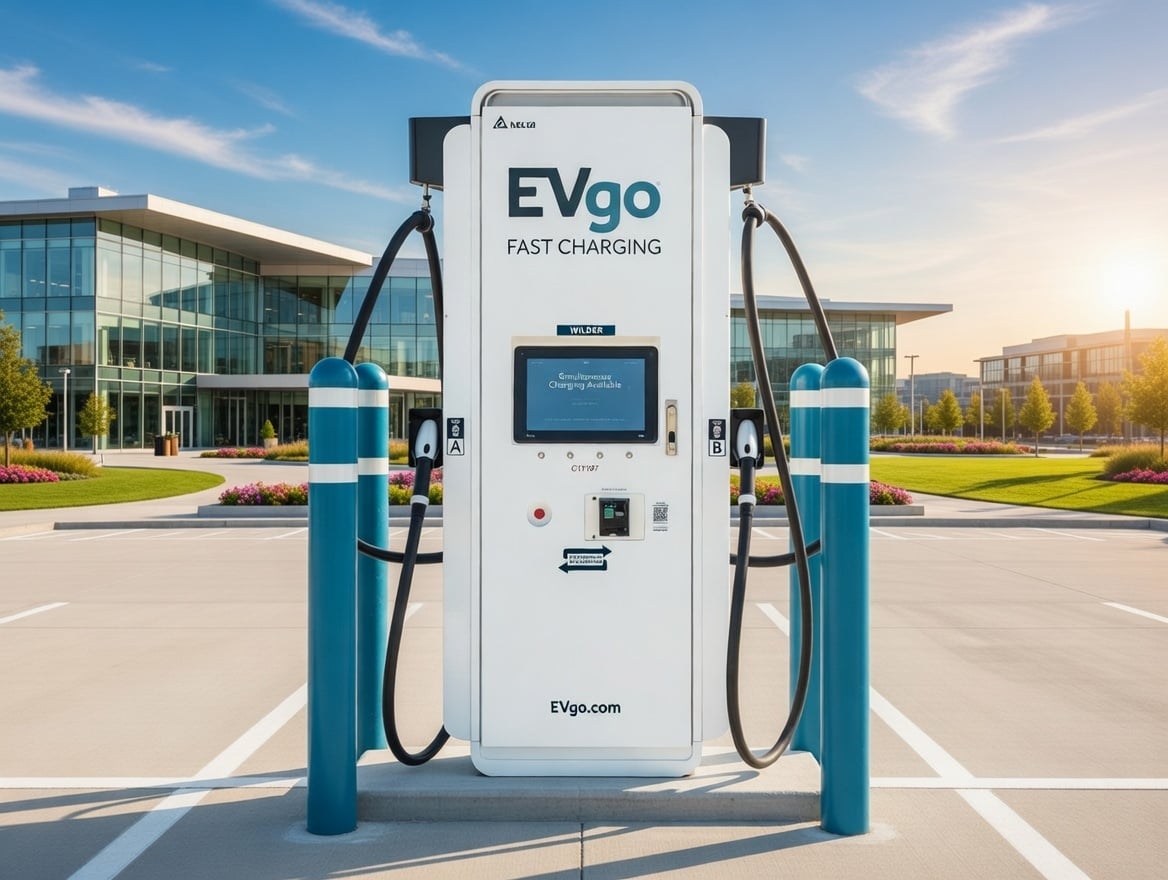
EVgo exceeded quarterly earnings projections for Q4 2025, yet conservative forward guidance for 2026 pressured shares downward. Here’s the detailed breakdown.
EVgo announced fourth-quarter adjusted EBITDA reaching $25 million alongside revenue of $118.4 million. Analysts had anticipated significantly lower EBITDA of merely $2.5 million with revenue of $103 million. In the comparable period last year, the company recorded an EBITDA deficit of $8.4 million with revenue of $67.5 million.
Gross margin experienced a remarkable expansion of 2,350 basis points, reaching 38% during the quarter. Fourth-quarter revenue soared 75% compared to the prior year.
For the complete 2025 fiscal year, EVgo recorded $384 million in revenue — representing nearly 50% growth versus 2024 — while achieving EBITDA of $12 million. This milestone represents the company’s inaugural annual profitability.

Notwithstanding these impressive results, EVGO shares declined 5.3% to $2.68 during Tuesday’s trading session. The broader equity market also faced headwinds, with the S&P 500 retreating 0.9%.
The primary catalyst for the decline was forward guidance. EVgo projects 2026 revenue between $410 million and $470 million with breakeven EBITDA. Wall Street consensus had anticipated $478 million in revenue alongside $33 million in EBITDA. This substantial shortfall caught investors’ attention.
Revenue expansion is forecast to decelerate to approximately 15% in 2026, compared to the nearly 50% growth achieved in 2025.
What’s Driving the Network
Network throughput — representing total electricity dispensed to electric vehicles — reached 99 gigawatt-hours during Q4, advancing 18% year over year. This expansion occurred despite a significant contraction in US EV sales.
American consumers purchased approximately 234,000 all-electric vehicles in Q4 2025, declining 36% from the previous year. EV market penetration fell below 6% of total new vehicle sales during the quarter, down from roughly 10% in Q3.
The federal $7,500 EV purchase incentive concluded in September, increasing the effective cost for prospective buyers.
However, EVgo’s CEO Badar Khan emphasized that the business model relies more heavily on the existing installed base of EVs than new vehicle sales metrics. “We are putting in charging stations where people are, where people are running errands,” Khan explained.
EVgo deployed over 500 additional stalls during Q4 and concluded 2025 with 5,100 operational stalls, representing 25% year-over-year expansion. DC fast charging infrastructure now constitutes 62% of the total network.
Khan noted that utilization rates per stall have increased approximately sixfold compared to previous periods, while EVgo’s demand per stall stands roughly five times higher than most competitors excluding the top three market participants.
NACS Expansion and Fleet Growth
EVgo continues expanding NACS connector availability — the Tesla-originated charging protocol — throughout its infrastructure. Numerous automotive manufacturers across North America have embraced NACS, enabling more vehicles to charge at EVgo facilities without requiring adapters.
The organization is also pursuing fleet operators and rideshare enterprises as supplementary demand channels.
Khan recognized that aggressive network expansion necessitates elevated depreciation and amortization expenses, which pressure net income metrics despite EBITDA improvements.
Heading into Tuesday’s trading session, EVGO shares were down 3% year to date while maintaining a 16% gain over the trailing twelve-month period.
Get 3 Free Stock Ebooks
Discover top-performing stocks in AI, Crypto, and Technology with expert analysis.
- Top 10 AI Stocks - Leading AI companies
- Top 10 Crypto Stocks - Blockchain leaders
- Top 10 Tech Stocks - Tech giants



