


TLDR
- The dollar index climbed as much as 1% to reach 99.34, marking its strongest level since January 2026.
- Against both the euro and yen, the greenback has advanced approximately 1% since Iran conflict escalation.
- America’s energy self-sufficiency shields the dollar from oil price volatility.
- Surging natural gas costs are weighing on Europe, driving EUR/USD lower by about 1%.
- ING forecasts the DXY could reach 99.50–100.00 as long as energy costs remain high.
The greenback has surged to its strongest position since January 2026 as Middle Eastern hostilities intensified, driving capital flows back toward the U.S. currency amid heightened global uncertainty.
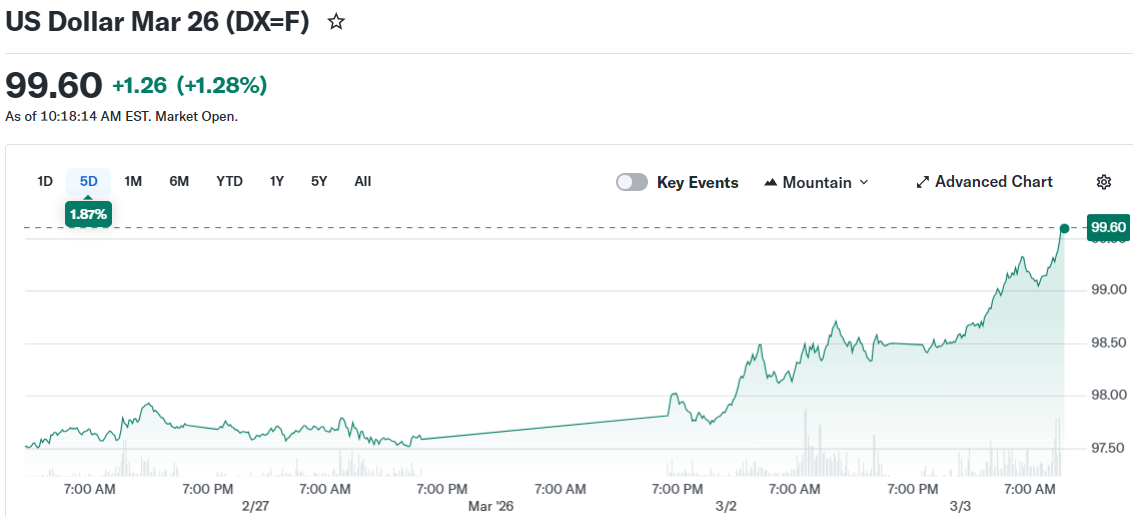
The dollar index (DXY), which tracks the U.S. currency’s performance against six major counterparts, advanced approximately 1% during Tuesday’s session to reach 99.34. This follows Monday’s nearly 1% appreciation.
The American currency has gained roughly 1% versus the euro and Japanese yen since tensions with Iran escalated. Both currencies had been viewed by certain market participants as viable dollar alternatives in recent months.
What started primarily as confrontation between Washington and Tehran has now expanded across the region. The U.S. diplomatic compound in Riyadh reportedly faced missile attacks. Amazon cloud computing facilities in both the UAE and Bahrain were also reportedly hit during Iranian counterstrike operations.
On Tuesday, the State Department mandated the evacuation of non-essential U.S. government staff and their families from Bahrain, Iraq, and Jordan. Israeli officials confirmed simultaneous operations against targets in Iran and Lebanon, following Hezbollah’s assault on Tel Aviv using missiles and unmanned aerial vehicles.

Why the Dollar Is Benefiting
Market observers attribute the dollar’s strength to America’s position as an energy-independent nation. With substantial domestic petroleum and natural gas production, the United States faces minimal exposure to energy price spikes compared to European or Asian economies.
“The dollar looks the best currency to take advantage of this energy shock,” ING analyst Chris Turner wrote. Countries like Australia and Norway, which are also large energy exporters, have also seen their currencies hold up.
This resurgence comes after months of uncertainty surrounding the dollar’s traditional safe-haven status. The currency notably failed to rally during last year’s tariff-induced market turbulence, prompting speculation about accelerating de-dollarization trends.
David Morrison, senior market analyst at Trade Nation, said the move was “a strong indication that the U.S. dollar remains the go-to safe-haven currency” and that those calling for further weakness “may be a bit early.”
Euro Under Pressure from Energy Costs
EUR/USD declined approximately 1% to 1.1581 during Tuesday trading. The Eurozone relies heavily on energy imports, and natural gas valuations have skyrocketed due to regional instability.
ING notes that substantial long euro positions suggest limited appetite for dip-buying unless de-escalation signals emerge. The Eurozone’s preliminary inflation data for February was scheduled for release Tuesday afternoon, with annual rates forecast at 1.7%. According to ING, any upside inflation surprise might offer modest euro support by potentially restraining European Central Bank rate reduction plans.
Despite recent strength, the DXY remains down roughly 6.5% year-over-year. ING strategists project continued dollar support in coming sessions, targeting the 99.50 to 100.00 range as long as energy market stress persists.
Get 3 Free Stock Ebooks
Discover top-performing stocks in AI, Crypto, and Technology with expert analysis.
- Top 10 AI Stocks - Leading AI companies
- Top 10 Crypto Stocks - Blockchain leaders
- Top 10 Tech Stocks - Tech giants



