


TLDR
- Coordinated US-Israel military operations targeted Iran during the weekend, resulting in the death of Supreme Leader Ayatollah Ali Khamenei
- The precious metal soared more than 2% to exceed $5,400 per ounce, reaching levels not seen since the end of January
- Crude oil experienced its largest surge in four years amid concerns about the Strait of Hormuz
- Other precious metals including silver, platinum, and palladium posted gains as market participants sought refuge in defensive assets
- Market watchers identified $5,595 and $6,000 as critical price targets for gold in coming months
The price of gold experienced a significant surge on Monday following coordinated military strikes by the United States and Israel against Iran during the weekend. The operations resulted in the death of Iran’s Supreme Leader, Ayatollah Ali Khamenei.
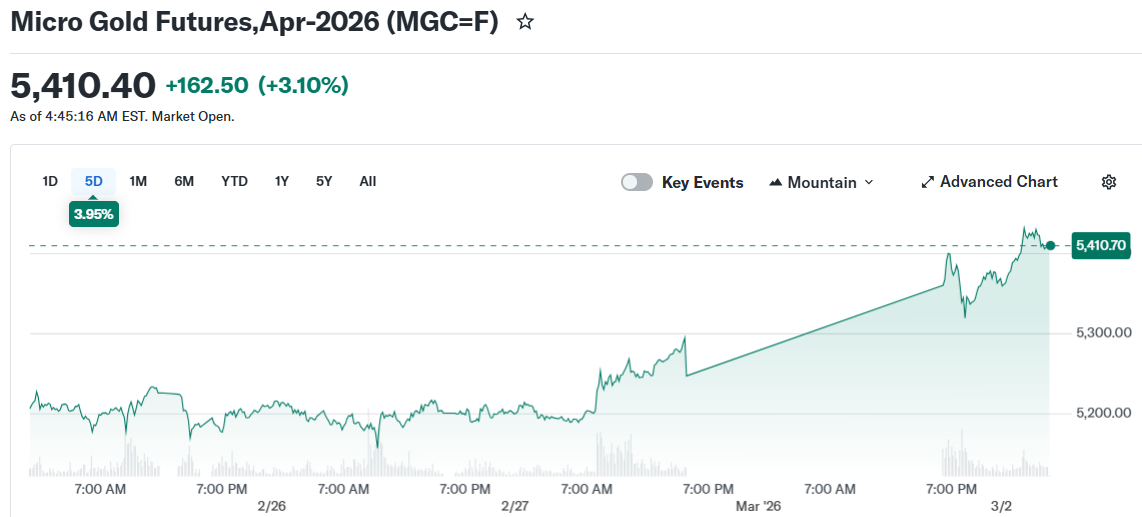
The spot price for gold increased 2.4% to reach $5,406 per ounce during early Asian market hours. This advance followed a weekly gain exceeding 3% in the prior trading period.
US Gold Futures advanced 2.8% to settle at $5,391.46. The yellow metal has accumulated approximately 25% in gains year-to-date.
Tehran launched retaliatory missile attacks targeting Israel and American military installations across Qatar, the UAE, Kuwait, and Bahrain. President Donald Trump indicated that military operations against Iran would persist until achieving stated objectives.
Ali Larijani, Iran’s national security chief, declared via social media that Tehran has no intention of entering negotiations with Washington. This statement suggests the confrontation may extend for an indefinite period.

Financial markets responded swiftly. Capital flowed out of equities and into defensive positions such as gold and other commodities.
Oil prices registered their steepest increase in four years when trading commenced Monday. Market participants expressed concern about potential disruptions to the Strait of Hormuz — a critical passageway for international petroleum transport.
Saudi Aramco suspended activities at one of its refining facilities following a drone attack in the vicinity, according to sources with knowledge of the situation. This development applied additional upward pressure on crude prices.
Gold Hits $5,400 as Middle East Conflict Escalates
Silver posted a 2.4% increase to $96.04 per ounce. Platinum advanced 1.7% while palladium jumped 3.1%.
Copper futures recorded modest gains, with London Metal Exchange contracts rising 0.3%.
The US dollar strengthened, with the Bloomberg Dollar Spot Index advancing as much as 0.7%. Typically, dollar appreciation creates downward pressure on commodities, yet gold and oil defied this pattern.
“Precious metals, oil and commodities are rising despite the dollar’s rebound,” said Hong Hao, chief investment officer of Lotus Asset Management. “This demonstrates that these hard assets are the true hard currency during this extraordinary period.”
Analysts Target $5,595 and $6,000 for Gold
Michael Brown, Senior Research Strategist at Pepperstone, identified $5,400 as the initial resistance level to monitor, with the late-January peak of $5,595 per ounce representing the next milestone.
Brown noted that the weekend’s developments reinforce the bullish outlook for gold. He anticipates a possible advance toward $6,000 before the conclusion of 2026.
Strategists at ING observed that any interruption to energy supply chains would provide additional support for gold through elevated oil prices and heightened inflation expectations.
Gold has received fundamental support throughout the year from central bank purchases, portfolio reallocation away from government bonds, and expectations of Federal Reserve rate reductions. February represented the metal’s seventh consecutive monthly advance — the longest winning streak since 1973.
Analysts at Franklin Templeton recommended “selective gold exposure over broad equity shorts” as market sentiment shifts to risk-off mode.
Spot gold was quoted at $5,406.27 as of Monday afternoon trading hours in Singapore.
Get 3 Free Stock Ebooks
Discover top-performing stocks in AI, Crypto, and Technology with expert analysis.
- Top 10 AI Stocks - Leading AI companies
- Top 10 Crypto Stocks - Blockchain leaders
- Top 10 Tech Stocks - Tech giants



