


TLDR
- Mark Karpelès, the former chief executive of Mt. Gox, has introduced a controversial Bitcoin hard fork concept designed to recover roughly 80,000 BTC stolen in a 2011 hack, now valued at over $5.2 billion.
- The proposed mechanism would allow the movement of these assets without requiring the original private key, utilizing a unique consensus rule targeting one wallet address.
- Karpelès shared the concept on GitHub as a preliminary discussion document, not as a formal Bitcoin Improvement Proposal.
- Critics argue the proposal sets a dangerous precedent that could compromise Bitcoin’s core principle of immutability.
- The stolen Bitcoin remains separate from approximately 200,000 BTC being returned to Mt. Gox creditors, a process extending until October 2026.
Mark Karpelès, the former chief executive of the collapsed Mt. Gox Bitcoin exchange, has introduced a preliminary proposal calling for a Bitcoin hard fork. The goal is to reclaim approximately 79,956 BTC stolen in a security breach more than 15 years ago.
These cryptocurrency holdings remain inaccessible within a single wallet address, worth over $5.2 billion at today’s prices. The assets have sat untouched since the June 2011 theft.
Under Bitcoin’s current protocol, any transaction requires the original private key for authorization. That essential key was never recovered.
Karpelès published his concept to GitHub last Friday. The proposal outlines a new consensus rule that would permit moving the funds to a recovery wallet without requiring access to the lost key.
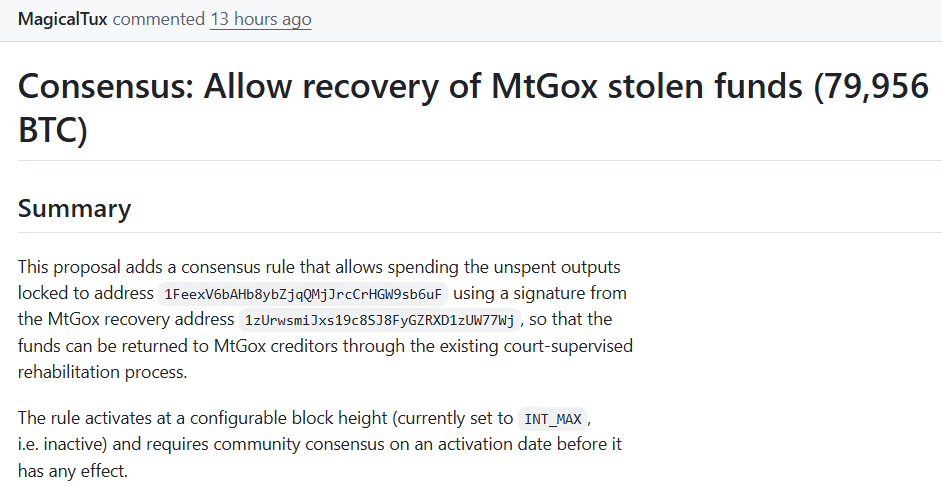
The suggested rule would apply exclusively to that specific wallet address. Implementation would occur at a predetermined future block height if the network adopts it.

Karpelès acknowledged the controversial nature of his proposal openly. “I want to be upfront: this is a hard fork,” he declared.
He framed the submission as a resolution to a deadlock. Nobuaki Kobayashi, the Mt. Gox bankruptcy trustee, has declined to pursue blockchain-based recovery options without confirmed community backing for such a protocol alteration.
Why Critics Are Pushing Back
The proposal has generated significant backlash, centered primarily on Bitcoin’s immutability principle. Bitcoin‘s fundamental design ensures that validated transactions remain permanent and irreversible.
Many community members argue that altering ownership rules for one specific address, even in theft cases, creates a troubling precedent. Forum discussions on Bitcointalk warned this could open the door to similar demands after future hacks.
The proposal itself acknowledges this criticism, stating: “If it can be done once, the argument goes, it can be done again.”
Governance questions arise as well. Bitcoin has no established framework for deciding which historical thefts merit changes to protocol rules.
Implementing a hard fork demands broad consensus from miners, node operators, and exchanges. Throughout Bitcoin‘s existence, reaching agreement on contentious changes has proven extremely difficult.
How This Fits Into Broader Mt. Gox Repayments
The 80,000 BTC locked in the hacked wallet are separate from the funds currently being distributed to creditors. Ongoing repayments come from a different pool of approximately 200,000 BTC recovered after the exchange’s 2014 collapse.
Creditor distributions began in mid-2024, with the final deadline now extended to October 2026. The stolen coins remain entirely outside the trustee’s control.
Mt. Gox filed for bankruptcy in Tokyo on February 28, 2014, after losing around 750,000 customer bitcoins. At its peak, the exchange handled 70% of global Bitcoin trading volume.
Some creditors have voiced support for this initiative. One person claiming creditor status noted receiving only about 15% of their Bitcoin through the bankruptcy process and would support a legal mechanism to recover the remaining stolen funds.
The proposal remains a preliminary discussion document with no official backing or implementation timeline.
Get 3 Free Stock Ebooks
Discover top-performing stocks in AI, Crypto, and Technology with expert analysis.
- Top 10 AI Stocks - Leading AI companies
- Top 10 Crypto Stocks - Blockchain leaders
- Top 10 Tech Stocks - Tech giants



