


TLDR
- Nvidia’s fiscal Q4 revenue reached $68 billion, surpassing projections, while Q1 outlook points to $78 billion
- Physical AI segment generated $6 billion for Nvidia in fiscal 2026, fueled by robotics and autonomous vehicle applications
- Tesla relies on Nvidia’s computing infrastructure for Optimus humanoid robots and autonomous taxi development
- If Tesla produces 1 million Optimus units annually at approximately $25,000 each, it could generate $25 billion in new revenue
- Over the last year, Tesla shares climbed 44% while Nvidia gained 49%
Shares of Tesla $TSLA slipped modestly in Thursday’s premarket session, declining 0.5%, despite impressive fiscal fourth-quarter earnings from Nvidia $NVDA that exceeded analyst projections.
The semiconductor giant delivered quarterly revenue of $68 billion, a significant jump from the prior year’s $39 billion. This figure topped consensus estimates of $66 billion and exceeded Nvidia’s own projected range of $63.7 billion to $66.3 billion.
For the current quarter, Nvidia issued guidance calling for $78 billion in revenue, comfortably above the $73 billion Street estimate. Yet Nvidia shares gained just 1% in premarket activity following the announcement.
What’s the Tesla connection?

Tesla counts itself among Nvidia’s key customers, leveraging the chipmaker’s advanced computing systems to power what industry insiders refer to as “physical AI”—artificial intelligence designed to function in real-world environments through robotics and autonomous driving technology.
During the earnings call, Nvidia CFO Colette Kress revealed that physical AI applications contributed $6 billion in revenue during fiscal 2026, which concluded in January. She explicitly mentioned Tesla alongside Alphabet’s Waymo as autonomous taxi developers utilizing Nvidia’s technology platform.
Kress emphasized that training robots and self-driving systems demands substantially greater computational resources compared to language models or chatbots. This positions Nvidia favorably as the market for physical AI applications expands.
Nvidia CEO Jensen Huang described robotics powered by AI as a “wonderful opportunity” for the company’s future. The partnership between these two technology leaders has become mutually beneficial—Nvidia requires real-world AI deployments to drive chip demand, while Tesla needs Nvidia’s processing capabilities to realize its vision.
Tesla’s Optimus Ambitions
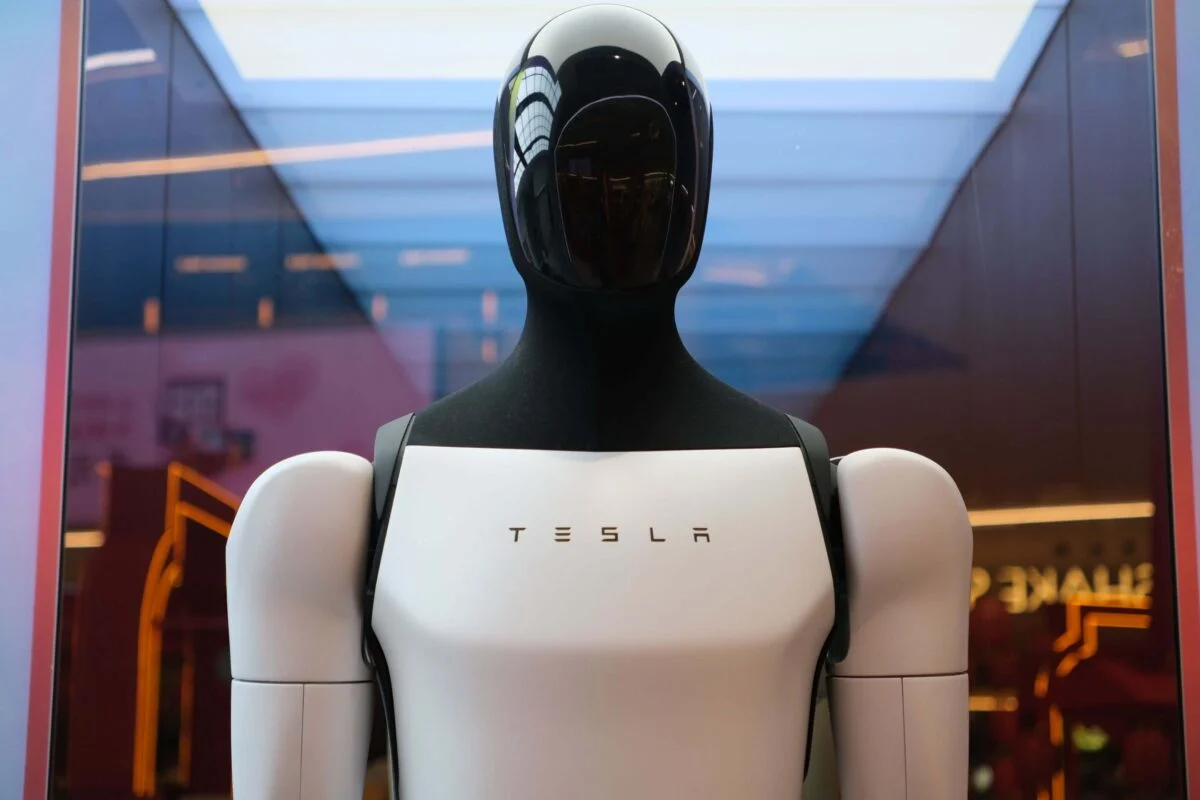
Tesla chief Elon Musk has characterized the robotics sector as a multi-trillion-dollar market opportunity. The automaker’s humanoid robot platform, Optimus, is slated for initial commercial availability in 2026, with long-term production targets aiming for one million units annually.
With an anticipated retail price around $25,000 per robot, achieving that production volume would inject approximately $25 billion in fresh annual revenue. To put this in perspective, Tesla recorded total revenue of $94.83 billion throughout 2025.
This potential revenue stream represents an entirely new business vertical—one that operates independently of vehicle sales while significantly expanding Tesla’s total addressable market.
Risks Still on the Table
Musk cautioned investors last month that initial robot manufacturing would prove “agonisingly slow” before production ramps up to scale. Manufacturing complexities and supply chain challenges present tangible obstacles.
Tesla faces stiff competition in the robotics arena as well. Chinese manufacturers are pouring capital into humanoid robot development, and if rivals successfully target the budget segment, Tesla’s profit margins could face downward pressure.
Tesla’s stock has already appreciated 44% over the trailing twelve months, leading some market analysts to suggest that current valuations may already incorporate significant optimism regarding Optimus and autonomous vehicle prospects.
Nvidia shares have climbed 49% during the same timeframe.
Heading into Thursday’s session, both equities were trading near their 52-week peaks, with market participants closely monitoring how physical AI demand evolves throughout 2026.
Get 3 Free Stock Ebooks
Discover top-performing stocks in AI, Crypto, and Technology with expert analysis.
- Top 10 AI Stocks - Leading AI companies
- Top 10 Crypto Stocks - Blockchain leaders
- Top 10 Tech Stocks - Tech giants



