


Key Highlights
- Nvidia’s Q4 financial results arrive Wednesday — serving as the year’s first major benchmark for AI sector investment momentum
- Following a 6-3 Supreme Court decision invalidating IEEPA-based tariffs, Trump introduced a 10% universal tariff alternative
- President Trump’s State of the Union on Tuesday will likely detail revised trade policy framework
- Crude oil has surged 15% year-to-date amid escalating US-Iran tensions and a 10-day negotiation ultimatum
- Producer Price Index data Friday plus multiple Federal Reserve commentary close out an event-packed week
Investors face an exceptionally dense calendar of market-moving events this week. A critical earnings report from the AI sector’s flagship company, major policy announcements from Washington, new economic indicators, and heightened Middle East tensions converge simultaneously.
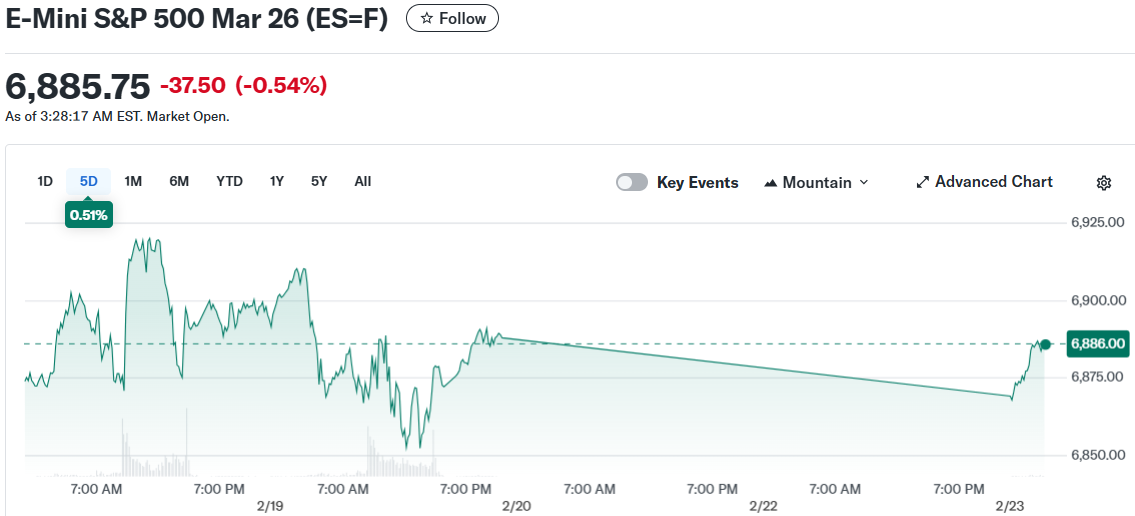
Equity markets concluded last week with gains across major indices. The S&P 500 advanced 1.1%, while the Nasdaq Composite climbed 1.3% and the Dow Jones Industrial Average rose 0.3%. Friday’s judicial decision on trade policy provided much of the late-week lift.
Supreme Court Decision Reshapes Tariff Landscape
In a 6-3 ruling, the Supreme Court determined that Trump’s application of the International Emergency Economic Powers Act for broad tariff implementation exceeded legal authority. Equity markets responded positively, though without dramatic volatility.
Market observers noted that trading patterns suggested investors had already anticipated this outcome. While IEEPA-based levies represented approximately 60% of total tariffs in place, one analyst characterized the immediate economic consequences as relatively contained.
The administration’s response came swiftly. Within hours, the White House unveiled a replacement framework: a 10% universal tariff implemented through Section 122 of the Trade Act of 1974. The invalidated tariffs could trigger refunds approaching $175 billion, though the distribution process will likely move through specialized trade tribunals.

Tuesday’s State of the Union address is anticipated to provide additional clarity on the administration’s trade approach, along with initiatives related to residential real estate and fiscal policy.
Tech Giant Leads Packed Earnings Calendar
Nvidia releases quarterly performance metrics following Wednesday’s closing bell. Given its status as the world’s highest-valued corporation, the company’s financial disclosure functions as a critical barometer for artificial intelligence infrastructure spending trends. Market participants will parse CEO Jensen Huang’s commentary on semiconductor demand dynamics and the company’s strategic positioning in Chinese markets.
The week’s earnings roster extends beyond Nvidia to include Salesforce, Dell, Lowe’s, and Home Depot. The home improvement retail segment has faced headwinds from sluggish residential market activity, making their quarterly performance particularly relevant for gauging housing sector vitality.
Berkshire Hathaway’s Saturday release marks a historic milestone as the first under newly appointed CEO Greg Abel, following Warren Buffett’s transition to emeritus status.
Major Canadian financial institutions round out the reporting schedule, with Royal Bank of Canada, Toronto Dominion, and Bank of Nova Scotia all publishing results.
Energy Markets React to Iran Nuclear Standoff
Crude oil benchmarks have appreciated approximately 15% since the start of January. The primary catalyst involves intensifying friction between Washington and Tehran surrounding nuclear program negotiations. The administration issued a 10-day ultimatum Thursday for diplomatic resolution.
Iran maintains operational control over the Strait of Hormuz, through which roughly 20 million barrels of crude oil transit daily. Energy consultancy Rystad Energy projects that a contained military operation could elevate prices by $10 per barrel, while extended conflict scenarios could add $15 or more to benchmark prices.
Friday’s Producer Price Index release will provide fresh insight into wholesale inflation trends. Throughout the week, several Federal Reserve policymakers are scheduled to deliver public remarks, including Governor Christopher Waller, who has previously advocated for more aggressive monetary easing.
Get 3 Free Stock Ebooks
Discover top-performing stocks in AI, Crypto, and Technology with expert analysis.
- Top 10 AI Stocks - Leading AI companies
- Top 10 Crypto Stocks - Blockchain leaders
- Top 10 Tech Stocks - Tech giants



