



Key Highlights
- VanEck debuted the inaugural U.S. spot BNB exchange-traded fund on NASDAQ this Thursday, trading as VBNB with a 0.39% annual expense ratio.
- Currently, the ETF excludes staking rewards, although VanEck retains the option to introduce third-party staking services in the future.
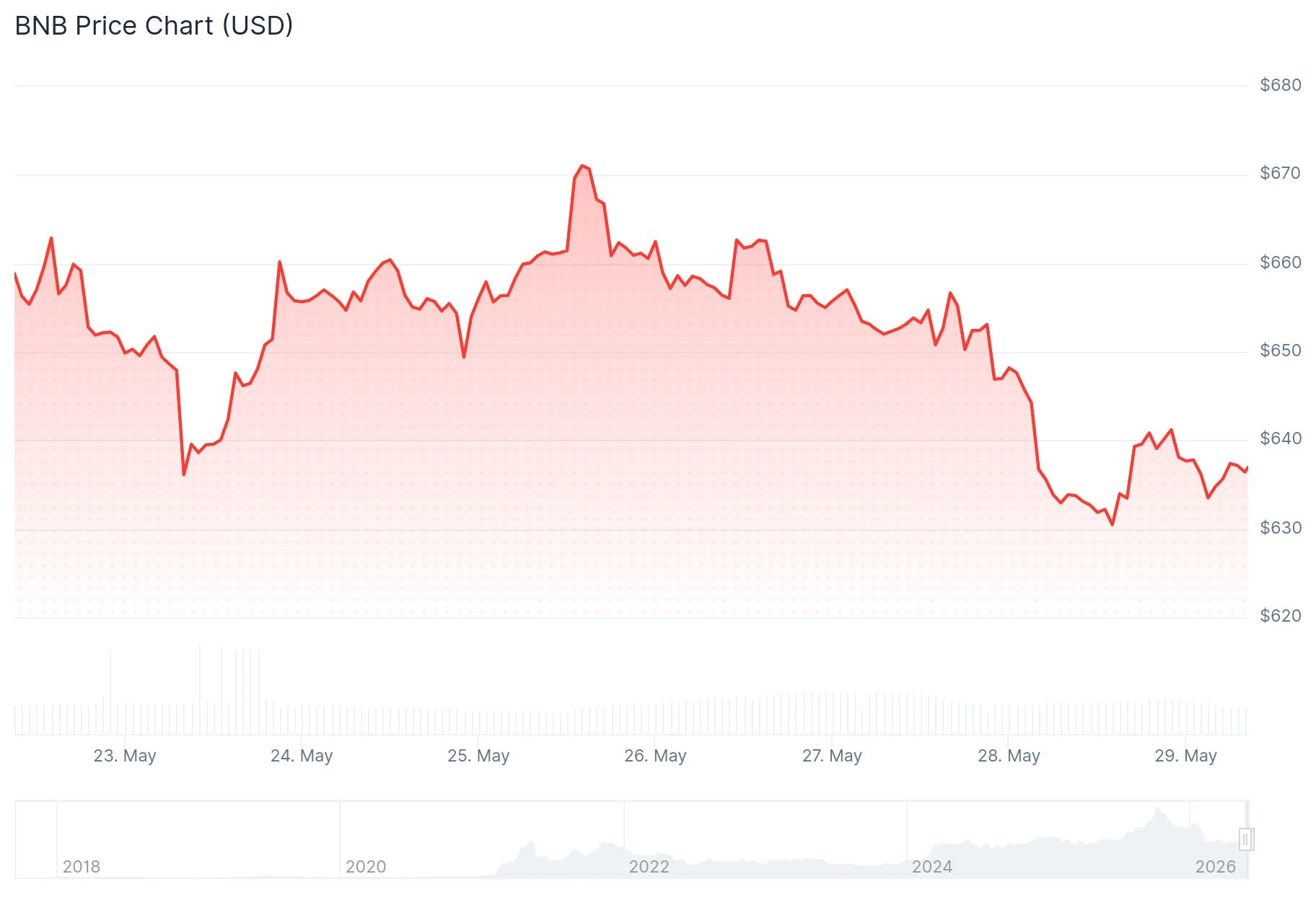
- Binance Coin is hovering between $631 and $635, declining more than 2% intraday and dropping over 26% since the year began.
- Futures open interest for BNB has contracted to approximately $961 million, signaling a cautious stance among derivatives traders.
- With this launch, BNB joins ten other altcoins now accessible through U.S. spot ETFs, including Ethereum, Solana, and XRP.
VanEck introduced the VanEck BNB ETF this Thursday, marking a historic moment as the first regulated U.S. spot exchange-traded fund providing direct exposure to Binance’s native cryptocurrency. The product began trading on NASDAQ under VBNB with a management fee of 0.39% per year.
Built as a registered investment company under the Investment Company Act of 1940, the ETF follows a traditional ’40 Act structure. According to VanEck, the trust aims to mirror the spot market price of BNB as closely as possible.
Notably absent from the fund’s current features is staking. VanEck has not committed its BNB holdings to any staking protocols at this stage. While the firm may explore third-party staking arrangements down the line, no concrete plans or schedules have been announced. For now, VBNB shareholders will not earn any staking yields.
Patrick Bush, a Senior Investment Analyst at VanEck, emphasized that the BNB blockchain handles approximately 14 million transactions daily and supports more than 2.5 million active users each day. He characterized BNB as among the “most resilient” leading cryptocurrencies throughout the latest market cycle.
Kyle DaCruz, who directs Digital Assets Product at VanEck, pointed out that BNB stood out as one of the few major crypto assets lacking a U.S. spot ETF. “We’re thrilled to be changing that with the launch of VBNB,” DaCruz remarked.

Crypto commentator Sjuul from AltCryptoGems offered a more reserved outlook prior to the ETF’s debut. In a post on X, Sjuul cautioned that BNB “seems in trouble after that double top and the bearish retest of that key resistance level,” suggesting that without renewed buying interest, a test of lower support zones appears probable.
ETF Debut Fails to Boost Token Value
Contrary to optimistic expectations, the ETF rollout did not provide a price boost for BNB. On launch day, the token traded in the $631 to $635 range, registering a decline exceeding 2%. Year-to-date losses now surpass 26%.
External factors beyond the cryptocurrency sector are contributing to the selling pressure. BNB’s downturn aligns with renewed military tensions between the United States and Iran, which triggered widespread selling across risk-sensitive assets. Digital currencies were caught in the broader risk-off wave.
Charts Signal Continued Weakness
From a technical standpoint, BNB remains positioned beneath its 50-period exponential moving average at $645, the midpoint of the Bollinger Bands near $657, and the 100-period EMA hovering around $663. Each of these levels is serving as overhead resistance.
The MACD histogram has dipped into negative territory while the relative strength index lingers just below the 50 mark, both indicators reinforcing the prevailing bearish momentum. Additionally, open interest in BNB futures contracts has declined to roughly $961 million from nearly $1 billion the previous session, indicating that market participants are unwinding positions rather than initiating fresh bets.
Near-term support lies close to the lower Bollinger Band around $634. A daily close beneath that threshold could pave the way for additional downside movement.
Meanwhile, Grayscale has submitted an updated S-1 filing for its own BNB-focused fund, hinting at a potential launch in the near term. BNB now represents the 11th alternative cryptocurrency to gain a U.S. spot ETF, joining the ranks of Ethereum, Solana, XRP, Avalanche, Litecoin, Polkadot, Hyperliquid, Hedera, Chainlink, and Dogecoin.
Get 3 Free Stock Ebooks
Discover top-performing stocks in AI, Crypto, and Technology with expert analysis.
- Top 10 AI Stocks - Leading AI companies
- Top 10 Crypto Stocks - Blockchain leaders
- Top 10 Tech Stocks - Tech giants



