


TLDR
- Precious metal prices tumbled on Monday with gold briefly trading beneath $4,000 per ounce—a level not seen in three weeks
- Silver prices declined 3.4%, reaching the lowest settlement since early December
- Federal Reserve Governor Christopher Waller indicated potential rate increases if inflation remains stubbornly high
- Futures markets now reflect a 43% probability of a rate increase during the Fed’s July 28-29 policy meeting
- A modest rebound occurred Tuesday with gold gaining 0.54% to $4,022.87 as market participants await inflation data and Fed Chair Kevin Warsh’s congressional appearance
Precious metals experienced significant volatility this week, with sharp declines Monday followed by modest recovery Tuesday, as market participants assessed escalating inflation concerns, geopolitical developments in the Middle East, and shifting Federal Reserve monetary policy expectations.
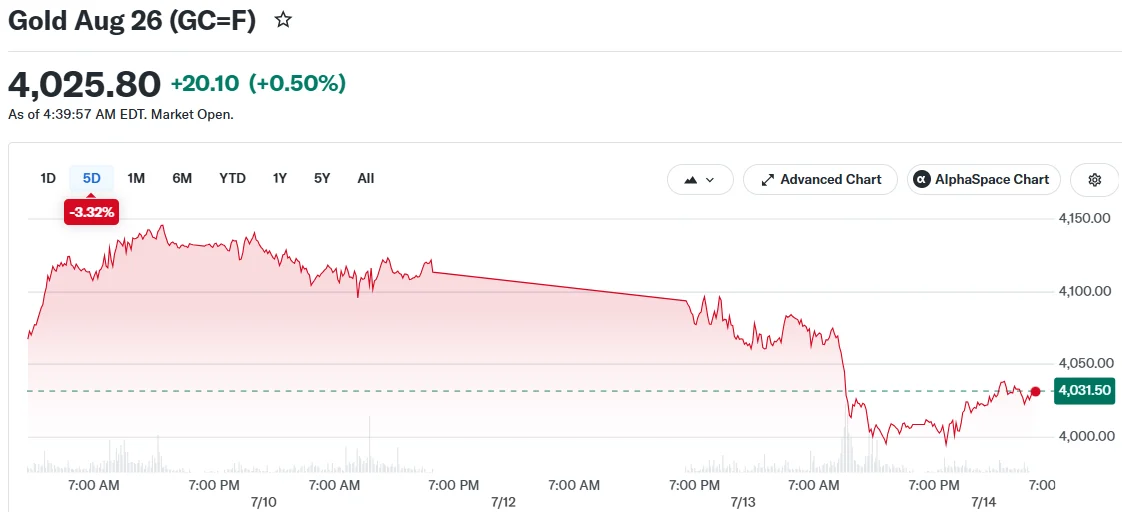
The front-month July delivery contract for Comex gold plummeted 2.6% to settle at $3,997 on Monday. This represented the steepest single-session loss since June 24 and marked the second-lowest settlement price for the yellow metal in 2025.
Silver experienced even more pronounced weakness. The July contract plunged 3.4% to settle at $57.634, representing the lowest closing level since December 4. Year-to-date performance shows silver down 17.8%, significantly underperforming gold’s 7.6% decline.
Geopolitical Developments Intensify Market Pressure
The precious metals selloff coincided with heightened geopolitical tensions in the strategically vital Middle East region. President Donald Trump announced plans to reimpose a blockade targeting Iranian maritime commerce in the Persian Gulf, proclaiming the United States as the “Guardian of the Hormuz Strait.” His proposal included implementing a 20% transit fee on all cargo vessels navigating the critical waterway.
This development cast uncertainty over the ceasefire agreement established in June and triggered a surge in crude oil quotations. Climbing energy costs amplified worries that inflationary pressures could persist longer than previously anticipated.

Crude prices continued their upward trajectory as market participants evaluated potential supply interruption scenarios through the Strait of Hormuz. This reignited concerns that energy-sector inflation could complicate the Federal Reserve’s path toward monetary policy easing.
For gold investors, rising energy prices present contradictory signals. While they can enhance gold’s attractiveness as an inflation hedge and wealth preservation tool, they simultaneously tend to strengthen the dollar and elevate bond yields—both factors that typically pressure precious metal valuations.
Market Expectations Shift Toward Monetary Tightening
Federal Reserve Governor Christopher Waller indicated that central bank officials might need to implement interest rate increases in the near term if inflation data continues demonstrating widespread upward pressure. His remarks catalyzed a shift in market expectations regarding future policy direction.
Analysts at ANZ noted that financial markets are currently assigning a 43% probability to a rate hike during the Federal Reserve’s scheduled policy meeting on July 28-29. Rising interest rates diminish the relative appeal of non-interest-bearing assets such as gold.
Gold staged a modest recovery during Tuesday’s trading session, advancing 0.54% to reach $4,022.87 per ounce. Silver similarly rebounded, climbing 0.63% to $58.02. Market participants were closely monitoring the forthcoming June U.S. consumer price index report and Fed Chair Kevin Warsh’s scheduled congressional testimony for insights into future monetary policy direction.
Michael Cuggino from Permanent Portfolio Family of Funds maintained that gold’s long-term fundamental outlook remains constructive, highlighting sustained central bank accumulation from nations including Poland, China, and Russia. He observed that the selloff intensified following Warsh’s appointment to Fed Chair, as market participants grew concerned about potentially tighter monetary conditions.
Cuggino further explained that silver’s more pronounced decline reflects its significant industrial applications across technology sectors, semiconductor manufacturing, and residential construction, rendering it more vulnerable to economic growth uncertainties.
Investors are now focused intently on Warsh’s congressional testimony and the upcoming inflation report for definitive signals regarding the Federal Reserve’s next policy moves.
Get 3 Free Stock Ebooks
Discover top-performing stocks in AI, Crypto, and Technology with expert analysis.
- Top 10 AI Stocks - Leading AI companies
- Top 10 Crypto Stocks - Blockchain leaders
- Top 10 Tech Stocks - Tech giants



