



Key Takeaways
- Bullion faces approximately 3% weekly decline and an 11% monthly drop overall
- Greenback hovers near 13-month peak, raising gold costs for foreign currency buyers
- May PCE inflation registered 4.1%, marking the highest level in more than three years
- Fed rate increase probability by September now stands at 63% according to market pricing
- Silver tracks toward 12% weekly decline; platinum records seventh consecutive weekly loss
Precious metal values showed modest stabilization Friday following three consecutive weeks of downward momentum. Spot gold climbed 0.3% to reach $4,036.88 per ounce, with U.S. Gold Futures advancing 0.1% to $4,051.30. The marginal recovery does little to offset the approximately 3% weekly decline still in progress.
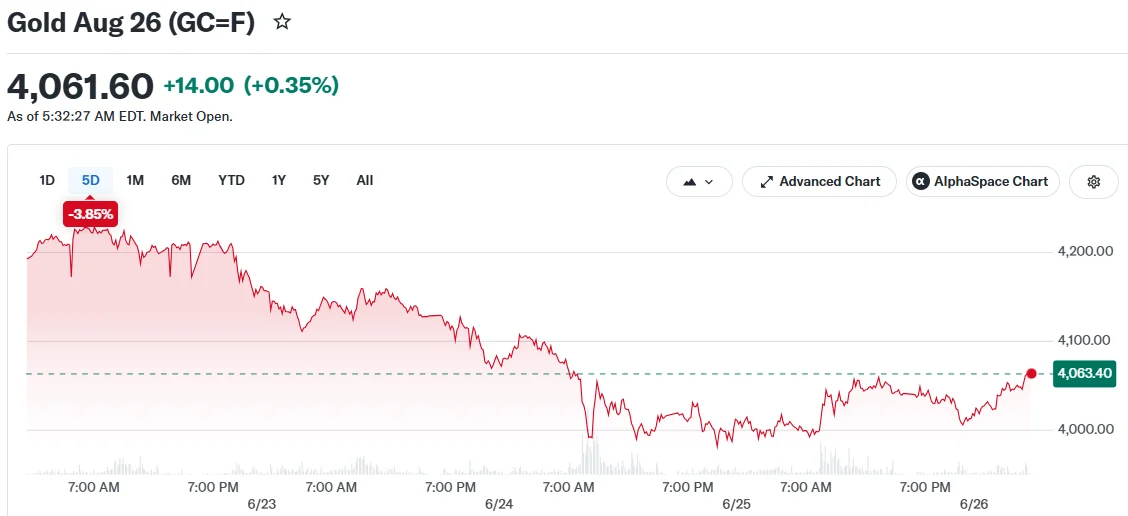
Bullion has surrendered approximately 11% of its value throughout the current month. This substantial retreat correlates directly with intensifying dollar strength and mounting anticipation that the Federal Reserve will implement additional monetary tightening.
The greenback maintained its position near a 13-month peak Friday, advancing toward a second consecutive weekly gain. Enhanced dollar valuations increase gold purchasing costs for international buyers holding alternative currencies, typically suppressing overall demand.
As benchmark interest rates climb, gold’s appeal diminishes among investors since the asset generates no income yield. With rates potentially ascending further, capital has been migrating toward yield-producing alternatives.
Hot Inflation Numbers Amplify Tightening Expectations
Thursday’s personal consumption expenditures report intensified downward pressure on precious metals. The PCE price index advanced 4.1% year-over-year in May, representing the strongest reading in over three years and the first time the measure exceeded 4% since 2023.

The PCE gauge serves as the Federal Reserve’s primary inflation metric. Such elevated readings strengthen the central bank’s rationale for sustained policy restriction.
Market participants now assign a 63% probability to a Fed rate increase by September, based on CME FedWatch tool data. This hawkish expectation has emerged as a primary catalyst behind gold’s recent underperformance.
Saxo Bank analysts observed that bullion approaches its fourth consecutive weekly setback. They indicated investor confidence remains fragile following the recent selloff as markets recalibrate expectations around an aggressive Fed stance and robust dollar conditions.
Nevertheless, Saxo Bank highlighted that declining energy costs and moderating bond yields might ultimately ease pressure on the Fed to maintain its tightening trajectory. Such developments could provide downside protection for gold in future sessions.
Regional Tensions Provide Temporary Lift
Reports of an assault on a commercial vessel near the Strait of Hormuz temporarily boosted gold values. The episode rekindled some safe-haven buying interest, as regional tensions persist notwithstanding a preliminary U.S.-Iran diplomatic framework.
The geopolitical support proved fleeting. Dollar resilience and rate hike projections continued to overshadow security considerations.
Broader precious metals faced similar headwinds. Silver inched 0.1% higher to $57.96 per ounce yet remained positioned for a 12% weekly retreat. Platinum gained 1% to $1,618.23 per ounce, though it continues toward a seventh straight weekly decline.
Copper values also softened. London Metal Exchange Copper Futures decreased 0.4% to $13,249.33 per ton. U.S. Copper Futures declined 0.2% to $6.06 per pound.
Gold traded near $4,053 per ounce during early Friday sessions, maintaining a nearly 5% weekly loss.
Get 3 Free Stock Ebooks
Discover top-performing stocks in AI, Crypto, and Technology with expert analysis.
- Top 10 AI Stocks - Leading AI companies
- Top 10 Crypto Stocks - Blockchain leaders
- Top 10 Tech Stocks - Tech giants



