


Key Highlights
- An inactive whale wallet offloaded 27,585 ETH valued at approximately $44.84M following a seven-year dormancy period
- Market participants are monitoring $1,500 as the critical support threshold for ETH’s price action
- Joseph Lubin, Ethereum’s co-founder, announced that zero-knowledge proof enhancements will accelerate cross-chain transaction speeds
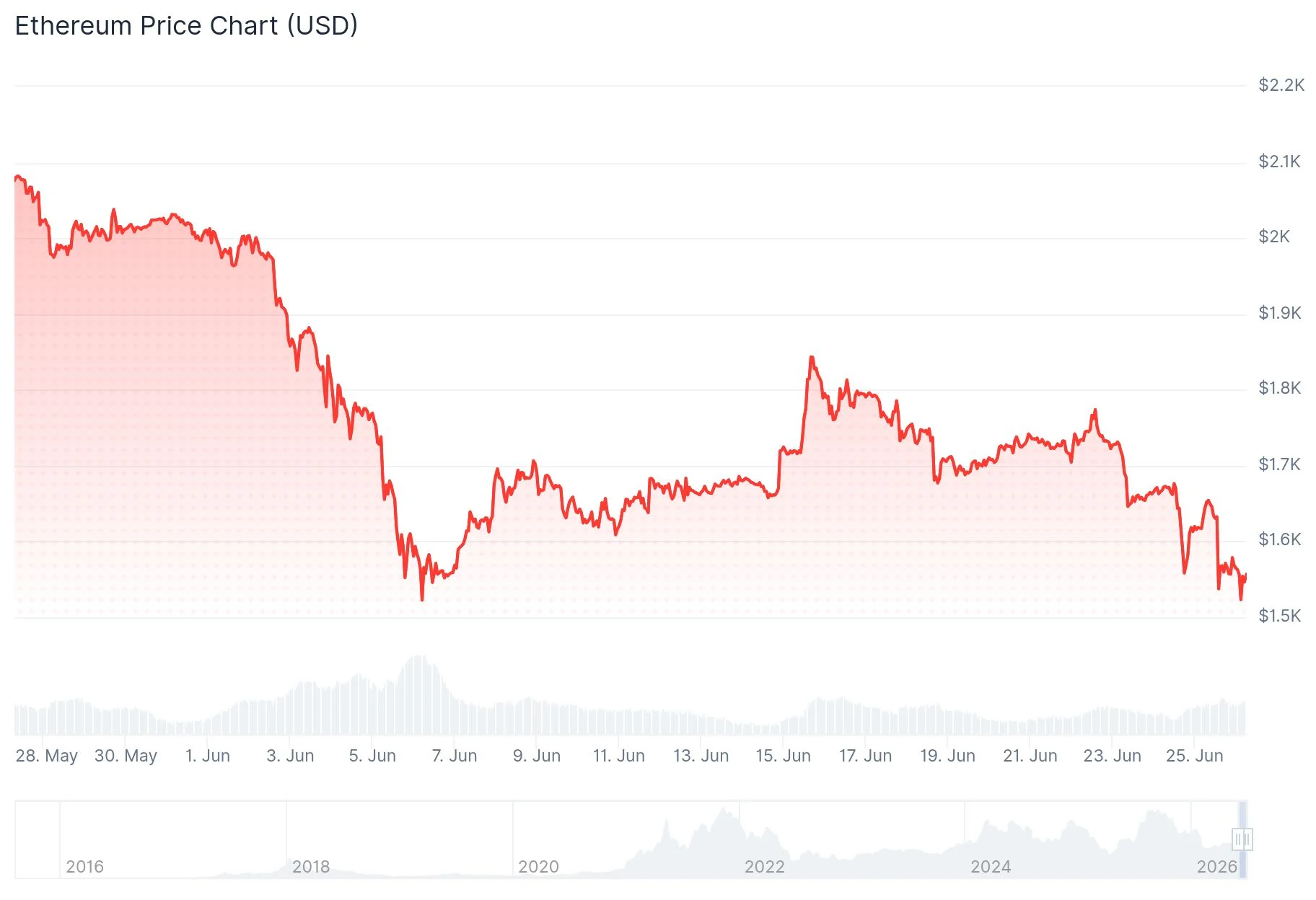
- ETH currently changes hands around $1,665, reflecting a decline exceeding 30% over the last twelve months
- Despite intensifying competition, Ethereum maintains control of more than 50% of total value locked in decentralized finance
Ethereum (ETH) maintains its position near $1,665 following a tumultuous week marked by substantial whale activity, development announcements, and conflicting analyst perspectives on crucial price thresholds.
A long-inactive cryptocurrency wallet, tracked by on-chain analytics platform Lookonchain, reactivated after remaining silent for seven years. The wallet address 0x0965 liquidated 27,585 ETH across a two-day period at an average exit price near $1,625. This massive transaction generated approximately $44.84 million in proceeds, representing an estimated profit exceeding $39 million.
During ETH’s all-time high, this wallet’s paper gains had surpassed $130 million.
Cryptocurrency market analyst Ali Charts provided insights into potential price trajectories for ETH. According to his analysis, Ethereum is currently consolidating within a significant volume concentration zone spanning $1,584 to $1,683, where approximately 4 million tokens have been exchanged. Ali indicated that maintaining this range could enable ETH to target supply resistance clusters positioned at $1,980 and $2,079. Conversely, failing to defend this zone might trigger a descent toward demand support areas at $1,237 or potentially $1,089.
Meanwhile, market analyst Ardi emphasized that $1,500 represents the most significant price benchmark for the upcoming four-month period. His assessment highlights that ETH has successfully defended the $1,500 level during each substantial correction since the conclusion of the 2022 bear market cycle.

Development Roadmap Emphasizes Performance and Cross-Network Functionality
Joseph Lubin, one of Ethereum’s founding architects, recently detailed forthcoming upgrades designed to enhance coordination between Layer 1 and Layer 2 infrastructure. The roadmap incorporates zero-knowledge proof technology, which would facilitate accelerated asset transfers between distinct Ethereum-based networks.
According to Lubin, these technical improvements could diminish dependence on cross-chain bridges, mechanisms that have historically been associated with multiple security vulnerabilities and exploits. The proposed modifications would simultaneously enable more efficient liquidity distribution throughout the broader ecosystem.
Lubin further suggested that traditional banking institutions, financial service providers, decentralized finance protocols, and artificial intelligence platforms stand to gain significant advantages once implementation is finalized.
Ethereum’s forthcoming Glamsterdam upgrade, anticipated to deploy later this calendar year, aims to deliver enhanced scalability capabilities alongside reduced transaction costs.
Ethereum Maintains Dominance in DeFi and Tokenized Asset Sectors
Notwithstanding a 30% valuation decline throughout the previous year, Ethereum continues to command over half of all capital deployed across decentralized finance protocols. The network similarly captures approximately 50% of the total stablecoin supply and tokenized real-world assets currently in circulation.
Prominent financial institutions, including JPMorgan Chase, are leveraging Ethereum’s infrastructure to introduce tokenized financial instruments. The blockchain supports nearly 2,000 decentralized applications and has maintained uninterrupted operational uptime for more than ten years.
ETH’s present valuation hovers around $1,665, with market participants intensely observing the $1,584–$1,683 volume concentration zone to determine the subsequent directional breakout.
Get 3 Free Stock Ebooks
Discover top-performing stocks in AI, Crypto, and Technology with expert analysis.
- Top 10 AI Stocks - Leading AI companies
- Top 10 Crypto Stocks - Blockchain leaders
- Top 10 Tech Stocks - Tech giants



