


Key Takeaways
- Wells Fargo increased its S&P 500 year-end projection to 7,950 from 7,300
- Earnings per share forecasts for the S&P 500 now stand at $340 for 2026, revised upward from $315
- Reduced geopolitical uncertainty from a U.S.-Iran agreement contributed to improved market outlook
- The bank’s top equity strategist believes the AI-driven bull market has further to run
- Semiconductor and AI infrastructure sectors continue to be the bank’s preferred investments
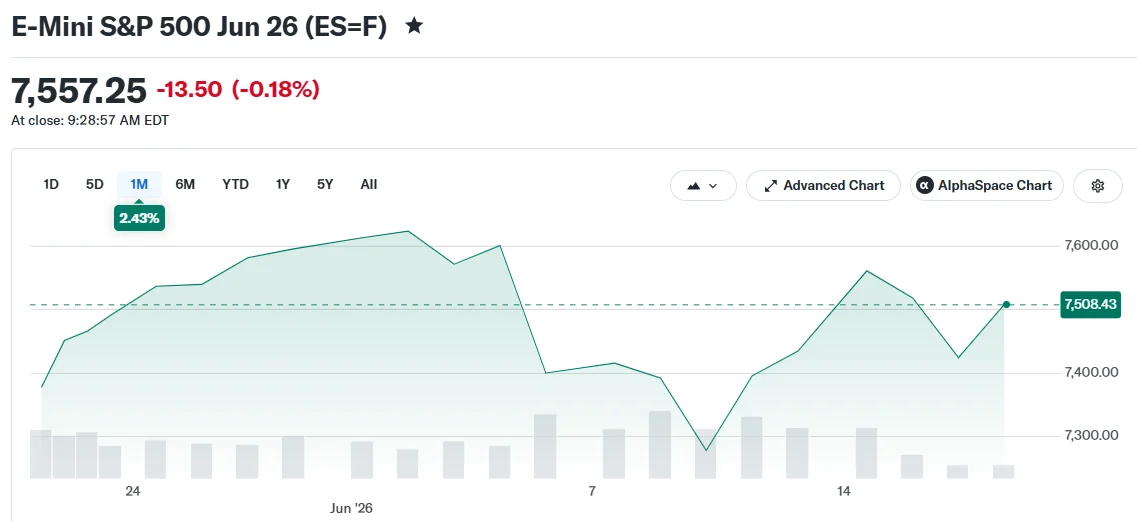
Wells Fargo has elevated its 2026 year-end projection for the S&P 500 to 7,950, marking an increase from its earlier forecast of 7,300. This revised target represents approximately 5.2% potential growth from the index’s latest closing level of 7,554.29.
The financial institution attributed the upgrade to improved corporate profitability, diminishing geopolitical concerns, and a recent market correction that recalibrated investor expectations.
The bank has revised its S&P 500 earnings per share projection for 2026 upward to $340 from the previous $315 estimate. Additionally, its 2027 EPS forecast has been increased to $390 from $365.
In a parallel move, Wells Fargo Investment Institute adjusted its year-end S&P 500 target range to 7,800–8,000, rising from the prior 7,400–7,600 range. The institute has also established a 2027 target range of 8,600–8,800.
The S&P 500 has advanced 10.3% year-to-date, propelled primarily by artificial intelligence sector enthusiasm and developments surrounding the Iran situation.

Market Psychology Shows Signs of Reset
In a conversation with CNBC, chief equity strategist Ohsung Kwon explained that a recent modest market decline successfully recalibrated investor sentiment to more neutral territory. According to Kwon, this shift provides opportunity for additional market appreciation.
“The path of direction for the equity market is still higher,” Kwon stated.
The institution highlighted declining crude oil prices, currently hovering near $70 per barrel, as a supportive factor that should help maintain inflation stability in the coming months.
Kwon emphasized that recent Federal Reserve communications were “more balanced than what the market perceived,” seeking to alleviate worries about the central bank’s monetary policy direction.
The bank identified inflation as the primary outstanding threat to equities, though only under a scenario where the Fed responds with aggressive measures. Wells Fargo suggested that a “run it hot” approach to policy would actually favor equity performance.
Reduced oil prices and falling bond yields could provide support to sectors outside of technology. Nevertheless, Kwon recognized that the Fed’s somewhat hawkish positioning creates challenges for broader market sector rotation.
Technology and Chip Makers Stay in the Spotlight
Notwithstanding the broader macroeconomic analysis, Wells Fargo maintained its emphasis squarely on the technology sector. Kwon expressed confidence that the AI-fueled bull market has considerable momentum ahead.
He referenced substantial AI infrastructure spending from leading technology firms, including Alphabet and Meta, as a positive catalyst for what he terms “CapEx takers” — semiconductor manufacturers and AI infrastructure providers.
Kwon rejected worries about declining token valuations, contending that more affordable AI models could drive higher aggregate demand for computational resources. “I think we’re still in the very early phase of the AI adoption,” he stated.
Throughout recent market turbulence, semiconductor and AI infrastructure equities gained ground while other sectors experienced losses, a pattern Wells Fargo interprets as encouraging.
“I don’t see that much stress in the equity market right now,” Kwon observed.
Get 3 Free Stock Ebooks
Discover top-performing stocks in AI, Crypto, and Technology with expert analysis.
- Top 10 AI Stocks - Leading AI companies
- Top 10 Crypto Stocks - Blockchain leaders
- Top 10 Tech Stocks - Tech giants



