


Key Takeaways
- Natural gas futures in Europe extended losses for a sixth consecutive trading day
- Interim agreement between Washington and Tehran includes immediate reopening of critical shipping lanes
- Dutch benchmark contract declined to €40.04/MWh while UK prices dropped to 96.45p/therm
- Former President issued stern warning about resuming military operations if Tehran violates terms
- Shipping traffic from Qatar and regional suppliers already returning to Gulf waters
European natural gas futures continued their downward slide on Thursday, marking the sixth consecutive session of declines and approaching their lowest valuations since late April.
The Dutch TTF benchmark, Europe’s primary pricing reference, retreated to €40.04 per megawatt hour. Meanwhile, UK natural gas futures dipped beneath the psychologically significant 100-mark, settling at 96.45 pence per therm.
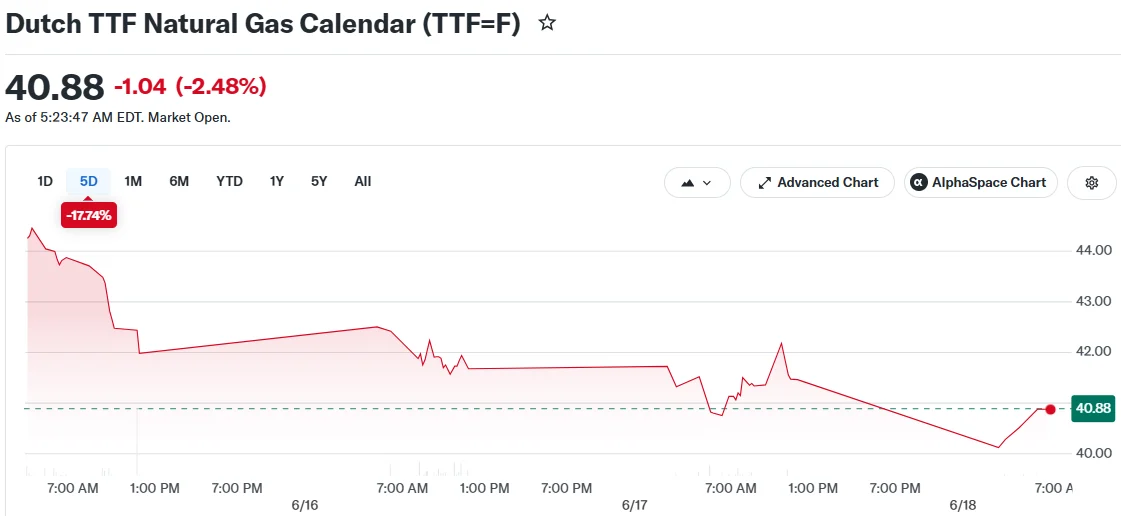
Both benchmark contracts are now hovering near their lowest points in approximately eight weeks.
The sustained selloff follows the remote signing ceremony where American and Iranian leaders formalized an interim peace framework. The memorandum was executed by both presidents via digital platforms.
According to Pakistan’s prime minister, who helped facilitate the negotiations, the agreement ensures Iran will “instantly reopen” the strategically vital Strait of Hormuz. Simultaneously, Washington has committed to “immediately lift” its naval blockade surrounding Iranian maritime facilities.

Geopolitical Risk Premium Dissipates
The Strait of Hormuz represents one of the world’s most critical bottlenecks for energy transportation. Its prolonged closure had inflated European energy prices with a substantial geopolitical risk premium throughout recent months.
As prospects for reopening the waterway improve, that embedded premium has begun systematically deflating. Natural gas valuations have trended downward since initial signals emerged indicating a diplomatic resolution was within reach.
The preliminary accord also establishes a comprehensive cessation of military activities. It launches a 60-day negotiation window for both nations to finalize a comprehensive arrangement addressing Iran’s nuclear ambitions.
The former President, however, attached explicit conditions to American compliance. He cautioned that military operations would promptly resume should Tehran fail to honor all fourteen provisions outlined in the memorandum of understanding.
Lingering Market Uncertainty
Notwithstanding the substantial price correction, European natural gas valuations haven’t fully retreated to pre-conflict levels. This persistent gap suggests ongoing market skepticism regarding the agreement’s durability.
Market participants appear to be maintaining a cautious buffer, accounting for the possibility that Trump might abandon the framework. His explicit warning about reactivating hostilities has prevented traders from completely dismissing geopolitical risks.
Nevertheless, tangible market responses are already observable. Multiple vessels have commenced their return voyages toward Middle Eastern waters, including liquefied natural gas carriers originating from Qatar.
Qatar maintains its position as the planet’s second-largest LNG exporter. The return of Qatari tankers to regional shipping lanes provides concrete evidence that maritime corridors may be normalizing.
European natural gas markets endured sustained pressure throughout the conflict duration. Energy trading desks maintained vigilant monitoring for any indications of diplomatic progress.
Current pricing around €40.6 per megawatt hour represents the lowest valuation recorded since April 20. This marks a substantial departure from the elevated pricing witnessed during the conflict’s most intense period.
Future price movements will largely depend on whether the Strait of Hormuz achieves full operational reopening and whether the upcoming 60-day nuclear negotiations yield meaningful progress.
Get 3 Free Stock Ebooks
Discover top-performing stocks in AI, Crypto, and Technology with expert analysis.
- Top 10 AI Stocks - Leading AI companies
- Top 10 Crypto Stocks - Blockchain leaders
- Top 10 Tech Stocks - Tech giants



