



Quick Overview
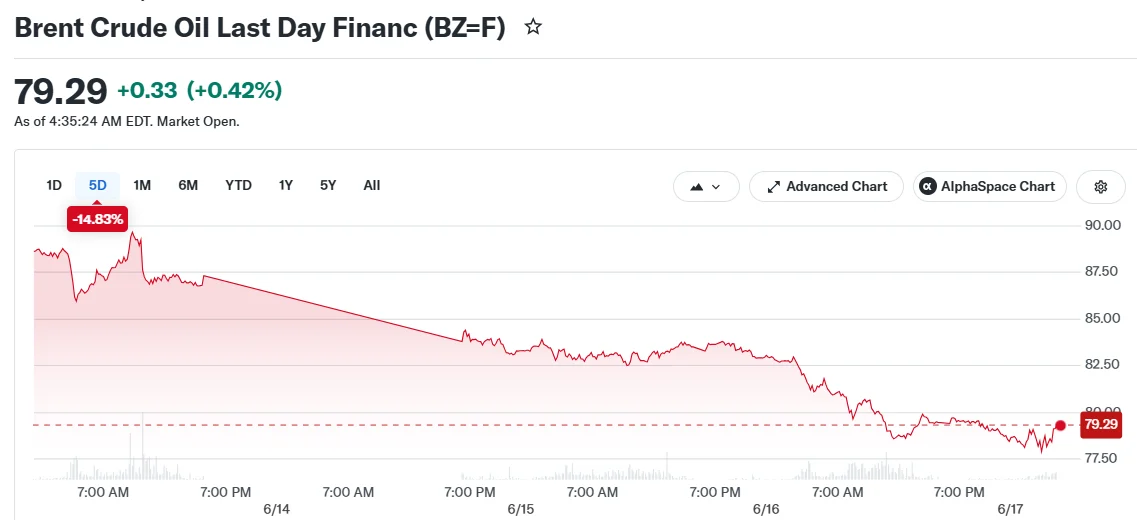
- Brent crude touched approximately $78 per barrel, marking the weakest level since March
- U.S.-Iran diplomatic agreement scheduled for Friday signing would unlock Strait of Hormuz
- Tehran gains immediate authorization to resume oil exports upon agreement implementation
- American crude stocks declined 8.33 million barrels last week, significantly exceeding forecasts
- National gasoline prices in the U.S. have retreated closer to $4 per gallon after surpassing $4.56 in May
Crude oil markets extended their decline for the fifth consecutive trading session Wednesday, plummeting to levels not witnessed since early March, as market participants anticipated the return of Iranian barrels to global supply chains following a diplomatic breakthrough between Washington and Tehran.
Brent crude descended to approximately $78.23 per barrel, while its American counterpart, West Texas Intermediate, slid to $75.16. The twin benchmarks have surrendered roughly 10% of their value across the previous two sessions alone.
Peace Agreement Fuels Market Downturn
Washington and Tehran have finalized an interim diplomatic accord scheduled for Friday’s signing ceremony. The framework requires Iran to lift restrictions on the Strait of Hormuz for commercial vessel passage, while the United States agrees to withdraw its naval blockade from Iranian harbors.
Iran receives authorization to recommence petroleum sales immediately following the agreement’s execution. The accord incorporates American exemptions spanning Iranian crude oil, petrochemical products, and associated financial services including banking operations and insurance coverage.
A comprehensive 14-clause draft memorandum details the arrangement’s provisions. Additionally, it initiates a 60-day negotiation period designed to establish permanent peace and implement restrictions on Iran’s nuclear development program.

The Strait of Hormuz represents a critical maritime chokepoint linking the Persian Gulf with the Indian Ocean. During normal operations, approximately 20% of global oil supplies traverse this narrow passage.
Export Recovery and Maritime Logistics
Market observers are closely monitoring the timeline for actual supply restoration. Maritime transport operators await comprehensive security protocols before dispatching tankers through the contested waterway.
Dennis Kissler, senior vice president for trading operations at BOK Financial Securities, anticipated that American naval forces would provide convoy protection during the initial weeks, while mine-clearing operations would temporarily constrain vessel throughput.
Parash Jain, who leads global transport and logistics research at HSBC, projected a measured resumption pace. He emphasized that shipping corporations invested considerable time reorganizing routes and would exercise caution before reversing those decisions until security conditions stabilize.
Vessel tracking systems have identified two oil tankers previously bound for African destinations that have reversed course in the Indian Ocean, now heading toward Middle Eastern ports.
Storage Figures Provide Market Floor
Notwithstanding the pessimistic sentiment surrounding supply expansion, a substantial decrease in American petroleum reserves offered modest price support.
The American Petroleum Institute disclosed that U.S. crude inventories contracted by 8.33 million barrels during the week concluded June 12. This reduction exceeded analyst projections of 4.5 million barrels by more than double.
The figures suggested robust consumption patterns in the United States, the planet’s foremost oil-consuming nation. Official government storage statistics were scheduled for release later Wednesday.
Pump prices have demonstrated relief as well. The nationwide average in America has retreated toward the $4 threshold after reaching peaks above $4.56 during May, based on American Automobile Association tracking.
The Federal Reserve convened Wednesday for its monetary policy deliberation. While rate modifications were not anticipated, declining energy expenses represented a consideration for policymakers’ evaluation.
Get 3 Free Stock Ebooks
Discover top-performing stocks in AI, Crypto, and Technology with expert analysis.
- Top 10 AI Stocks - Leading AI companies
- Top 10 Crypto Stocks - Blockchain leaders
- Top 10 Tech Stocks - Tech giants



