


Key Highlights
- SK Group’s Chairman Chey Tae-won revealed ambitious plans to expand wafer production capacity by 100% within five years during Computex in Taipei.
- The memory chip manufacturer commands 58% of the worldwide HBM market, while Samsung and Micron trail at 21% each.
- The company achieved a historic $1 trillion market capitalization milestone last week.
- Goldman Sachs upgraded its 2028 operating profit projection for SK Hynix by 24%, reaching 454 trillion won (approximately $299.62 billion).
- The chairman cautioned that rapid price escalation in DRAM and HBM chips might threaten the AI industry’s long-term viability.
SK Hynix is embarking on an aggressive expansion strategy. The parent company, SK Group, announced Tuesday its intention to double wafer manufacturing capacity during the coming five years, capitalizing on surging AI-driven demand that has positioned memory chips as critical components in the technology sector.
Chairman Chey Tae-won unveiled these plans during Computex in Taipei, a premier annual event for semiconductor industry leaders and technology executives. Nvidia, which stands among SK Hynix’s key clients, also had representation at the conference.
“We are going to double the whole capacity over the next five years,” Chey stated to media representatives. “There are a lot of obstacles and hurdles, but we will get over them and expand.”
While the objective is undeniably bold, market dynamics strongly support the strategy. Artificial intelligence applications are driving unprecedented consumption of high-bandwidth memory (HBM) chips, with SK Hynix positioned as the leading global provider.
According to data from Counterpoint Research, the company controlled 58% of the worldwide HBM market during Q1 2026. Samsung and Micron each captured 21% market share.
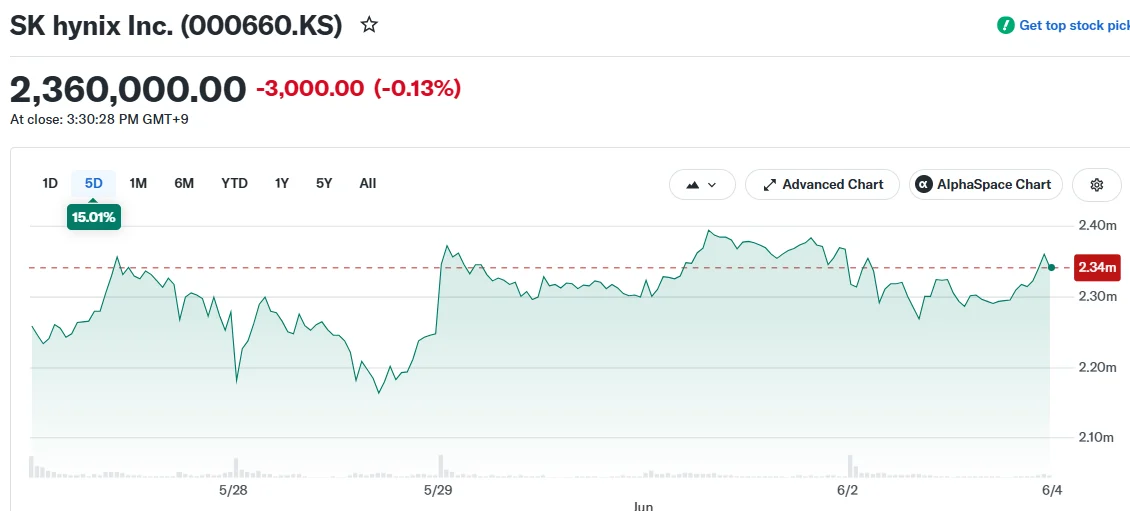
The South Korean chipmaker surpassed the $1 trillion market capitalization threshold for the first time last week, becoming the third company alongside Samsung and Micron to reach this landmark. The stock’s impressive performance has been fueled primarily by investor enthusiasm surrounding artificial intelligence and persistent demand for cutting-edge memory solutions.

Chey also reinforced an earlier projection: worldwide chip wafer supply constraints could continue through 2030. This outlook, initially shared in March, explains the company’s urgency in expanding production capabilities immediately.
Battle for Nvidia’s Next-Generation Platform
Chey emphasized SK Hynix’s determination to secure a leading position in providing HBM chips for Nvidia’s forthcoming Vera Rubin AI platform. “There’s only one customer for HBM4E right now,” he noted, clearly referencing Nvidia.
He further explained that SK Hynix aims to establish additional strategic partnerships in Taiwan beyond its current collaboration with TSMC. This indicates the manufacturer’s strategy to strengthen its presence within the island’s extensive semiconductor infrastructure as production scales upward.
Samsung also made significant announcements at Computex on Tuesday, presenting a prototype of its HBM5 chip while introducing advanced thermal management technology for the product. The previous week, Samsung disclosed it had started distributing HBM4E chip samples to clients—gaining an edge over competitors in delivering this particular product.
Wall Street Upgrades Outlook
Financial analysts are responding positively. Goldman Sachs recently increased its 2028 operating profit projection for SK Hynix by 24%, elevating the estimate to 454 trillion won, equivalent to approximately $299.62 billion. Samsung received a similar boost, with its forecast raised 23.3% to 610 trillion won.
Both revisions reflect expectations of continued AI-fueled demand for memory semiconductors.
Despite the optimistic outlook, Chey exercised caution regarding pricing dynamics. He emphasized that excessive price growth in DRAM and HBM products could potentially harm the wider AI ecosystem and compromise sustainable long-term expansion.
“The whole AI industry needs more sustainability,” he explained. “Sudden jumps in prices can become a problem and actually hurt sustainability.”
Goldman Sachs’ updated 2028 operating profit projection for SK Hynix remains at 454 trillion won (~$299.62 billion).
Get 3 Free Stock Ebooks
Discover top-performing stocks in AI, Crypto, and Technology with expert analysis.
- Top 10 AI Stocks - Leading AI companies
- Top 10 Crypto Stocks - Blockchain leaders
- Top 10 Tech Stocks - Tech giants



