


Key Takeaways
- SK Hynix reached a $1 trillion market capitalization this week, making it just the second South Korean firm ever to achieve this landmark.
- Shares have jumped 240% year-to-date, including an 80%+ rally in May alone.
- First-quarter revenue nearly tripled from the prior year to 52.6 trillion won ($34.8bn), while operating profit increased fivefold.
- The chipmaker commands a 57% market share in high-bandwidth memory (HBM) and secured roughly 70% of Nvidia’s Vera Rubin HBM contracts.
- While US investors cannot purchase shares directly yet, the Roundhill Memory ETF (DRAM) — trading near $60 — features SK Hynix as its second-largest holding at 27%.
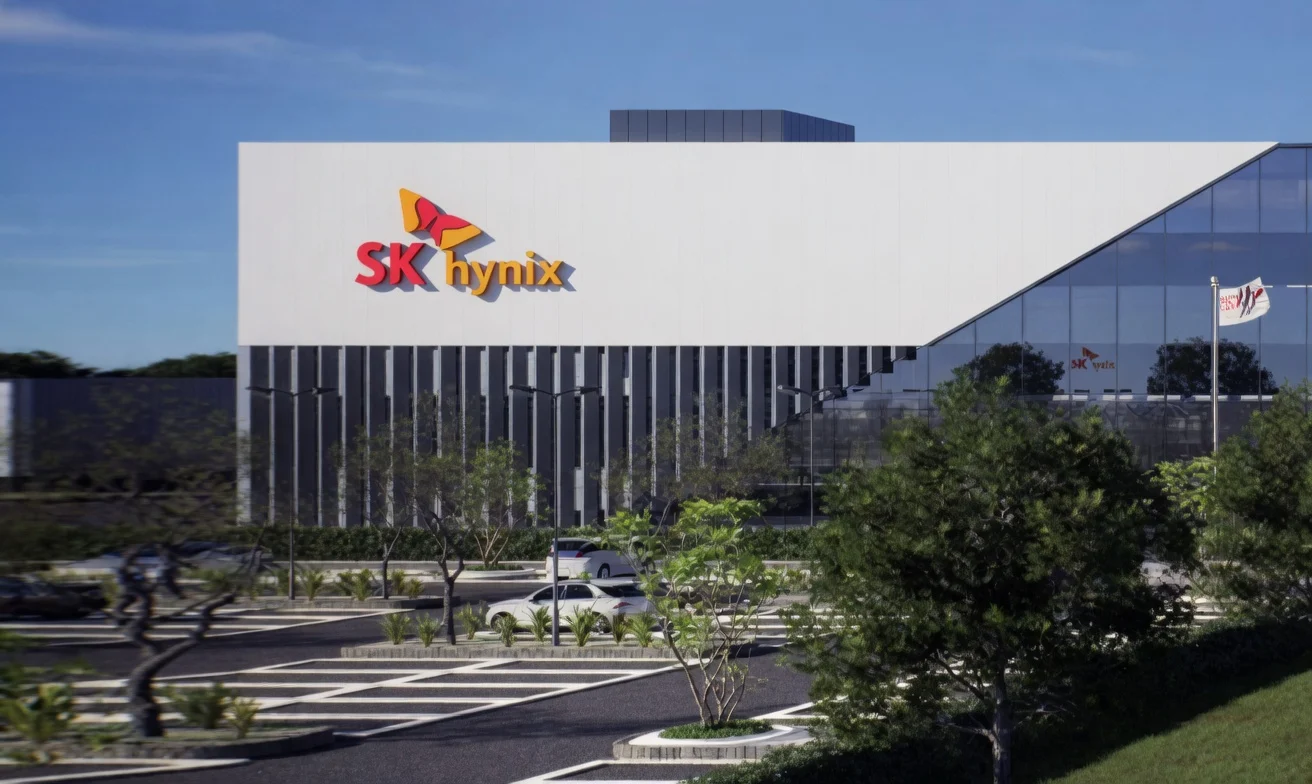
SK Hynix achieved a rare milestone in corporate history this week, surpassing the $1 trillion market capitalization mark driven by unprecedented AI-fueled demand for advanced memory semiconductors.
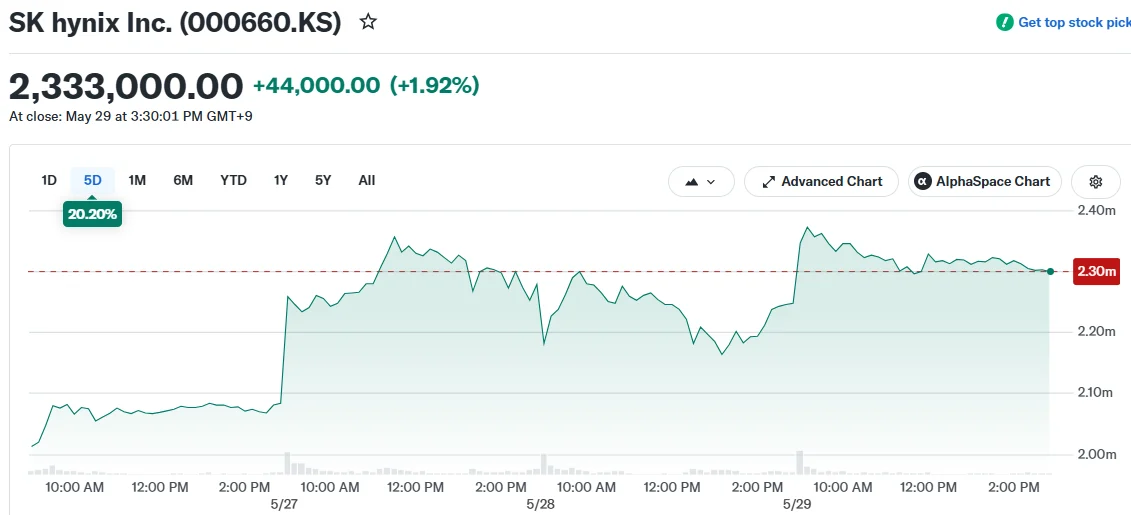
The Korean memory manufacturer’s share price has rocketed 240% since the beginning of January, with over 80% of those gains coming in May alone — representing one of the most spectacular monthly performances for any mega-cap company. By Friday’s close, its market capitalization reached 1.66 quadrillion won, approximately $1.10 trillion.
SK Hynix becomes the third semiconductor manufacturer to cross this threshold this month, joining American rival Micron and domestic competitor Samsung Electronics. This trio collectively produces virtually all of the world’s memory chips.
The catalyst is straightforward: AI infrastructure demands massive quantities of memory. As consumption of GPUs and AI accelerators has skyrocketed, the appetite for high-bandwidth memory (HBM) that enables them has surged proportionally — with SK Hynix emerging as the primary winner.
Financial Performance Reflects HBM Dominance
First-quarter revenue reached 52.6 trillion won ($34.8bn), representing a threefold increase year-over-year. Operating profit jumped fivefold to 37.6 trillion won ($24.9bn). Operating margins touched an unprecedented 72%.

These figures go beyond impressive — they’re record-breaking. The company’s entire financial profile has been transformed by HBM, a product category it helped create and continues to lead.
SK Hynix captured 57% of the worldwide HBM market during Q4 2025, and projects maintaining over 50% market share for next-generation HBM4 throughout 2026. The company has also locked in approximately 70% of HBM supply contracts for Nvidia’s Vera Rubin architecture, closely aligning its trajectory with the world’s dominant AI chip producer.
Additionally, the firm is executing three-to-five year long-term supply agreements with clients — a fundamental change that should dampen the extreme cyclical volatility that has traditionally characterized the memory sector.
Access Options for American Investors
SK Hynix shares are not currently available on US exchanges. The company has submitted paperwork for American depositary receipts (ADRs), which may commence trading later in 2025, though no timeline has been finalized.
For now, the Roundhill Memory ETF (DRAM), trading in the $60–$63 range, provides the most direct route for exposure. SK Hynix represents 27% of the fund’s assets. Micron leads the portfolio at slightly over 29%, followed by Samsung at 19%.
The fund also incorporates NAND exposure via Kioxia and Sandisk, alongside hard-disk-drive manufacturers including Seagate and Western Digital.
From a valuation perspective, SK Hynix trades at a forward P/E below 7 — remarkably modest for a company delivering these results, though partially attributable to currency dynamics and limited investor access.
SK Hynix anticipates DRAM will face supply constraints extending through 2030, prompting a 19 trillion won ($13bn) investment in a new fabrication facility focused on advanced packaging to meet escalating demand.
Only 17 corporations throughout history have achieved a $1 trillion valuation. SK Hynix now joins an exclusive group of just four non-American companies at this level, alongside Samsung, TSMC, and Saudi Aramco.
Get 3 Free Stock Ebooks
Discover top-performing stocks in AI, Crypto, and Technology with expert analysis.
- Top 10 AI Stocks - Leading AI companies
- Top 10 Crypto Stocks - Blockchain leaders
- Top 10 Tech Stocks - Tech giants



